


“To me, it doesn’t feel like a city you decide to move to,” the fashion designer Reese Cooper says of Los Angeles. “You just spend enough time there until you realise it’s irresponsible to be anywhere else.”
Not only does Cooper now call the city home, his eponymous clothing label is also headquartered there. He lives in the city’s gritty downtown district and often drives an hour away for weekend hikes with his girlfriend. You can see glimpses of that life in his designs, which are a mix of outdoor gear, streetwear and workwear. Cooper also makes use of his adopted city’s robust manufacturing infrastructure, with almost everything he designs made within a 10-mile radius, he says.
Cooper is one of several new designers making a name on the West Coast. There’s Josué Thomas of Gallery Dept in West Hollywood, and Eli Russell Linnetz of ERL in Venice Beach. Farther afield, in San Francisco, Evan Kinori designs an eponymous clothing line and recently opened his own store there. The retail scene has been active, too. In 2020 the acclaimed Belgian designer Dries Van Noten opened his first US flagship store in LA, in a large, artful building in West Hollywood. The label Bode opened its second store there — four times the size of its original New York location — in February.

Los Angeles, with its laid-back, unrushed energy, is the perfect host to young, enterprising designers looking to make waves beyond the established fashion capitals. Cooper says that, while in some cities it may be difficult to create connections as a newcomer to the fashion industry, he’s found it easy to make inroads in LA. “Once I was here, it was a few quick introductions to, like, a friend who makes hoodies. Or you go to the dye house and they’re like, ‘Oh, we do denim too.’ Things spiral quickly.”
Gallery Dept’s Thomas grew up in Los Angeles, and his work is infused with the city’s love of vintage and thrifting. He’s taken an artisanal approach, creating upcycled garments that are splattered with paint, sun faded, cut up and reassembled or embellished with patches. Resembling wearable art, they have become part of the uniform of the city’s creative class.
“There’s a history of manufacturing here,” he says, noting that much of his collection is made locally. “There are a lot of resources. I think there’s a freedom and good space to develop something.” Perhaps because it’s where the film industry is based, LA has long drawn dreamers and those hungry for glamour. Thomas says: “You can move to LA and be anybody. That’s part of that creative magic.”
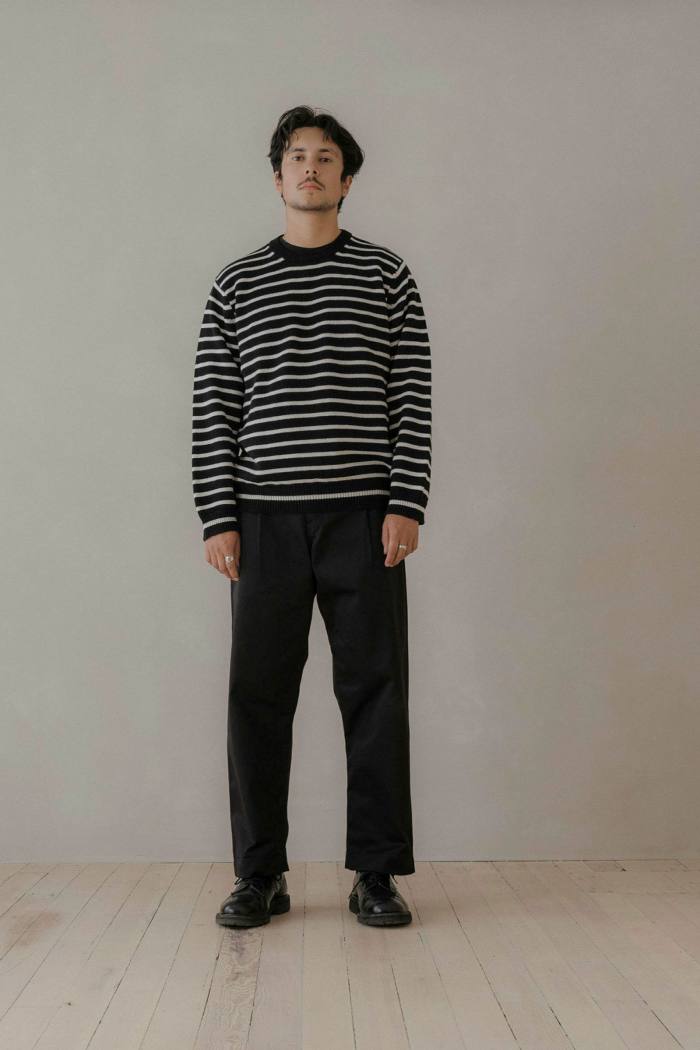

Up in San Francisco, Kinori has built a company that looks and feels different from what’s happening in Los Angeles — or New York or London or Paris, for that matter. It’s distinctly American in its workwear silhouettes, modernised through thoughtful fabrications. “I don’t think California has been a literal influence,” says Kinori, who is from Connecticut. “But perhaps by living in a place where ‘capital-F fashion’ doesn’t really exist, I’m allowed to look at clothing with a less trend-driven perspective.”
That separation makes a difference. Kinori’s clothing and business feel less dictated by the gruelling industry schedule of showing clothes and shipping them to stores many times throughout the year, and more about creating a model that is small yet sustainable and, crucially, works for him.
It should be said that in terms of fashion, California — and Los Angeles in particular — is no backwater. There is a long, well-established history there, dating back to Hollywood costume designers such as Adrian or Edith Head, who, long before social media, created the most widely seen images of clothing in the world. The Sunset Strip helped to popularise a certain haute hippie and rock-star look, a stark and definitive contrast to New York’s more formal fare. Further up the coast, Levi Strauss popularised jeans — arguably America’s most important contribution to the fashion lexicon.

Recently, though, more traditional fashion houses have been setting down roots and a new generation of designers have built their fortunes in the abundant sunshine, based on more casual styles — John Elliott, Jerry Lorenzo of Fear of God, Mike Amiri of Amiri, Rhuigi Villaseñor of Rhude and Greg Chait of The Elder Statesmen to name just a few.
“There’s probably some novelty to making clothing in a city that’s more off the grid with regards to the fashion world,” says Kinori. “It may be less expected and thus stand out a bit — but that’s not why I’m here. It’s just helpful not to see what other people are doing all the time and not see trendy ways of dress on the street.”
Thomas says that, when he decided to create clothing that was less polished and mass-produced and had a more one-of-a-kind look, he felt that staying in LA would benefit him. “I think subconsciously I thought I shouldn’t go to New York or Paris or Milan, because it’s so saturated and they have a history of doing things a certain way.” Still, Paris came calling anyway — his brand, Gallery Dept, was tapped by the French maison Lanvin for a much-hyped collaboration last year (another collection has just been released).
California is experiencing certain struggles — with housing prices, a homelessness epidemic and the effects of global warming. But it still has a mystique that continues to draw young, carefree creatives. The way of life, with its warm weather and lush golden hour, is bewitching. “I can’t really picture where else I would be,” says Cooper. “The place I get my juice from is downstairs from where my outerwear is made. And it’s on my walk to the studio. I can just pop in, say what’s up to everybody, see how things are going. I don’t think I could do that living anywhere else.”
Find out about our latest stories first — follow @financialtimesfashion on Instagram

