


Who pays the price?
In Media, EMS staffers have been paid for the last 20 years. The Media Fire Company has an emergency medical technician whom it pays and has a contract with Main Line Health’s Riddle Hospital for a paramedic to staff the ambulance 24/7.
But Media Fire Company gets very little municipal funding, according to Chief Ed Gibson III. He said EMS tends to be treated as the outcast of first responders.
“Our municipality, they don’t give us a ton of funding. They pay for fuel, they pay for vehicle insurance, they pay for major equipment insurance, but they don’t help us with salaries. They don’t help us with the contract for the paramedic — nobody helps us. And not only do we cover Media Borough, we cover Upper Providence Township, Nether Providence Township, and half of Rose Valley Borough, that’s our primary response district,” Gibson said.
Vickie Petriw is the deputy chief at Skippack EMS, one of the smallest squads in Montgomery County. The agency typically does around 1,500 calls a year. The total for 2021 was close to 1,800, and it has just opened a second station in Worcester Township.
“Skippack Township does give us some money, but some of the other townships that we help to cover don’t. So we pretty much rely on our residents,” Petriw said.
The agencies say they must deal with insurance companies that will try everything in their power to pay the least amount for their calls. For some EMS agencies, insurance payments barely cover their expenses, which in turn disrupts the agencies’ ability to properly pay their EMS workers.
“The impact to the community is that we may not have a crew up, so it means that they’re, or a neighboring squad may not have crews up, so we’re covering them. We have a certain area that we cover, and then if a squad neighboring us is out on a call, or they don’t have a crew because they’re having staffing issues, if someone calls 911, we may be sent to another area to cover their call,” Petriw said.
Extending coverage to Lansdale or Souderton could possibly mean ambulance rides of 20 minutes or longer.
“When you’re calling 911, you don’t expect an ambulance to take 25 minutes to get there, especially if you’re living in Montgomery County,” Petriw said.
In the more rural parts of Chester County, where homes and hospitals may be quite far apart, ambulance rides can be even longer. Gary Vinnacombe, deputy chief of EMS for Union Fire Company No. 1 of Oxford, said that his squad’s coverage area is upwards of 100 square miles, and that his unit is very fortunate to receive strong municipal support.
Longer ambulance rides mean the possibility of deadly loss of a precious resource: air.
“We could easily go through one or two oxygen cylinders on the way to the hospital, if we have a severe respiratory patient or if we’re managing their ventilations,” Vinnacombe said.
It’s not unheard of for EMTs to work more than one job, or take shifts at more than one EMS agency.
McCans, in Haverford, often tells people about a situation a few years back that embodied the struggle of the overworked EMT who bounces back and forth between long shifts.
“There was this EMT and he was upset because … the EMT who was relieving him hadn’t come in and because he was going to his next job. And a lot of them will do that, they will go job to job. So he calls the guy at the job, ‘I can’t come to get you right now because my relief isn’t in either.’ … He calls that guy, and he’s waiting for his relief. Well, the irony is that all three were each other’s relief,” McCans said.
Second Alarmers Rescue Squad is one of the largest EMS agencies in the Philadelphia suburbs, with five stations and a coverage area that includes Abington Township, Upper Moreland Township, Whitpain Township, Hatboro, Rockledge, Jenkintown, and part of Upper Dublin Township. In total, that’s about 52 square miles.
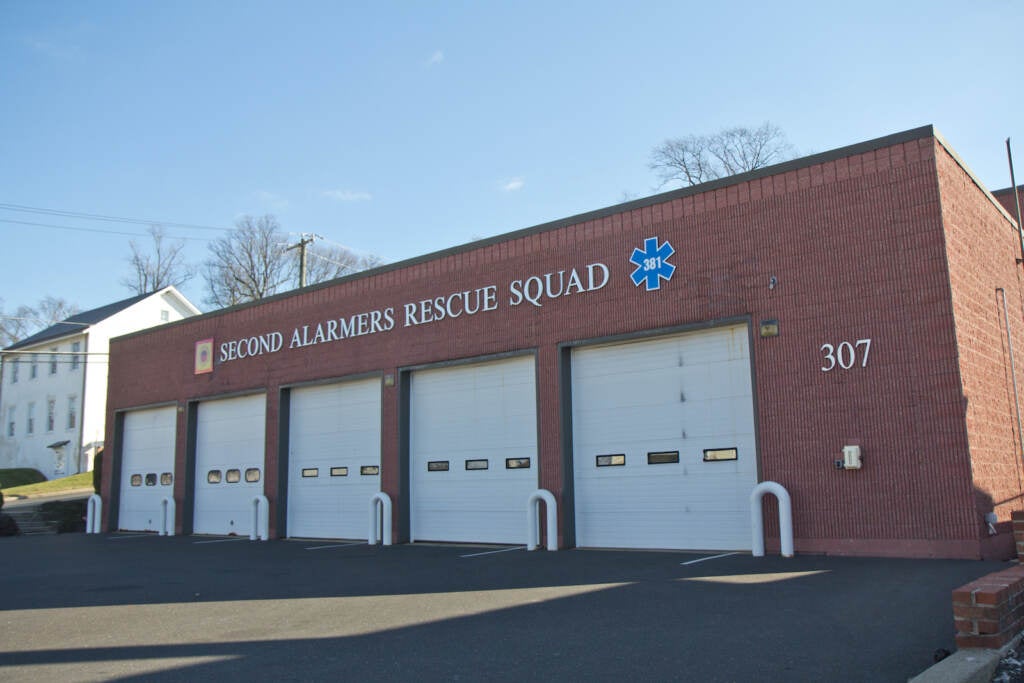
The nonprofit agency has been around for more than 80 years and has mostly career EMTs, but still manages some volunteer providers. Second Alarmers fields about 13,000 calls a year and is proud of the service it provides.
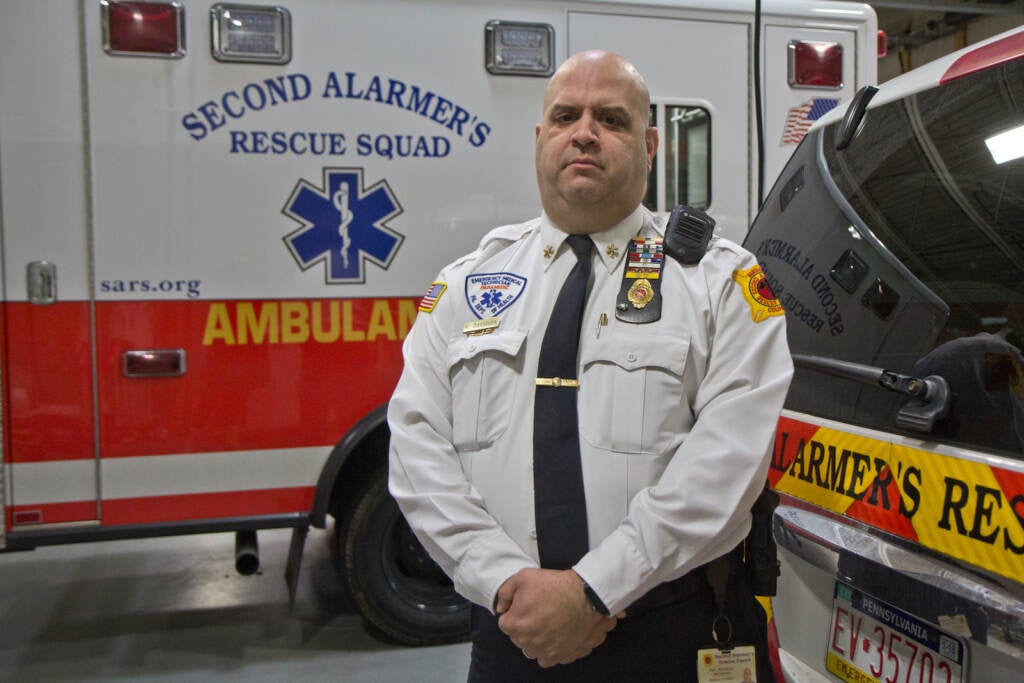
“But as we are short-staffed, and as we don’t have providers to fill shifts on the street, we have people who are working two or three shifts a week of overtime — or more,” assistant chief Ken Davidson said. “We don’t let providers work more than 24 hours in a row because obviously we want them rested and physically fit to do their job. But when you start running out of providers, you then have to start looking at [in] some cases downgrading the service at a station from that advanced life support to basically support which is still emergency care, but not quite at the same level.”
As far as answers go, there seems to be some consensus that money plays a major role.
“I’m always known for saying that money is not the only solution, it is a solution. But what I’ve been saying recently is, it’s really the one solution we haven’t had the luxury of trying to use,” Davidson said.
In the suburbs, EMS services are not primarily funded through taxes. For example, only one town in the Second Alarmers coverage area has an ambulance tax.
“We made requests to all our municipalities for funding from … the American Recovery Plan Act. We feel that we are very clearly one of the uses, it’s appropriate for those funds. It’s directed at first responders, frontline health providers, and that’s certainly what we do. And very disappointingly, we have gotten a very lukewarm response,” Davidson said. “The important thing is for the public to realize that they really need to be reaching out to their elected officials and urging them to support EMS, just like the other branches of public safety.”
After Davidson’s interview with WHYY News, Abington Township approved its recent budget — which included an ARPA allocation of around $227,000 for the Second Alarmers.
Davidson said the township stepped up.

