


Dr. Sophia Omoro is a New Orleans head and neck surgeon, originally from Nairobi, who trained at Tulane University. She’s also a fashion designer with storefronts in Kenya and on Chartres Street in New Orleans.
Featured on her website is the Crescendeux collection — named after a fundraiser held earlier this month that seeks to advance the economic wellbeing of women minorities. All of the collection’s hand-crafted pieces are deep red with embellished designs strewn throughout. Prices range from $145-$400.
Omoro’s work, along with that of New Orleans designer Kristine Pichon, New Orleans Boutiques: West London and Beaux Curvian Gurlz and four other Southern-based designers of color, were highlighted in an event to benefit the work of local women-led organizations.
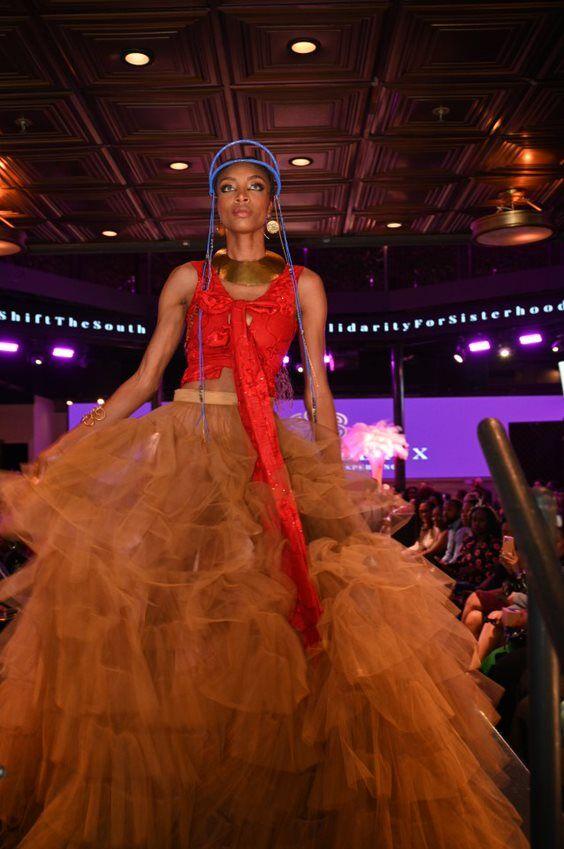
A model wears a design by Dr. Sophia Omoro.
Admission to the Crescendeux fundraiser was between $100-$200, with an opportunity to purchase showcased clothing items after the show.
“It wasn’t just for the sake of having a fashion show,” said Women’s Foundation of the South executive director Carmen Randolph. “It was about elevating each other from a deep soul space. We accomplished giving women the opportunity to look good and feel good about who they are.”
Introducing the designers was Real Housewives of Atlanta star Marlo Hampton with radio and TV host Bevy Smith, leading chats and unpacking the women’s stories with the audience.
Founded in 2021 by grant-makers concerned about the upward mobility of Southern women of color, the Women’s Foundation of the South is raising money to change narratives and to invest in women of color leaders and entrepreneurs.
Thirty days after the foundation opened its doors, Hurricane Ida arrived and Randolph said that was when she and her team sprung into action, focusing on what the gender experience was like for women-led nonprofits after a disaster.
They circulated stories about disaster recovery such as the difficulties that may hinder women from evacuating, including caregiving responsibilities and cost.
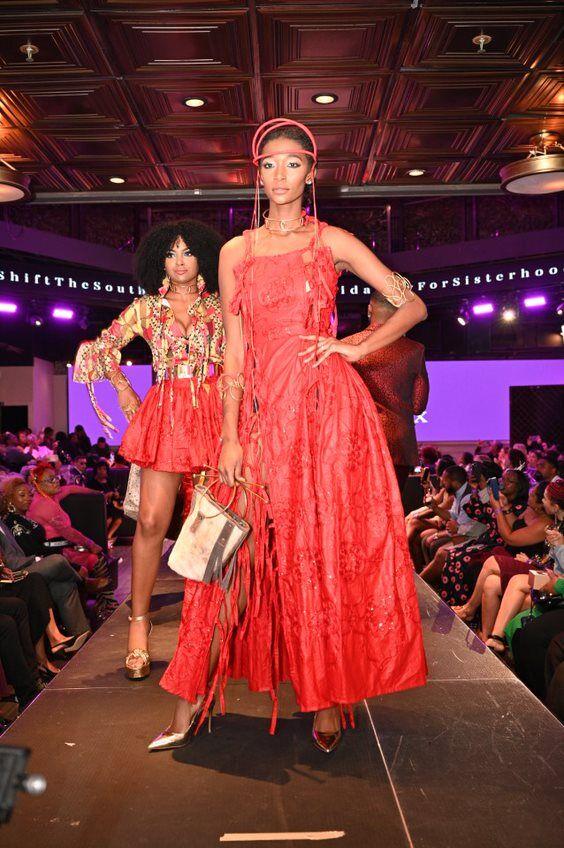
Models wearing collection by Dr. Sophia Omoro. Provided courtesy of Jessica Allen
Through philanthropic partnerships, they were able to use these stories to leverage grants for local women-led organizations. “We knew that these leaders were exhausted. We knew that they had been working triple duty from COVID to Hurricane Ida,” she said.
And now the work has deepened.
Still in its infancy stage, the foundation is supporting its first cohort of 25 organizations led by women of color, maximizing their work and their leadership with grants totaling $182,000. Their goal is to invest in 350 women across 13 Southern states.
“Too often, women of color are not a part of public discourse. Our priorities are not seen as priorities.” Randolph said. She cited the ongoing issue of high black maternal mortality rates and barriers in access to prenatal care as an example.
“It was very difficult to elevate that issue and to put a human face on what women experience when trying to access care,” she said.
Women of color serve as strategic leaders who hold up entire communities, Randolph said. But they often face a perception that they are angry or hostile.

Fashion lovers wait in anticipation at the runway at Generations Hall.
“We’re also amplifying their stories and doing a lot of strategic communication to help change the narrative about who they are, why their work is important and why it needs to be resourced and at the highest level,” Randolph said.
Some of the groups included in the cohort are the Power Coalition for Equity and Justice, whose work centers around increasing voter engagement; the Ashé Cultural Arts Center, an arts and culture hub that supports community and economic development; and House of Tulip, a nonprofit that provides housing solutions for transgender and gender non-conforming people in Louisiana.
The organizations will receive general operating grants, personal development and leadership grants, and other resources.
By channeling the philanthropic efforts of donors, corporations, and individual investors into communities of women whose needs have been ranked as a low priority, the foundation team said they hope to create systemic change.

