


There’s a shot you’ve tried to take. A bird perched too far away on a branch, a player on the far end of the field mid-celebration, the full moon looking enormous to your naked eye and laughably small on your screen. You zoomed all the way in, the image went soft and grainy, and you posted it anyway with a moody filter hoping nobody would zoom in on your zoom.
That ceiling isn’t a skill problem. It’s a hardware problem. And no matter how good your iPhone Pro or Samsung Ultra is — and they are genuinely good — there’s a point where the native telephoto system simply runs out of road.
Reeflex is making a very specific argument that a €319 lens can fix that. And the argument is hard to dismiss.
The ULTRA Telephoto 300–600mm is the most powerful lens in Reeflex’s G-Series lineup, and it’s engineered around a simple but clever idea: your flagship phone already has a sophisticated telephoto system inside it. What if you multiplied that instead of replacing it?
The lens is designed specifically for the tetraprism telephoto camera systems in recent flagship smartphones — the folded optical architecture that Apple and Samsung have both adopted in their Pro and Ultra tiers to achieve longer focal lengths without making the camera module thicker. Reeflex sits a 3x optical multiplier directly over that existing system, which means you’re stacking real glass on top of real glass rather than doing any digital interpolation.
The result is a 300–600mm equivalent focal length range, with magnification that scales depending on which device and which resolution mode you’re shooting in. On the iPhone 17 Pro and Pro Max, that’s 24x at 12MP or 12x at 48MP. On the Samsung S24, S25, and S26 Ultra, you’re looking at 30x at 12MP or 15x at 50MP. The Samsung S23 Ultra also makes the compatibility list, hitting the same 30x and 15x figures at 10MP.
To put those numbers in context: 300–600mm is the focal length range that wildlife photographers and sports photographers work in professionally. The lenses that cover that range in traditional camera systems are large, heavy, expensive, and conspicuous. The Reeflex ULTRA Telephoto weighs 308 grams and fits in a bag.
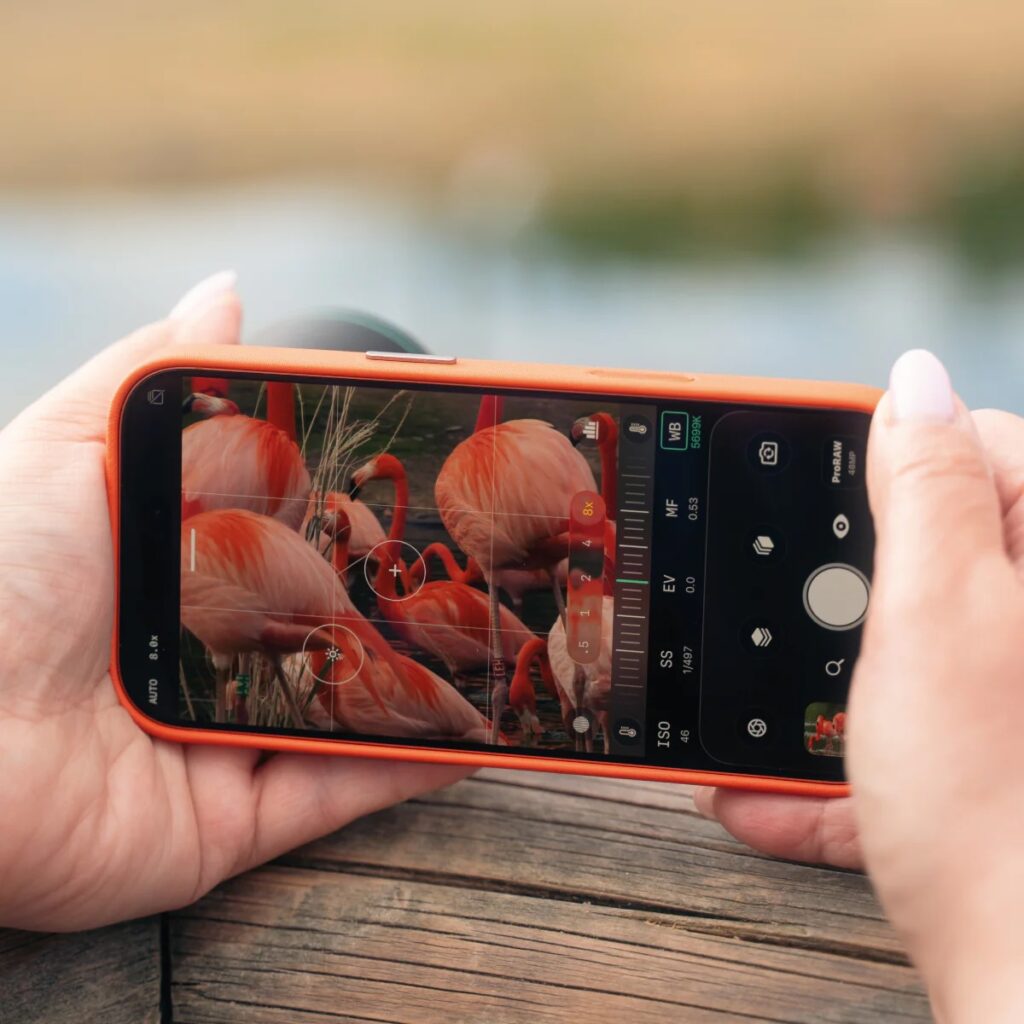
At this focal length range, the optics have to do serious work. Any weakness in the glass — dispersion issues, poor element alignment, cheap coatings — shows up immediately in the image as color fringing, soft edges, or that particular kind of haziness that makes a technically long-range shot look like it was taken through a screen door.
Reeflex uses lanthanum glass for the optical elements, which is significant. Lanthanum glass has a higher refractive index and lower dispersion than standard optical glass, meaning it bends light more efficiently and keeps different wavelengths of color arriving at the sensor in tighter alignment. In practice, that’s what separates a sharp, contrasty telephoto image from one where you can see purple fringing around high-contrast edges or a general loss of micro-detail. It’s also why professional camera lenses use it, and why it’s not standard in cheaper add-on optics.
The optical design uses four lens elements — one doublet and three singlets — arranged to deliver an ultra-narrow field of view with precise subject isolation. The body housing those elements is machined from aerospace-grade aluminum alloy, which keeps it rigid enough to maintain optical alignment without flex, and durable enough to handle real use without babying.
It mounts via a 17mm thread onto the Reeflex G-Series case (which is sold separately and is required — factor that into your total outlay). The front of the lens is compatible with Reeflex’s ReeMag magnetic filter system, which means you can attach and stack magnetic filters — CPL polarizers, ND filters, streak filters — without any additional thread adapters or swapping hardware. For anyone who shoots video or wants to control exposure at long focal lengths, that’s a meaningful addition to the system rather than an afterthought.
The zoom number is the headline, but it’s not the full story. What changes most dramatically when you shoot at 300–600mm equivalent isn’t just how close your subject looks — it’s what happens to everything around and behind it.
Background compression is the optical phenomenon that makes telephoto photography look different from wide and standard focal lengths in a way that goes beyond simple magnification. At extreme focal lengths, the spatial relationship between your subject and its background collapses. Distant elements get pulled forward and flattened. A cityscape behind a portrait subject turns into a dense, layered wall of light and texture. A crowd at a sporting event dissolves into an abstract wash of color. Mountains behind a landscape subject appear to loom closer, creating that stacked, cinematic depth that wide-angle lenses physically cannot produce.
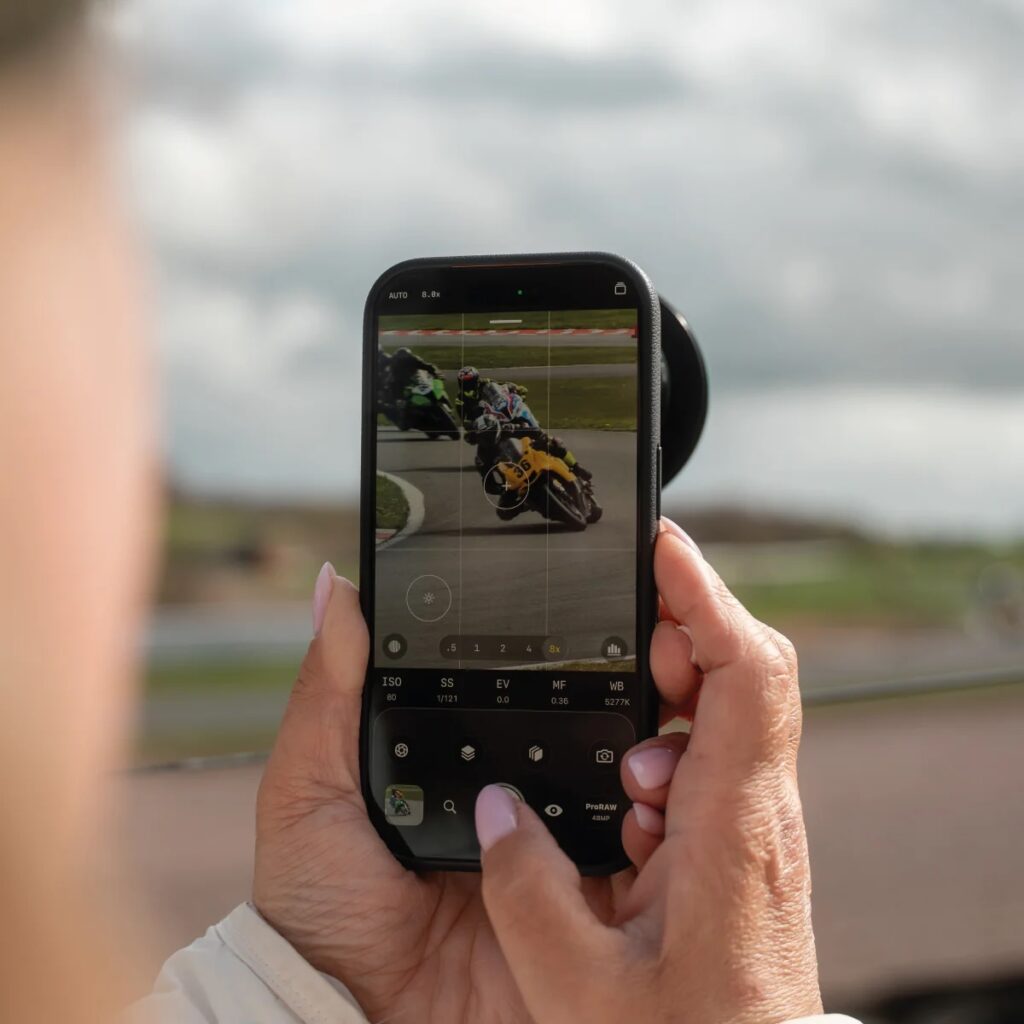
This is the compositional quality that cinematographers and photographers spend careers learning to use deliberately. It’s why sports portraits shot on 400mm lenses look different from anything shot on a smartphone — not just sharper, but different in their visual logic. The Reeflex ULTRA Telephoto hands you that tool automatically at every focal length in its range.
The focus range starts at 6.8 meters and extends to infinity, which tells you exactly who this is built for. This is not a closeup lens, not a portrait lens for subjects standing three feet away. It’s a reach lens. It’s for the gap between you and what you’re trying to photograph that you cannot physically close — the wildlife that will leave if you move closer, the athlete who is on the other side of the pitch, the architectural detail forty meters up a building facade, the moon.
The honest version of this recommendation has a specific profile attached to it.
If you’re already shooting on a flagship device and you regularly hit the zoom ceiling — if you’ve ever lowered your phone in frustration because the native telephoto just couldn’t get you there — this is the most direct solution available in mobile photography right now. There’s no software update, no computational photography trick, no AI enhancement that replicates what real optical glass at this focal length does to an image. This is the hardware answer.
Creators who shoot wildlife will find the most obvious use case. The combination of extreme reach, silent operation, and a form factor that doesn’t require a tripod or a camera bag opens up shooting situations that a dedicated telephoto rig would close off — you can move faster, stay quieter, and cover more ground. The same logic applies to sports and events: long focal length, real optical quality, device you already have in your pocket.
Travel photographers who want to shoot architecture and landscapes with serious compression — the kind of layered, atmospheric images that look like they required a full camera system — will also find this expands what’s possible from a single bag. Moon photography, which has become its own dedicated genre on smartphones, gets a significant upgrade at 300–600mm equivalent.
There’s also a video argument here. Cinematic storytelling at long focal lengths — compressed backgrounds, isolated subjects, that particular quality of depth that makes mobile footage look like it was shot on something much larger — is exactly the territory this lens opens up for creators who are already working within the Reeflex ecosystem.
For anyone who wants them in one place:
Magnification: 3x optical. Focal length equivalent: 300–600mm. Focus range: 6.8 meters to infinity. Optical design: 4 elements (1 doublet, 3 singlets). Glass: lanthanum. Body: aerospace-grade aluminum alloy. Dimensions: 70.5mm tall, 55mm diameter. Weight: 308g. Mount: 17mm thread. Accessory system: ReeMag magnetic compatible.
Compatible with iPhone 15 Pro, iPhone 15 Pro Max, iPhone 16 Pro, iPhone 16 Pro Max, iPhone 17 Pro, iPhone 17 Pro Max, Samsung Galaxy S23 Ultra, S24 Ultra, S25 Ultra, and S26 Ultra.
At €319, this is a considered purchase. It requires the G-Series case, it weighs 308 grams, and it is emphatically not for everyone. But for the creator who already knows what a 300–600mm focal length can do — or who has been quietly frustrated by the limits of what their flagship phone can reach — this is the most compelling mobile telephoto option built yet.
The zoom ceiling was always a hardware problem. This is the hardware answer.

