


The concept of making fashion inclusive to people with disabilities isn’t new, but it is complicated. For over 20 years between 1955 and the mid-1970s, American fashion designer Helen Cookman and New York Times style editor Virginia Pope fought to make adaptive fashion accessible. Together, the two founded the Clothing Research and Development Foundation, overseeing the largest collaborative effort to create adaptive fashion in the U.S., as well as Functional Fashions, an adaptive clothing line designed by Cookman and nearly 30 other participating designers. Before she died in 1973, Cookman teamed up with American denim giant Levi’s to create a truly functional pair of pants, later named the 1975 jeans. They featured full-length zips and stretch denim fabric as well as easy-to-reach pockets for added utility. As a deaf woman, Cookman recognized early on how important—both socially and financially—it is for the fashion industry to cater to people with disabilities by designing not only functional clothing but functional stylish clothing.
In the close to 50 years since Levi’s 1975 jeans were released, the industry’s dedication to adaptive fashion has fluctuated at best. But the last decade has seen a resurgence on the part of both independent and global brands—brands that have come to understand the same concept that Cookman did: The roughly 13% of the American population that currently lives with a disability is worth catering to, and not just because doing so makes the companies look good. According to the American Institutes for Research, 22 million of those people are of prime working age and have a disposable income (after-tax income to cover necessities, including clothing) of around $490 billion and a discretionary income (leftover income for non-necessities) of about $21 billion. That’s a market of over half a trillion dollars. And now that the World Health Organization is reporting that the population of people with disabilities is expected to rise with age and the increasing prevalence of noncommunicable diseases, those numbers are only going to go up.
There is still much work to be done, but we’re seeing promising progress year over year.
With more people in need of solutions, this sector of the fashion industry should, too, be growing and adapting. And in many ways, it is. In 2016, Tommy Hilfiger made history when he modified his spring 2016 children’s collection to be more accessible for people with disabilities, becoming the first global fashion brand ever to do so. “Initially, we noticed that fashion’s diversity efforts focused on size, race, gender, and sexuality, largely overlooking people with disabilities,” Hilfiger tells Who What Wear. Hilfiger, who has three children with autism spectrum disorder (ASD), knows firsthand how few options there are for people with disabilities in the fashion department and has seen how difficult basic tasks can be when your clothing doesn’t work for your body. A year later, in 2017, the designer followed up the launch of his children’s line with a new, functional offering for adults, solidifying his brand’s place in the world of adaptive fashion.
“Since launching Tommy Adaptive, our goal has been to provide fashionable clothing with innovative design twists that make dressing easier and more enjoyable for those with disabilities,” he says—emphasis on the word “fashionable.” One of Hilfiger’s top priorities is to create functional pieces that still fit his brand’s aesthetic and therefore provide customers with disabilities the opportunity to buy the same styles as everyone else. For seven years, he’s combined his brand’s signature preppy Americana look with thoughtful designs and unique technologies to give people with disabilities more independence in every aspect of their days. Think trench coats, striped tees, dark-wash denim, and poplin shirtdresses that feature functional details such as concealed magnetic closures, internal pull-up loops, elastic waist and wrist details, and zip cuffs.
By focusing just as much on style and aesthetics as function, Hilfiger started a movement that other fashion brands have been getting on board with ever since. “It’s encouraging to see more brands joining the adaptive conversation and incorporating designs for people with disabilities,” he says. “There is still much work to be done, but we’re seeing promising progress year over year.”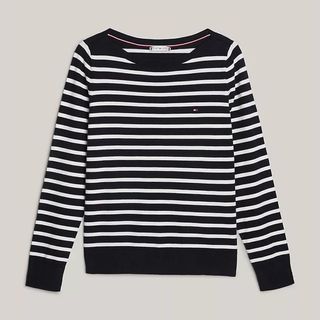
tommy adaptive
Boatneck Sweater

