


Gov. J.B. Pritzker announced Monday that he will seek a second term in office. This video was posted on Pritzker’s social media accounts.
Democratic Gov. J.B. Pritzker announced his widely anticipated bid for reelection Monday and acknowledged his handling of the COVID-19 pandemic will be the overarching issue in the 2022 race.
“When I ran for governor four years ago, I could not have imagined that I would end up leading the state through a pandemic,” Pritzker said in a three minute video focused on the way he dealt with COVID-19 issues which accompanied his reelection announcement.
Pritzker acknowledged that “I may not have gotten every decision right” in handling the pandemic, which involved his use of emergency orders restricting public activity. But, he said, at every step he “followed the science” to protect residents.

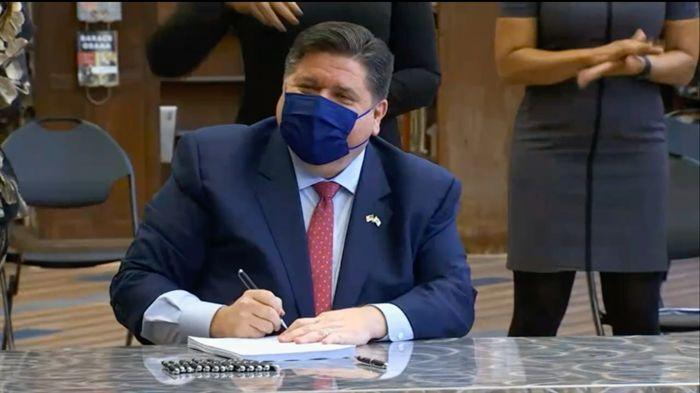
Flanked by lawmakers and supporters, Gov. J.B. Pritzker smiles after signing a sweeping criminal justice reform bill into law during a ceremony at Chicago State University on the South Side on Feb. 22, 2021.
“Part of why I’m running for reelection is because I watched the heroes across our state step up and do the right thing. We had so much to accomplish and we were able to do that together,” he said. “I’m very proud of all of the people in the state of Illinois. And, we have so much more we can do together.”
While Pritzker’s decision was widely expected, particularly after he put $35 million of his own money into his campaign account in March, the governor had been silent publicly about his reelection plans — an effort to show he was more focused on the pandemic and governance than politics.
People are also reading…
Now, with less than a year until the state’s newly moved June 28 primary, the wealthy heir to the Hyatt fortune believes the state is far enough along in dealing with COVID-19 to issue his first reelection campaign message.
Pritzker, 56 and worth an estimated $3.5 billion according to Forbes, spent $171 million of his own money to defeat one-term Republican Gov. Bruce Rauner in 2018.
Pritzker’s campaign video takes a swipe at former President Donald Trump and his administration’s handling of the pandemic, with an announcer saying, “In Washington, science took a back seat to politics. But in Illinois, we knew the stakes were too high.”

Gov. J.B. Pritzker speaks to the media at the formal opening of the K-Town Business Centre on West Polk Street in Chicago, June 28.
The reference to Trump, whom Pritzker frequently criticized, also was a subtle shot at the three announced Republican candidates for governor — Burr Ridge businessman Gary Rabine, state Sen. Darren Bailey of Xenia and former state Sen. Paul Schimpf of Waterloo.
All three have sought to align themselves with their party’s Trump supporters and have been critical of Pritzker’s stay-home orders and limits on public gatherings both at work and for social occasions, as well as his rules on masks, during the pandemic.
Bailey was unsuccessful in repeated attempts to legally challenge Pritzker’s authority to issue emergency orders regarding public regulation and business access rules during the pandemic. At one point last year, Bailey was removed from the floor of a temporary Illinois House chamber for refusing to wear a mask.

Gov. J.B. Pritzker speaks during a press conference in Springfield on June 1, 2021.
In addition to arguing for his handling of the pandemic Pritzker can point to a number of legislative successes in his first term, including a major infrastructure plan, a minimum wage hike set to hit $15 per hour in 2025, the legalization of marijuana and a number initiatives including a criminal justice overhaul pushed by the Illinois Legislative Black Caucus.
See the new Illinois laws that took effect July 1
665 bills
The Democrat-controlled Illinois General Assembly approved 665 bills this legislative session, with the vast majority awaiting Gov. J.B. Pritzker’s signature.
But, Pritzker has signed 42 bills into law. A handful of those will take effect Jan. 1, 2022, but most went into effect immediately upon signing or will take effect this Thursday.
Here are some notable new laws in effect now or on Thursday that Illinoisans should know.
Election reform

With pandemic-related delays to U.S. Census redistricting numbers, lawmakers moved back the state’s 2022 primary election from March 15 to June 28. The legislation also makes Election Day a state holiday, requires every county to have at least one universal voting center and allow people to be added to a permanent vote-by-mail list. (SB825)
Vote by mail

Some pandemic-induced changes to voting for the 2020 general election, such as vote-by-mail and curbside drop-off, will now be permanent features of future elections. (House Bill 1871)
State legislative redistricting

As they are tasked with doing every 10 years, lawmakers approved new district boundaries for the Illinois House and Senate. The Democrat-drawn maps, which utilized the U.S. Census’ American Community Survey instead of waiting for the decennial census numbers that will arrive later this year, have been challenged in court by Republicans and some other groups. (HB2777)
Illinois Supreme Court redistricting
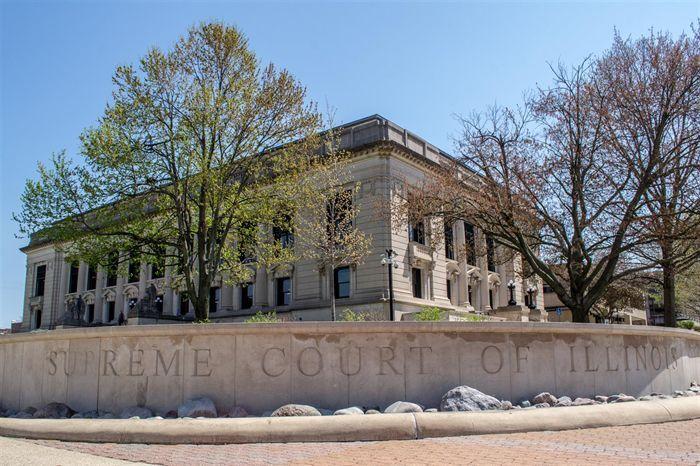
The seven-person Illinois Supreme Court’s district boundaries were successfully redrawn for the first time since the 1960s. (SB642)
Police reform

There was no more controversial bill that passed this year than House Bill 3653, also known as the SAFE-T Act, which passed during the lame duck session this January. The provisions ending cash bail and requiring all police to wear body cameras will not take effect until 2023 and 2025, respectively. But starting Thursday, police will be required to render aid to the injured, intervene when a fellow officer is using excessive force and and be limited in use of force. It also offers stricter guidelines for the decertification of officers and would allow people to file anonymous complaints of police misconduct. (HB3653)
Payday loans

Lenders are now prohibited from charging more than 36% annual percentage rate on consumer loans. The average rate in Illinois was nearly 300% prior to the law’s signing. (SB1792)
Vaccine lottery

Tucked into the state’s fiscal year 2022 budget is $10 million for a “vaccine lottery.” All Illinois residents vaccinated by July 1 will be automatically entered into the contest. It includes $7 million in cash prizes to vaccinated adults, ranging from $100,000 to $1 million, and $3 million in scholarship awards to vaccinated youth. (SB2800)
COVID-19 emergency housing

Created guidelines for distributing more than $1 billion in federal stimulus funds for COVID-related housing relief. Also creates automatic sealing of evictions during the pandemic. (SB2877)
Pretrial interest

Victims in personal injury and wrongful death cases will be allowed to collect interest from defendants from the time a lawsuit is filed. It is meant to incentivize settlement of these cases. It was supported by the trial lawyers and opposed by business groups. (SB72)
Casino labor

All casino applicants in Illinois are now required to enter into a project-labor agreement when seeking a new or renewed license. (SB1360)
Crime victims compensation

Provides that a victim’s criminal history or felony status shall not automatically prevent compensation to that victim or the victim’s family. Extends the applicant’s period for submitting requested information to 45 days from 30 days and provides that a final award shall not exceed $45,000, up from $27,000, for a crime committed on or after August 7, 2022. (HB3295)
Electronic signature

Provides that a contract, record, or signature may not be denied legal effect or enforceability simply because it is in electronic form or an electronic record was used in its formation. Provides that if a law requires a record to be in writing, an electronic record satisfies the law. (SB2176)

