


Lights. Camera. VAR check in progress. Action.
Friday 21 October, 2022 will go down in Scottish football history as the date fans embraced – well, that’s the plan – the introduction of Video Assistant Referees in the Scottish Premiership.
In an arena often driven by frenzied claims that one’s team is forever being unjustly wronged in some way, shape, or form, you’d think the safety net of VAR being brought in would be universally greeted by the great Scottish supporting public?
Alas, while the sweeping in of the 21st century has been broadly welcomed, it’s fair to say there are some who are yet to be fully convinced.
So, how will VAR work in Scotland?
Right, so how does it work?
You mean you’ve not been paying attention?
Each club in the Premiership will operate VAR from this Friday going forward, with Hibernian’s match with St Johnstone the first up.
The process will be familiar to anyone who has watched the system in play in any other competition, with the Scottish FA’s VAR system ratified by Fifa while following the global body’s protocol.
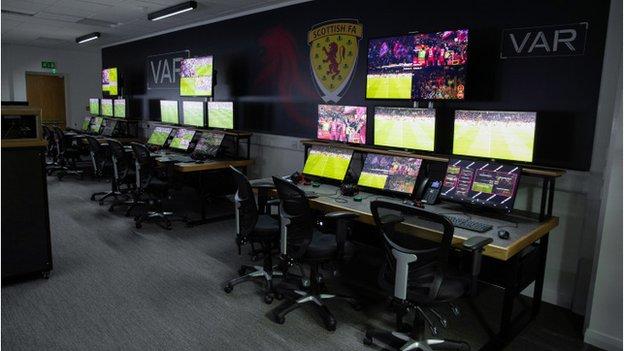
For each game, there will be a minimum of three people watching remotely. One video assistant referee (the VAR) who is a category one official, one assistant video referee (the AVAR), and one replay operator (the RO).
They will be following the action, and will be communicating with the on-field referee over any potential checks. On top of this, there will also be a VAR observer in the room.
Why do you need three people?
Glad you asked. If there is an incident the VAR team want to check, the main video assistant referee will take control of reviewing the matter in question while working with the replay operator.
At the same time, the assistant VAR will continue to monitor the live feed for anything else (imagine a penalty claim is being checked, with a goal then going in at the other end 10 seconds later).
Are incidents automatically reviewed or does the referee ask?
Well, both.
As a matter of course, anything in the immediate Attacking Phase of Play (we’ll explain this below..) prior to goals, potential red cards, penalty area incidents and potential cases of mistaken identity are looked at.
So when a goal is conceded and you see your team’s defender frantically making a big box with his arms as if he’s guiding in a Boeing 747, he’s wasting his time. It’s already being looked at.
The VAR watches the game live, but also has a monitor on a three-second delay for doing a quick “silent check”. If it’s clear there’s been no mistake made, the match will continue.
However, if it requires further attention, the VAR will hit a big red button – more on the big green button later, too – and the referee will be told to delay the restart while the VAR looks at it further.
And it is possible for the referee to ask for something to be checked. While the VAR team will catch most things, an off-the-ball incident, a sudden roar from the stands or a player in the corner lying on the deck may require further investigation.
Who has the final say?
Always the on-field referee.
If the VAR thinks there’s been a clear and obvious error, they’ll ask the on-field official to go to the monitor.
My team doesn’t have a scoreboard, what’s going on?
Off the 12 Premiership grounds, half don’t have LED scoreboards to display any VAR check messages.
Where screens do exist, a message will be sent to the scoreboard operator by someone at VAR HQ whenever a full review – and not a silent check – is ongoing. The system, called VARdict, will provide graphics to use.
As well as this, all stadium announcers will get a notification a review is in place and what it’s for, and can then inform the crowd.
How many cameras will be used in Scotland?
A minimum of six cameras will be in operation at every game.
That includes two on the main gantry, one looking along each 18-yard line, one high up behind one goal, and one low down behind the other.
In games where a live broadcaster is involved and is using even more cameras, all will be made available to the VAR team back at base. Each replay operator will take control of up to 12 cameras per game.
If there are any more than that (the Scottish Cup final might have 18 cameras, for example), and a second replay operator is brought in to help.
Do we have goal-line technology?
No. While goal-line technology (GLT) is still used for showpiece matches like the Scottish Cup final at Hampden, the cost to clubs makes it impractical to roll out on a wide scale.
Scotland is not alone in not using GLT (for example the MLS use the same model as we do in Scotland).
Instead, the VAR team will review goal-line incidents as part of their routine checks.
How far back does the VAR go when reviewing an incident?
Right, this gets a bit messy.
Speak to a referee, and you may hear them talk about “A-P-P”, even in their sleep. This stands for attacking phase of play. Stick with me…
Whenever a team starts an APP, the VAR presses a green button on the desk to bookmark the start of that team’s attack.
If a goal is scored or there’s an incident to be reviewed, the VAR will go all the way back to the start of that bookmark to review everything in the build up.
So, imagine Kevin van Veen scores for Motherwell after a counter attack started in his own box with a team-mate winning possession and passing forward.
If the winger who eventually receives the pass runs the ball just out of play before swinging the cross in, then it’s going to be included in the attacking phase of play the goal will be ruled out.
What happens if there’s a power cut?
You may have seen at Elland Road in the Premier League over the weekend there was a delay after a power cut. This caused a 40-minute delay, with VAR and all goal-line tech out of use.
These things happen, but the SFA have put extra provisions in place to ensure there’s a back up. Infrastructure and networking has been installed at every ground just for VAR, while there’s also a back-up monitor, and a back-up phone if communication is lost with the on-field referee.
If VAR ever does become non-operational and is not likely to come back, then, as per the Laws of the Game, the game will continue.
Is anyone else involved?
In the main VAR room during game time, there will be observers monitoring a maximum of three games each.
However, the observer is not allowed to speak to the match teams or influence any decision. Every person in the room also has no access to mobile phones or contact with the outside world.

