


As we wait for the video depicting the beating death of Tyre Nichols, there’s been a lot of focus on the perceived threat of violence in response.
“I expect our citizens to exercise their First Amendment rights to protest, to demand action and results but we need to ensure the community is safe in this process,” said Memphis Police Chief Cerelyn “C.J.” Davis, in a video released Wednesday night. “None of this is a calling card for inciting violence or destruction on our community or against our citizens.
The national and international media has picked up that theme, flying in star reporters whose only understanding of Memphis may be blues and barbecue.
But our mission statement says, in part, that we are here “to bear witness to movement making,” and that’s what we’ve done. We’ve seen Memphis protest peacefully. We’ve also seen unnecessary police aggression.
So, what the international attention may be unfamiliar with is the antagonistic relationship police have cultivated with the community, dating back decades. Below are a collection of MLK50 stories and columns to add context to this tragedy.
Protest in Memphis


‘Take it to the bridge’
MEMPHIS — July 10 marks the anniversary of the largest spontaneous act of civil disobedience in the city’s modern history. The spark: The police killings of two black men in less than 24 hours, Alton Sterling on July 5 in Louisiana and Philando Castile on July 6 in Minnesota. The kindling, though, was the generations-old resentment and rage […]
On July 10, 2016, more than 1,000 Memphis protesters – almost all young and Black – channeled Dr. Martin Luther King Jr.’s spirit of civil disobedience. It was the largest spontaneous act of civil disobedience in the city’s modern history.
The spark: The police killings of two Black men in less than 24 hours, Alton Sterling on July 5 of that year in Louisiana and Philando Castile on July 6, 2016, in Minnesota.
The kindling: Generations-old resentment and rage simmering in a majority-Black city where the wealth and prosperity are concentrated in the white minority and many Black people live on the economic margins.
So on that Sunday afternoon, they blocked the Interstate 40 bridge, with its iconic M-shaped arches, a span that funnels more than 37,000 vehicles daily from Arkansas to Tennessee.
Knowingly or not, the masses followed the instructions in one of King’s last speeches here: Apply economic pressure to force the city to provide better-paying jobs and end economic apartheid. (The demonstration was peaceful and police made no arrests.)

How police handle white domestic terrorists in Washington vs. racial justice advocates in Memphis
MLK50 has covered movement making in Memphis since our inception. Now feels like the right time to share images from these protests.
On Jan. 6, 2021, the MLK50 team noticed the difference between how police handled white domestic terrorists in Washington vs. how they have manhandled racial justice advocates in Memphis. These images from Black Lives Matter and other protests, taken by MLK50’s visuals editor Andrea Morales, are a stark reminder of the disparity inherent in police use of force.

Police have been spying on Black reporters and activists for years. I know because I’m one of them.
This article was produced in partnership with ProPublica, a nonprofit newsroom that investigates abuses of power. MEMPHIS, Tenn. — On Aug. 20, 2018, the first day of a federal police surveillance trial, I discovered that the Memphis Police Department was spying on me. The ACLU of Tennessee had sued the MPD, alleging that the department was in […]
In 2020, Memphis, like many cities, saw demonstrations sparked by the killings of George Floyd and Breonna Taylor. But in Memphis, like elsewhere, the seeds of distrust between activists and police were planted decades ago. And law enforcement has nurtured these seeds ever since.
The Memphis Police Department has been spying on Black reporters and activists for years. MLK50’s founding editor and publisher knows this firsthand.

‘This will be Strickland’s legacy,’ says protester as police arrest City Hall demonstrators
For 15 days, dozens of demonstrators occupied space outside City Hall, dotting it with tents and colorful messages written in chalk. They served meals, danced, posted “Black Lives Matter” and “Black Trans Lives Matter” signs and a list of demands, including reallocating police funding to community services. But on Tuesday afternoon, the city told protesters […]
n 2020, after protesters led a 15-day peaceful occupation outside City Hall, Memphis Mayor Jim Strickland sent in police, claiming that the area was no longer safe because the building was undergoing repairs.
Police officers descended, wearing black pants, black shirts and masks, as demonstrators chanted: “Why are you in riot gear? We don’t see no riot here!”
Said Baris Gursakal, social media coordinator for the Memphis-Midsouth DSA: “… This will be Strickland’s legacy right here: the violation of rights, the lack of transparency, the complete dysfunction of democratic process in our city, where the public is literally chained out of the City Hall.”


Bearing witness: Protest, white privilege and unequal policing
When Black people are unjustly killed for holding a wallet or cell phone, for jogging, for “fitting the description,” or even while sleeping in bed, I find it appalling that Memphis police refused to even question a white man Wednesday night when he pointed a gun at me and other protesters. There were multiple police […]
Policing in Memphis


What’s next after feds opt out of policing review Memphis asked for?
Memphis police monitor protesters at the Nathan Bedford Forrest statue in Health Sciences Park on Aug. 19, 2017. Photo by Andrea Morales. At a time
In 2017, then-Memphis Police Department Police Director Michael Rallings asked for a federal review in the wake of investigations by the Justice Dept.’s Civil Rights Division to get to the bottom of killings of unarmed Black people by police. Rallings was acting upon the recommendation of Edward Stanton III, former U.S. Attorney for the Western District of Tennessee, who served during the Justice Dept.’s investigation of the July 17, 2015, killing of Darrius Stewart.
But then the U.S. Attorney General Jeff Sessions decided that the Office of Community Oriented Policing, which would have conducted the review, needed a “course correction” and local police could better run their own shops without advice from the feds. In short: Nothing to see here, so carry on with policing yourselves.

Thinking about taking Memphis police’s ‘Response to Resistance’ survey? Read this first
An online survey asking Memphians their opinions on the use of force by police will produce results of dubious value. Memphis Police Director Michael Rallings has said he hoped 100,000 residents would take the “Response to Resistance” “so we can have real data on how you feel.” The deadline for responding to the survey is […]
In 2020, MPD released an amazingly bad survey designed to measure the public’s attitudes on police’s use of force. Amazingly bad. The survey relied on a non-random sample, the questions were ambiguous, and any conclusions drawn should be taken with a grain (or two or 50) of salt.

DeCarcerate Memphis begins countdown on recommendations for new police chief
DeCarcerate Memphis outlines 10 actionable items for new Memphis Police Chief Cerelyn “C.J.” Davis.
There are hundreds of Memphians who for years have been clamoring for police reform. DeCarcerate Memphis is just one group of many that had recommendations for the newly hired Davis.
“In 2016, we witnessed a wave of uprising in support of the Black Lives Matter movement. At that time, Memphians were made many promises regarding transparency, accountability and opportunities for community input. The results since then have been lacking, if not abysmal.”

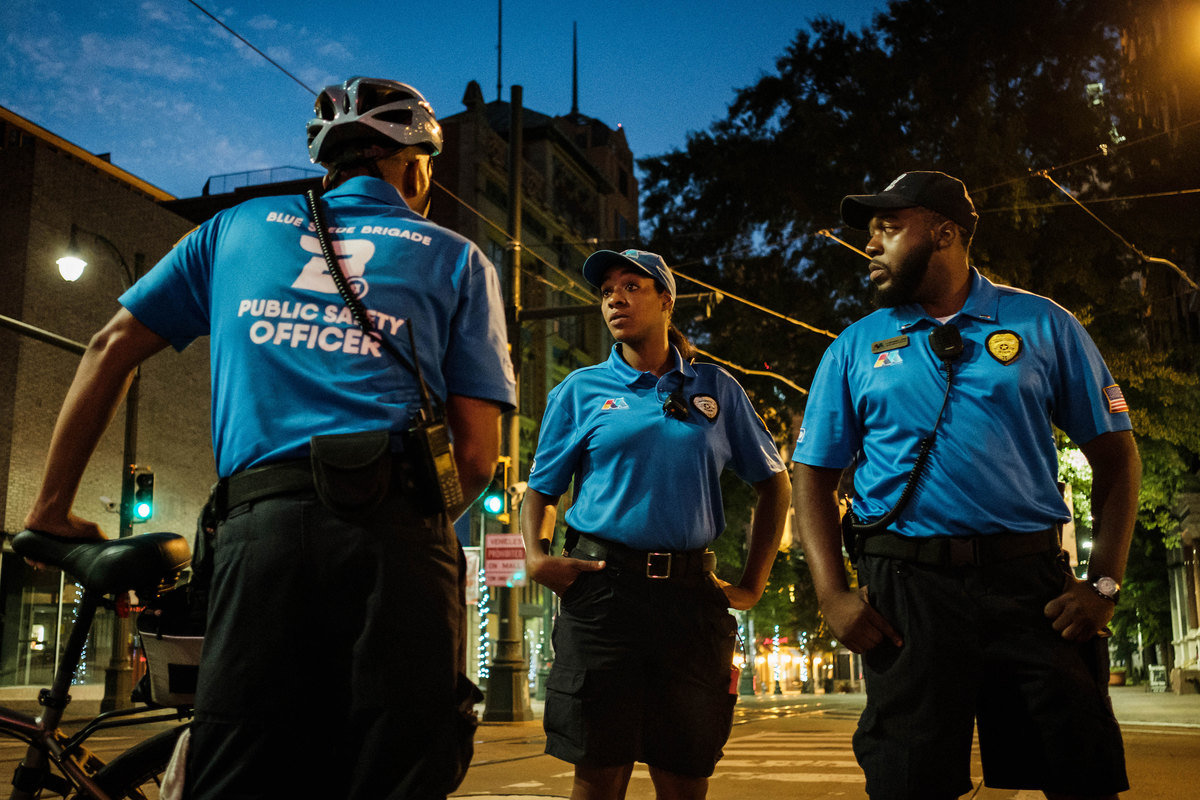
Is the Answer to Crime More Cops?
It’s not how many, it’s how you use them.
In 2019, MLK50’s Wendi C. Thomas partnered with Simone Weichselbaum, then of The Marshall Project, to try to answer the question: Is the answer to crime more cops? (Spoiler alert: No.)
“Memphis Mayor Jim Strickland took office in 2016 vowing to fight the city’s high violent crime rate by beefing up a dwindling police force,” Weichselbaum wrote. “His most novel idea: use an advisory body, the Memphis Shelby Crime Commission, to funnel anonymous private donations from the city’s elite to reward cops who remain on the force.
“His wish list, dubbed the “Blue Sky Strategy” and outlined in emails obtained by The Marshall Project, was ambitious: $48.2 million, including $12.7 million to subsidize housing and private school tuition for police families and $8 million for take-home cars.
“So far the fund has channeled $6.1 million into the city budget, most of it for police retention bonuses. FedEx, International Paper and about a dozen other private entities are now subsidizing public safety in a big American city.”
Politics

What Trump and Strickland share: A dangerous obsession with law and order
How did Memphis, a majority-Black city where voters chose Hillary Clinton over Donald Trump by a nearly 3 to 1 margin and whose U.S. congressman is a vocal Trump critic, become a demonstration site for a racist president’s “law and order” crime-fighting crusade? For weeks, streets across the country and in Memphis roiled as hundreds […]
What did (now former) President Donald Trump – a crude Republican – and Strickland – ostensibly a Democrat in lockstep with the (since ousted) Republican district attorney – have in common?
Trump was obsessed with cities as symbols of chaos. His directives that police squelch civil disobedience by any means necessary were troubling.
And Strickland, too, has brushed away demands to dismantle status-quo policing while offering what amounts to crumbs of reform — which he immediately follows with his own demand: Memphis must have more officers now.
But their message is the same: Only police can keep us safe, structural reform would put our safety at risk, and bigger police forces lead to better communities.

It’s not just the Russians: Mayor Strickland’s disinformation campaign
Memphis police illegally surveilled residents for political intelligence. So ruled a federal judge in 1978 and so ruled a judge in 2018. Doing so was and is a violation of residents’ rights to freedom of speech. So said a federal judge in 1978 and so said a judge last year. “The City violated the clear […]
Maybe instead of worrying about the Russians, we should have paid more attention to Strickland’s disinformation campaign. He essentially argued in a November 2019 weekly email that if Memphis police can’t violate a 1978 consent decree, the city can’t fight crime.
“Misinformation is generally defined as information that’s incorrect, but not intended to cause harm. Disinformation, however, is false information intended to cause harm. And in this case, the harm is to the civil liberties of all residents, especially the activists and organizers with whom Strickland has cultivated a contentious relationship.”
This story is brought to you by MLK50: Justice Through Journalism, a nonprofit newsroom focused on poverty, power and policy in Memphis. Support independent journalism by making a tax-deductible donation today. MLK50 is also supported by these generous donors.

