


But the omens, after his grievance-filled televised vent against Ukraine, the West and the indignities of history on Monday, are very, very dark.
As bad as this latest round of gangster geopolitics is, what unfolds in the coming hours and days will set the world’s course in the years ahead.
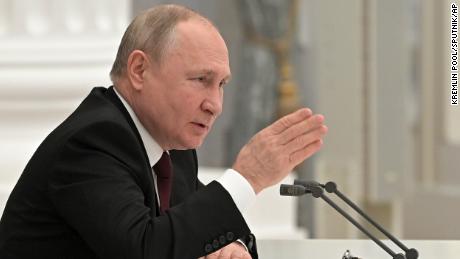
In his speech from the Kremlin, Putin made clear that he sees Ukraine as indistinguishable from Russia and not an independent entity — hardly an argument that suggests restraint. In fact, his screed came across as a justification for a far larger venture than a limited incursion into the east of the country.
He referred to Ukraine as “an integral part of our own history, culture, spiritual space” and referred to comrades, relatives and people “connected with us by blood.”
“Modern Ukraine was entirely created by Russia,” he added.
A speech that set Ukrainians on edge
Putin’s propagandistic view of history did not amount to a declaration of an invasion or an attempt to reunite Ukraine with the Motherland. But it would be easy to read it as an attempt to prepare the Russian people for war. It also surely augured a long-term effort to dominate and destabilize a democracy that includes large numbers of citizens who yearn to join NATO and the European Union.
Putin’s most chilling line came when he appeared to lay the groundwork for treating any attack on Russian forces due to enter eastern Ukraine as a pretext for a wider conflict that the US has said could kill thousands of civilians and trigger refugee flows.
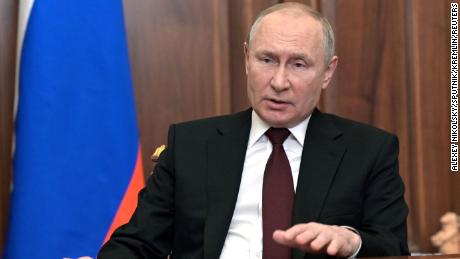
“From those who seized and hold power in Kyiv, we demand an immediate cessation of hostilities,” Putin said of a government that, unlike him, was chosen in a free and fair election. “Otherwise, all responsibility for the possible continuation of the bloodshed will be entirely on the conscience of the regime ruling on the territory of Ukraine.”
Just as ominously, multiple US officials told CNN that they interpreted Putin’s move on the two eastern Ukrainian regions, which call themselves the Donetsk People’s Republic and Luhansk People’s Republic (DPR and LPR), as part of a steady march to a wider invasion of Ukraine.
“This is Potemkin politics,” a senior administration official told reporters on Monday. “President Putin is accelerating the very conflict that he’s created.”
But again on Monday, administration officials appeared to make a distinction between eastern Ukraine and the rest of the country. “There have been Russian forces present in these areas” since 2014, a senior official told reporters.
“So we’re going to be looking very closely at what they do over the coming hours and days and our response will be measured, according, again, to their actions,” the official said.
It was not clear whether the administration position was due to sequencing issues with allies over sanctions or whether it was seeking to preserve one last-ditch point of potential leverage with Putin. In any case, the Russian leader scoffed at the idea of sanctions in his speech.
It is prudent for the US to actually punish Russia for what it does rather than what Putin says. But the semantics over what constitutes an invasion does risk diminishing the action that the Russian President took on Monday. It is well known that what Russia has described as pro-Moscow rebels in eastern Ukraine were trained by Russia and took its orders. In effect, Putin took a piece of another country, without giving that state a say in its destiny. This is classic expansionist autocracy using ethnic justifications and false claims that Russians were being persecuted and targeted by genocide — a playbook shockingly familiar from the horror of the 1930s.
The question of what constitutes an invasion of Ukraine may soon be moot anyway. The US has accurately predicted Putin’s move through a pre-invasion checklist in recent days that includes moves in eastern Ukraine. And it may be correct again.
Pressure on Capitol Hill
The Biden administration, which has largely succeeded in building a united NATO front against Putin in recent weeks, is already facing demands from Capitol Hill for a swifter, harsher response to his land grab — even from some Democrats.
Democratic Rep. Gerry Connolly of Virginia told CNN’s Wolf Blitzer that the US needed to put down a flag and to correctly define the pending dispatch of “peacekeepers” to eastern Ukraine.
“That’s an invasion by any sense of the imagination,” he said, adding that the most consequential sanctions ever against Moscow must immediately follow.
Two leading Republican lawmakers laid into the Biden administration.
“As we’ve said for months, setting the trigger for meaningful sanctions to Russian tanks rolling across Ukraine’s border was a dangerous mistake,” said Rep. Michael McCaul of Texas, the lead Republican on the House Foreign Affairs Committee, and Rep. Mike Rogers of Alabama, the top Republican on the House Armed Services Committee.
“We must immediately impose real costs for this blatant act of aggression and flagrant violation of Ukraine’s sovereignty and territorial integrity. Unfortunately, the sanctions previewed by the White House thus far are the definition of impotence,” the two Republicans wrote.
US officials said late Monday that they expected Russian troops to start rolling into eastern Ukraine and the two rebel regions within hours.
The world will soon thereafter find out whether Putin’s bitter fury on Monday was a precursor of a wider conflagration that would effectively end the post-Cold War era and usher in a new age of tension in Europe.
That reality would require a huge rethink of transatlantic security — including the likely dispatch of thousands of US troops back to bases they left in 1990s and early 2000s. Such deployments would also complicate Washington’s desire to pivot its military might to Asia to wage a burgeoning new Cold War-style conflict against a rising superpower, China.
A prolonged geopolitical tussle with Russia would also force US and European policy makers to consider just how far Putin might try to push his effort to rewrite the borders of Europe.
“What worries me is what happens after Ukraine,” former Director of National Intelligence James Clapper said on CNN on Monday evening. “We have got a real crisis on our hands here.”
Putin’s argument, for example, that Ukrainians were blood brothers of Russians was especially worrying since it could be applied to other countries that include large numbers of ethnic Russians — including the Baltic states, Latvia, Lithuania and Estonia, which were formerly under Soviet rule. Any attempt by Putin to extend his principle there could be hugely dangerous since all are now in NATO and benefit from the alliance’s guarantee of mutual self-defense.
The next few days will show how willing Putin is to act upon his words and will begin to answer Clapper’s question. The evidence so far looks ominous.

