


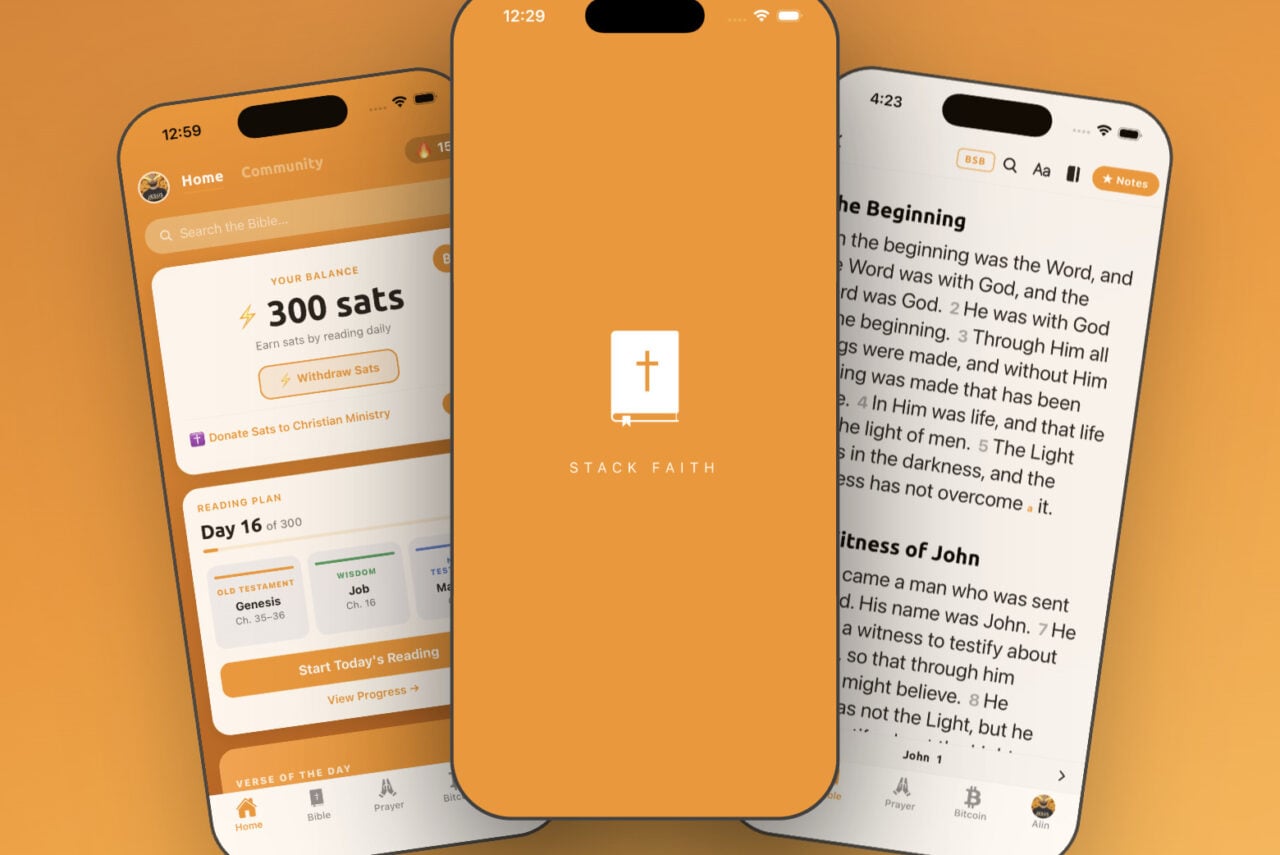
At first glance, Orange Bible looks like a standard scripture app. But this app is not just for followers of Jesus Christ, it’s also for followers of Satoshi Nakamoto. On top of that, it shows that even religious practice is now being pulled into our increasingly gamified app economy.
Orange Bible is an iOS Bible app (an Android version is in the works) built around a simple hook: read scripture, keep a streak, and earn small amounts of bitcoin. The app uses both the public-domain Berean Standard Bible and the King James Version, packaging them with the familiar features of a modern Bible app, including search, highlighting, note-taking, reading plans, a prayer journal, and syncing across devices.
This gives me an idea…
— Pastor Coin (@pastorcoin) March 16, 2026
But the defining feature is financial. Users open the app, start a reading plan, and collect satoshis (the smallest unit of a bitcoin) for maintaining a daily habit. Those rewards can increase as streaks unlock higher reward tiers. As the man behind the app, Alin Armstrong, put it when reached for comment, “What makes Orange Bible different from every other Bible app is the unique reward structure. You don’t earn a badge or a digital streak. You earn real Bitcoin.”
The app is free, but Orange Bible’s full pitch sits behind an $8.99 monthly premium tier. Premium subscribers are promised 3x bitcoin rewards on each reading session, access to an in-app “Bible Study Assistant” described as an AI scholar that can answer questions about verses, summarize chats, and save those summaries to a personal commentary, plus an “Orange Study Bible” with more than 200 study notes on biblical economics, wealth, and stewardship. The paid plan also includes book introductions focused on the economic world of each biblical book and a small built-in library featuring Armstrong’s book “The Bible and Bitcoin” and other titles.
The Overlap Between Online Christian and Bitcoin Communities
Notably, Armstrong has built Orange Bible out of an existing niche at the intersection of Christianity and Bitcoin advocacy. This, perhaps, explains why Armstrong talks about Orange Bible less like a quirky app idea and more like a product emerging from an already-existing online subculture. He told Gizmodo he was surprised when he first got into Bitcoin in 2020 to find what he described as “a rich, vibrant community of Christian Bitcoiners,” and said the success of his self-published book, which he says has sold more than 10,000 copies over the past three years, only reinforced his sense that the overlap was real.
Armstrong goes further than simply observing that some Bitcoin enthusiasts are religious. He argues that the technology itself pushes people toward faith, claiming that “people come for Bitcoin and leave as Christians” because the currency’s fixed, verifiable rules confront users with what he sees as objective truth in a world of “fake money, fake food, fake news, fake everything.” In his view, Bitcoin is not merely adjacent to Christian culture but fundamentally based on its values.
“The principles Scripture lays down about money, honest weights, no debasement, a just measure (Proverbs 11:1) are the exact principles encoded in the protocol,” said Armstrong. “Two thousand years of Christian economic thought, written into code. I call Bitcoin the truth machine, because all truth is God’s truth.”
That worldview appears to be the real product underneath the app’s rewards system. Orange Bible does not just pay users in satoshis to keep a Bible-reading streak alive; it wraps scripture and Armstrong’s wider argument about bitcoin as “sound money” into a single devotional habit.
An Increasingly Gamified World
Placed in the wider app ecosystem, Orange Bible feels less like an isolated oddity and more like the next logical extension of software that treats behavior itself as something to be shaped through rewards. Crypto incentives have already been used to push people toward a wide range of habits, from daily exercise to buying vapes, so it’s possible God and his followers also need to push the gamification of the good word.
At least in this case, Armstrong is using bitcoin micropayments rather than inventing a proprietary token of his own to be dumped on his followers, which is all too common with anything related to crypto and some say could be Hunter Biden’s next move. The app also does not lean on outright gambling mechanics more generally, which is another practice sometimes considered sinful that is seemingly being added to every aspect of society. “Let me be clear about one thing, because it’s the whole point: Bitcoin is not the point and never will be,” said Armstrong. “It’s a tool — a powerful one the Church has largely ignored — and our mission is to put it to work for the Kingdom.”
Notably, users can also direct their bitcoin rewards to partner ministries, turning the app’s read-and-earn loop into a mechanism for donations. Even so, Orange Bible still looks like part of the same broader drift toward incentive-saturated software, where every routine can be quantified, nudged, and monetized. If older tech promised convenience, products like this suggest something stranger: that no habit is too sacred to be converted into a retention strategy.

