


The House of Hungarian Music, a small glass-built venue with a roof like a fluffy pancake, is billed as a centre for a city seeped in music. A blend of gallery, concert hall and outdoor performance space, it was conceived as a glade, a clearing in the woods, with a perforated roof for trees to poke through and for shafts of light to pierce deep into the heart of the building. Witty, whimsical and seemingly weightless, it is a delicate addition to Budapest’s Varosliget.
Designed by Japanese architect Sou Fujimoto, the House of Hungarian Music is part of the rebirth of Budapest’s Varosliget (or City Park), which was the focus of Hungary’s millennial celebrations in 1896, a thousand years since the Magyars had settled in the country. The venue is the first new building in Europe’s biggest new cultural quarter, but has also become entangled in the culture wars that prime minister Viktor Orban has been waging.
The first thing to note is that this eccentric building is a genuine delight. The second — and I note this a little sheepishly — is that I was on the jury that selected the design. At the time, I raised objections, initially to the project’s site in the park. Why, I wondered, in a city full of abandoned industrial buildings, could some of these not have been repurposed?
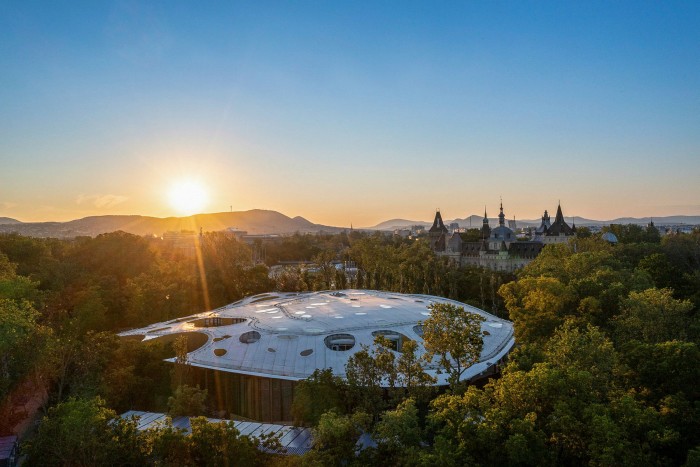
My next objection was that if this weird and difficult design had been submitted by a young, inexperienced practice, it could well have been a disaster. It was lucky that it transpired to be Fujimoto, an architect with real skill in creating delicate, surprising and ethereal architecture.
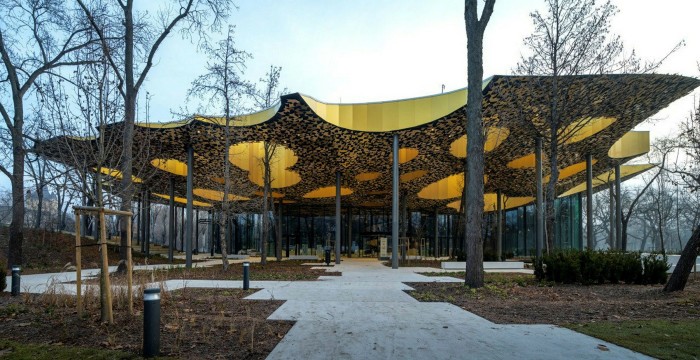
Spindly columns rise like saplings to support a kitsch canopy, its underside sparkling with 30,000 randomly tessellated spiky gold leaves intended to resemble autumn foliage. It is punctured by 100 tubes of anodised gold, funnelling yellow-tinged light down to ground level. It is quirky, eccentric and fun — though it’s unclear quite how well it will age.
The interior wasn’t finished when I visited but the intent was clear: a series of exhibition galleries deep inside, and around them the glazed public spaces, the inhabitant always conscious of the park outside. Circulation is simple, revolving around the vortex of a spiral stair that sheds weight as it rises through the height of the building, from a dense concrete corkscrew to a delicate cantilevered construction. A lot of heavy engineering has gone into making this building look so effortless.


The main concert hall is completely glazed, which you would think might be an acoustic nightmare but Nagata Acoustics (the firm that engineered Hamburg’s Elbphilharmonie and the Walt Disney Concert Hall in Los Angeles) has ensured it works using a serrated glass wall. This has been done in New York, where the musicians at Jazz at Lincoln Center play against a backdrop of the city’s skyline. In Budapest, the set is the park, as it is for the whole building. There is a tradition of alfresco music in the long, hot Hungarian summers and this pavilion in the park will surely prove a popular venue.
Perhaps partly to assuage residents’ fears about the scale of this development, the park itself has been completely reimagined. What was once a scruffy, dusty, neglected (though well-used) space is now a superb piece of green infrastructure. The playgrounds are as good as any I have seen, cycle and running routes have been carefully planned, planting completely transformed — something for those who might never visit a museum. Its site on a series of natural springs has been fully exploited, using the hot water to heat the buildings.
It might look like a fey, whimsical structure in a park, but all architecture is political. Orban, in power since 2010, has sought to rebuild Hungary’s status, forging an identity at the vanguard of the culture wars, using populist nationalism and Christian rhetoric to depict himself as a defender of “European values”.
The rebirth of the Varosliget, which will also include a vast, futuristic museum of ethnography, an odd design by local architects Napur, and a new national gallery by Japanese practice SANAA, has been criticised, notably by Budapest mayor Gergely Karacsony, as an unnecessary environmental burden.
Hungary, though, has had an outsized impact on music, from composers Liszt to Ligeti via Bartok and Kodaly, but particularly on its pedagogy, the teaching of music through innovative, humane and intriguing techniques, and on attitudes to understanding music as a cultural and physical phenomenon. The part of this building that is devoted to teaching acknowledges this tradition. It also raises the spectre of the understanding of music as a tool for building a nationalist and political agenda. The historical exhibition here leans towards this notion of nationhood, but perhaps we can forgive that as pride in its huge cultural impact.
This might well be a political project, an attempt to remake culture in a new image, but it has brought in international architects and animates a flagging neighbourhood. Sitting in the new concert hall, the audience will look out on to the backdrop of the Vajdahunyad, a fairytale castle from the original 1896 exhibition. Its gothic skyline was an attempt to coagulate Hungarian historical architecture into one proto-Disney landmark, an architectural distillation of the dream of a greater Hungary (then still a reality), of Transylvanian castles, gothic abbeys and Renaissance palaces. The styles may change, but whimsy, the sentimental picturesque and the politics remain.
ligetbudapest.hu
Follow @ftweekend on Twitter to find out about our latest stories first

