


Nike’s Air Jordan 3 “Laser” is finally escaping the vault, more than two decades after its creation. Originally made for Michael Jordan’s 40th birthday in 2003, the elusive player-exclusive has existed mostly through photographs and sneaker folklore. Now, Jordan Brand is preparing the intricate Air Jordan 3 for a public release, giving collectors access to one of its strangest treasures.
The timing feels unusually right. Sneaker culture has spent years revisiting familiar classics, from “Chicago” Jordans to “Bred” retros, while the internet keeps excavating forgotten samples. The “Laser” offers something different: history without nostalgia overload. Its engraved leather, personal references, and obscure backstory make it feel less like another retro and more like a lost chapter finally being published.
The Air Jordan 3 Laser Was Never Supposed to Be Ordinary
Jordan Brand officially unveils the ‘Laser’ Air Jordan 3 🔥
Expected to release on August 22. Cop or drop? pic.twitter.com/dNgQmPIaEF
— House of Heat° (@houseofheat) July 21, 2026
The Air Jordan 3 “Laser” has a peculiar place in Jordan Brand history. The original pair was produced in 2003 as a special player-exclusive for Jordan, reportedly marking his 40th birthday. Unlike the major Jordan retros that dominated sneaker shelves, however, this version was never intended for a public retail release. Instead, it remained an ultra-exclusive piece made only for the man whose legacy inspired it, becoming one of the brand’s most elusive creations.
That exclusivity made the shoe even more fascinating because it was built on one of the most influential silhouettes in sneaker history. Designed by Tinker Hatfield and originally released in 1988, the Air Jordan 3 helped transform Jordan’s signature line by introducing the visible Air unit, the iconic elephant-print detailing, and the now-famous Jumpman logo to the Air Jordan franchise.
Its influence extended well beyond design, arriving at a defining moment in Jordan’s career and cementing the silhouette’s place in basketball history. Jordan won the 1988 NBA Slam Dunk Contest wearing the Air Jordan 3 and continued to lace it up throughout the 1988–89 season, when the Chicago Bulls advanced to the Eastern Conference Finals. As a result, the shoe became inseparable from the mythology surrounding basketball’s most recognizable athlete.
The “Laser,” however, opens a more compelling chapter in the legacy of the Air Jordan 3. It does not rely on championship banners or an instantly recognizable color scheme. Instead, it turns the shoe into something closer to an illustrated archive. Laser-etched graphics cover the leather upper, creating a visual catalogue of references connected to Jordan’s life, career, interests, and cultural orbit, making the shoe feel unusually personal and historic.
Why the 2026 Retro Feels Different
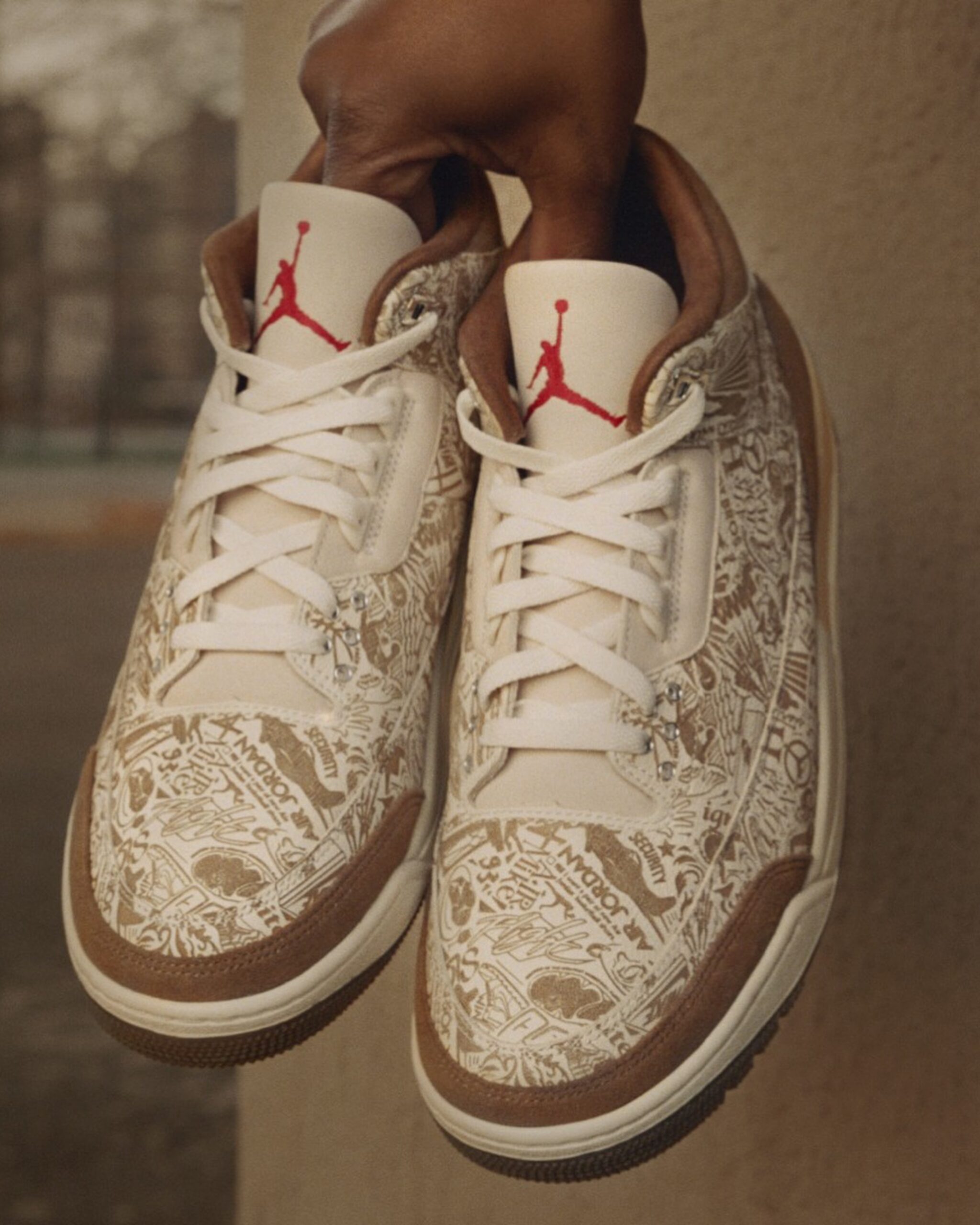
Jordan Brand has spent years mining its archives, but the most compelling retros are not always the ones with the biggest mainstream following. The “Laser” represents a different kind of archival strategy. Instead of reintroducing a sneaker that generations of fans have already owned, the brand is giving a wider audience access to a piece of Air Jordan history that was once reserved for Michael Jordan alone.
AIR JORDAN 3 RETRO “LASER” PROFILE
- Style Code: IO2365-001
- Colorway: Phantom / University Red / Palomino / Sail
- Release Date: August 22, 2026
- Retail Price: $225
- Key Materials: Premium Tumbled Leather & Low-Pile Suede
The Details Are the Whole Point
What makes this release remarkably unique is the absolute omission of the silhouette’s most famous element. Tinker Hatfield’s legendary 1988 elephant print panels have been entirely stripped away. Instead, the dark overlays on the toe and heel feature low-pile suede bumpers. This choice allows the laser-etched graphics to command the entire visual weight of the Phantom leather upper.
A close-up analysis of the intricately etched leather reveals a dense map of Michael Jordan’s historic career. Specifically, clear phrases like “Catch 23”, “Welcome to the Jordans”, and “Sandy Bros” are engraved directly into the skin of the shoe. Embedded within the design is the “M AIR J” license plate associated with Jordan’s black Ferrari 512 TR, a car connected to his cultural image during the peak of the Chicago Bulls dynasty.
Together, the textual nods mingle alongside classic silhouettes of Jordan’s iconic hand-switching layups and historic shoe outsoles. Notably, even the sacred “Nike Air” branding on the heel tab is beautifully engraved rather than traditionally stamped.
The shoe was “built around the idea that greatness is made up of countless details,” according to a representative. The company designed the visual narrative to invite wearers to discover something entirely new every single time they look closer. To ground the busy artwork, a vibrant University Red Jumpman pops cleanly off the tongue. Meanwhile, a slightly yellowed Sail midsole provides a beautifully aged, vintage aesthetic.
For Jordan Brand, that may be the most compelling direction for its vault. The future of retro culture does not have to mean endlessly repeating the greatest hits. Sometimes, the smartest move is opening the archive and showing people what was hiding behind the obvious classics.
Shop editors choice
Featured image: Nike
—Read also


