


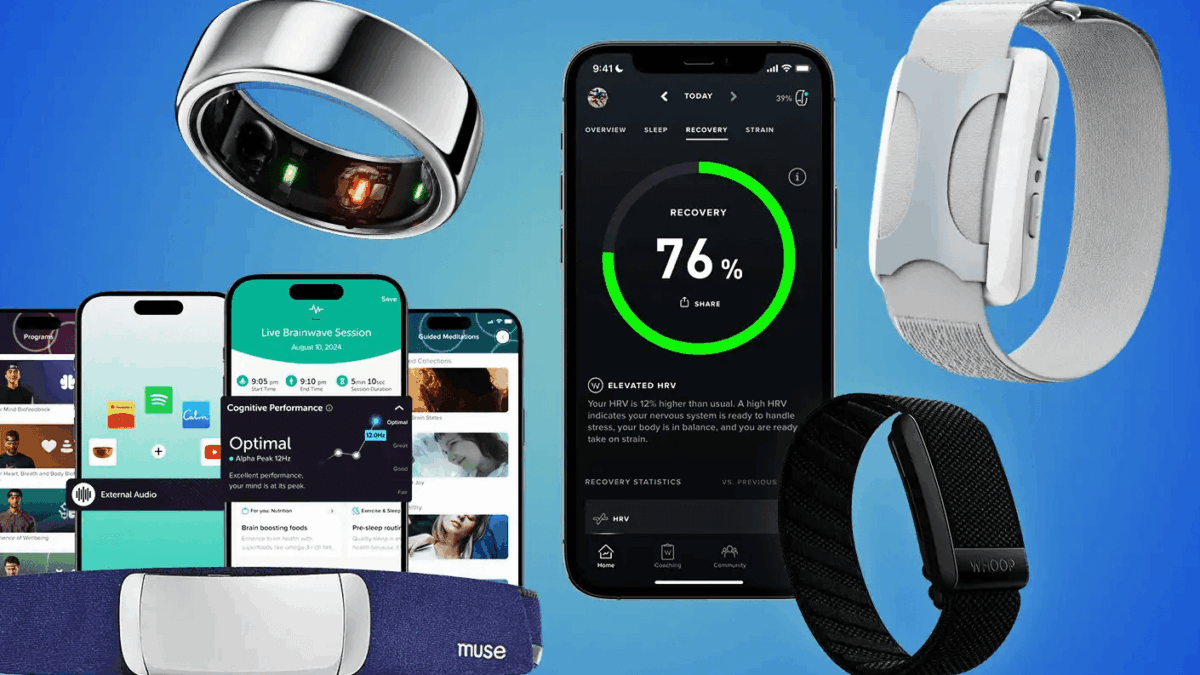
You wake up groggy. Not the pleasant kind of groggy where you know you slept deep and long. The suspicious kind, where your body is telling you one thing and your wrist is telling you another. You glance at your tracker. Eight hours. Ninety-two sleep score. Best night this week, it says.
You feel like you were hit by a bus.
This is the moment most people start questioning their sleep tracker. Not when they buy it. Not when they unbox it. After weeks of data that feels slightly, persistently, quietly wrong.
Here is the thing nobody tells you at the point of purchase: the problem usually started the night you chose the device.
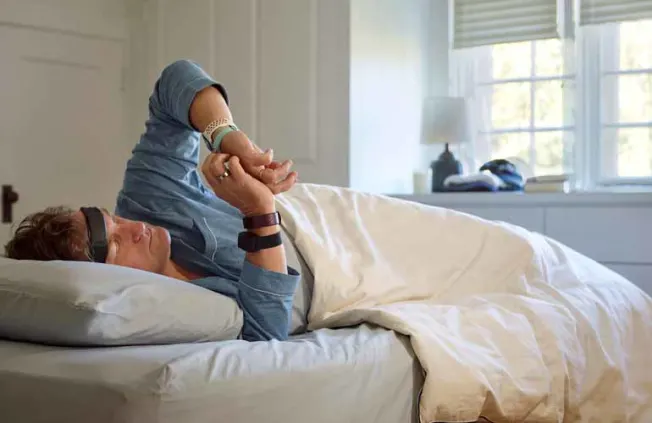
Image Credits: Consumer Reports
Two Types of People Buy Sleep Trackers. Only One Gets What They Actually Need.
If you need to understand your sleep, accuracy is non-negotiable. Go Oura Ring or Apple Watch and accept the charging trade-off. If you need consistent, low-effort coverage, battery life is the smarter priority. Xiaomi or Garmin will be there every morning without asking anything of you. And if you wear nothing to bed and sleep in the same place every night, the Withings mat is the most underrated option nobody talks about.
Everything else is a compromise. The question is which compromise fits your life.
The Hidden Truth About How These Things Actually Work
Sleep trackers are not sleep labs. They are pattern-recognition machines wearing the costume of sleep labs. They sense motion, heart rate, blood oxygen, sometimes skin temperature, and run that raw signal through a proprietary algorithm that produces a number that looks authoritative but is, at best, a well-educated estimate.
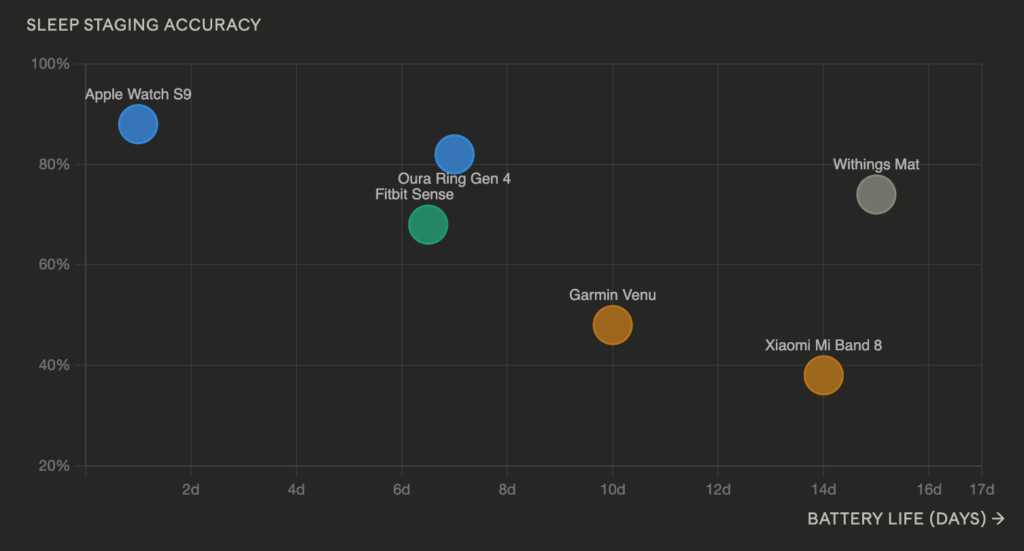
The more signals a device captures, the better its estimate. The more signals it captures, the faster it drains its battery. This is not a flaw in the design. It is physics.
A device pulling data from an accelerometer, an optical heart rate sensor, a blood oxygen reader, and a skin temperature probe all night is doing real computational work. That work costs energy. The devices that do it well give you richer, more accurate staging data. They also need charging every one to seven days. The devices that conserve power by leaning mostly on motion detection give you two weeks of battery. But they are making educated guesses about your sleep stages, and the data shows those guesses get cruder the longer the battery lasts.
The trade-off is not a coincidence. It is the whole game.
What the Numbers Actually Say
Nearly every consumer tracker does a decent job of knowing you are asleep. Detecting that you are awake, lying still in the dark at 2am, thinking about something you said in 2019, is where everything falls apart.
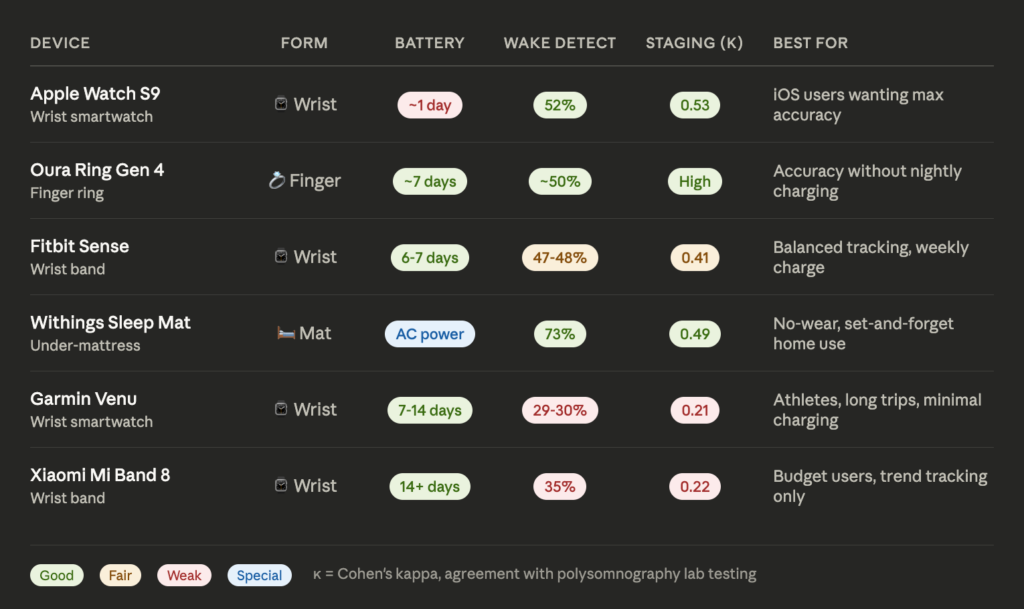
Long-battery devices show wake detection specificity as low as 29 to 35 percent. That means the device is calling you asleep when you are not, frequently and silently, inflating your sleep totals every single night. High-accuracy devices push that number closer to 52 percent. Still not perfect. But meaningfully better, built on a richer set of signals.
The contactless mat sits interestingly in the middle. No battery problem because it plugs into the wall. Better wake detection than most long-battery wrist devices. The catch is it only works at home, in your bed, under conditions that do not change too dramatically night to night.
Every device has a ceiling. The question is which ceiling you can live with.
When Accuracy Wins
If you are dealing with poor sleep, trying to understand it, or making decisions based on the data, accuracy is not optional. A tracker that consistently overestimates your deep sleep or misses your wake periods is not just inaccurate. It is actively misleading you. You will optimize for the wrong things based on data that does not reflect reality.
The Oura Ring and Apple Watch represent the current ceiling of consumer sleep tracking. Multi-sensor fusion, real staging depth, the highest wake detection specificity of any no-subscription device. Oura is the only option if you want ring form factor without nightly charging. Apple Watch is the better call if you are in the iOS ecosystem and the nightly cable does not bother you.
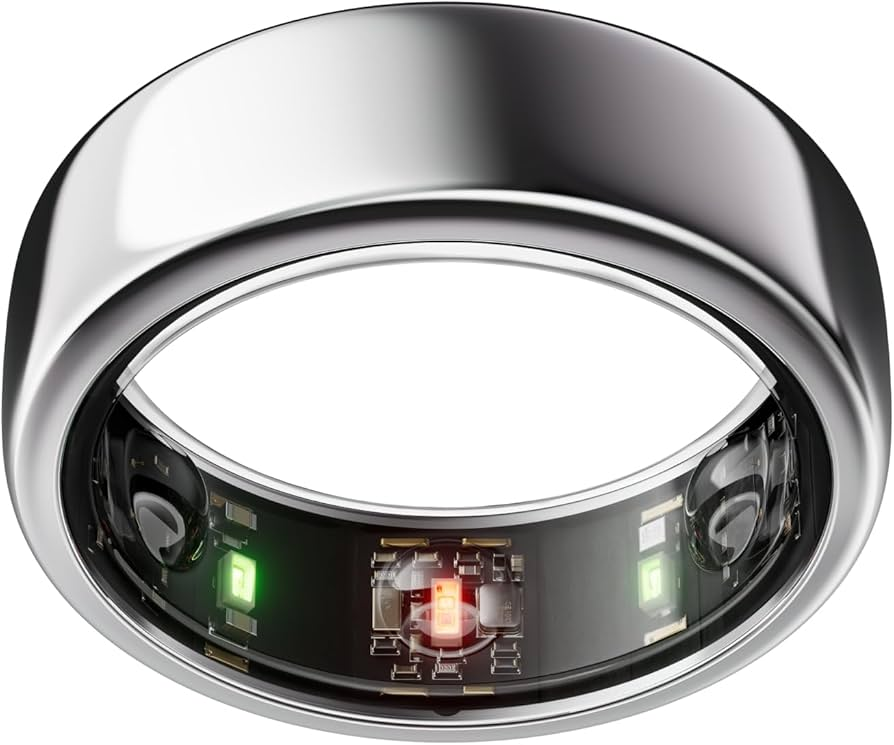
Image Credits: Amazon
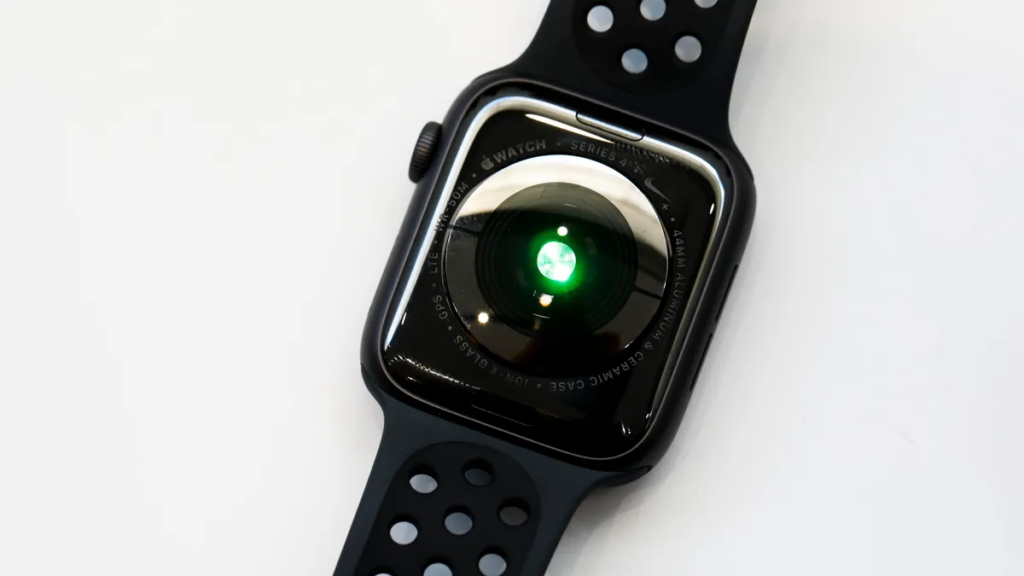
Image Credits: CNET
Yes, charging every night is annoying. But consider the alternative. Your sleep tracker went to bed without you the first night its battery died and you forgot to charge it. That night does not exist in your data. If it happens twice a week, your long-term trends are built on gaps you cannot see.
Accuracy costs battery. That is the deal. If understanding your sleep matters, take the deal.
When Battery Life Wins
If you travel constantly, forget to charge things, or simply want a passive long-term picture of your sleep trends, battery life is not laziness. It is a legitimate priority.
A two-week battery means the device is always on. Always collecting. Never missing a night because you forgot to plug in on a Tuesday. For long-term trend data, consistency of coverage often matters more than nightly precision. A rough picture every night beats a perfect picture four nights a week.
Garmin and Xiaomi Mi Band live here. They will not tell you much about your sleep architecture. But they will tell you whether your sleep is trending longer or shorter over months, and they will do it without ever asking anything of you.
Image Credits: Garmin
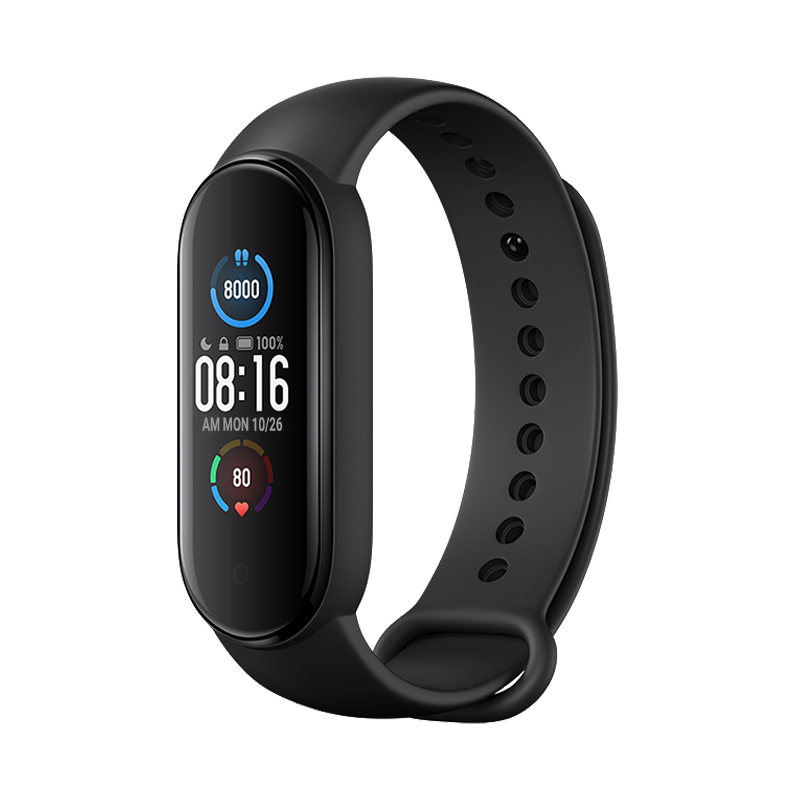
Image Credits: Mi
The mistake most people make: spending more does not automatically buy you accuracy.
A Garmin Fenix costs significantly more than a Xiaomi Mi Band. But its sleep staging accuracy sits far closer to the Mi Band than it does to the Oura.
Garmin prioritized battery life across its lineup, and that priority shaped the sleep tracking outcome regardless of price. Spending more buys you a better overall device. It does not always buy you better sleep data.
What People Get Wrong
Most people treat this as a quality decision. Better tracker, better data, done. They spend more money assuming the premium device is simply more capable across the board.
It is more capable. But not unconditionally.
A Garmin Fenix costs significantly more than a Xiaomi Mi Band. It has more features, better build quality, a far superior ecosystem. But its sleep staging accuracy is closer to the Mi Band than it is to the Oura. Because Garmin prioritized battery life across its lineup, and that priority shaped the sleep tracking outcome regardless of price.
Spending more does not automatically buy you accuracy. It buys you a better overall device that may or may not prioritize the specific feature you care about most.
The other mistake is ignoring the subscription trap in reverse. People choose no-subscription devices correctly, then unknowingly choose the wrong trade-off for their use case. They end up with a device that is free to use forever but never actually tells them what they need to know.
The Verdict
The most accurate sleep tracker is the one that was actually running while you slept.
If you need to understand your sleep, choose accuracy. Oura or Apple Watch. Charge accordingly.
If you need consistent no-fuss coverage, choose battery. Garmin or Mi Band. Accept the trade and track your trends.
If you want contactless and sleep in the same bed most nights, the Withings mat is genuinely underrated and almost nobody considers it.
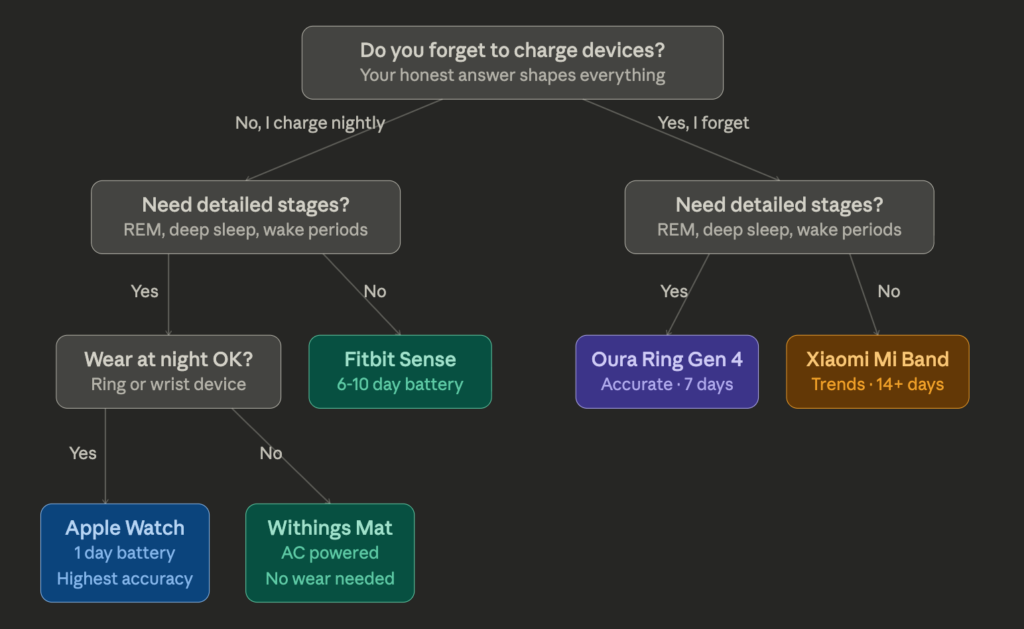
There is no wrong answer. There is only the honest question: what do you actually need from this data? Answer that first. Everything else follows.
Before You Buy
Spend five minutes answering three questions honestly.
- Do you consistently charge small devices, or do you forget?
- Do you need to know your sleep stages, or just whether your sleep is trending better or worse?
- And do you wear things to bed comfortably, or does a wrist device wake you up?
The answers will tell you more than any spec sheet.
Because in the end, the most accurate sleep tracker is the one that was actually running while you slept.

