


The price of a single ounce of gold soared by 64% last year, outpacing the returns of every major U.S. stock market index. It continues to climb this year and set a new record high of $5,400 in January, but it has since taken a breather and sits at around $4,500 as I write this.
Outside of global governments and central banks, most gold demand comes from investors who use it to hedge against economic and political uncertainty. While many of them still buy physical metal, an exchange-traded fund (ETF) like the SPDR Gold Shares ETF (GLD 1.33%) can be a cheaper and more convenient alternative.
Should you take this opportunity to invest in the shiny yellow metal while it’s trading below $5,000 per ounce?
Image source: Getty Images.
The ideal environment for higher gold prices
Gold is one of just eight precious metals, but unlike many of its peers, it isn’t very useful. Silver, for example, is used extensively in electronics manufacturing, while osmium and ruthenium are added to alloys to improve durability. However, gold is one of the only precious metals that is widely recognized as a true store of value.
Gold has a unique yellow color, and it’s highly malleable, so it can be reshaped to suit different storage requirements. Plus, it’s relatively scarce, with just 219,890 tons extracted from Earth throughout human history. However, it isn’t an income-producing asset, so its value is basically determined by what the next person is willing to pay. That’s why some famous investors, like Warren Buffett, steer clear of it.
That said, gold typically rises in value as paper currencies decline; in other words, it’s a reliable hedge against inflation. Until 1971, the U.S. was on the gold standard, which restricted the government’s ability to print money unless it had an equal amount of physical gold on hand. Money supply exploded higher after this mechanism was abandoned, leading to a sharp decline in the value of the U.S. dollar over the last five decades and an equally sharp increase in the value of gold in dollar terms.
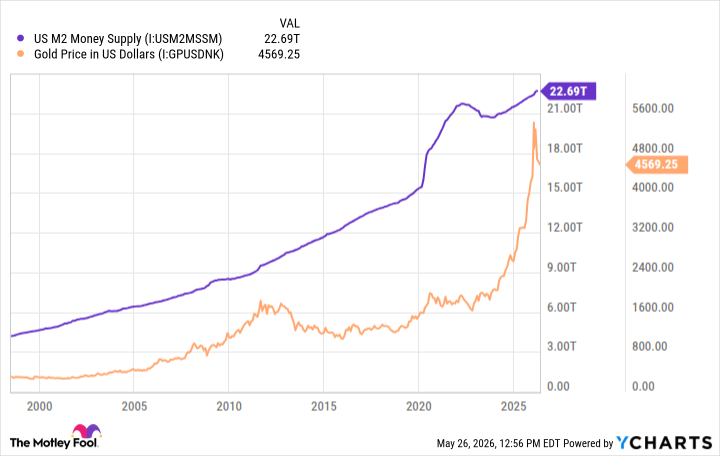
US M2 Money Supply data by YCharts.
The U.S. national debt currently stands at over $39 trillion, or roughly 122% of gross domestic product (GDP), and investors are increasingly worried that the government will resort to further devaluing the dollar to make the country’s finances more manageable. When the dollar falls, the price of goods, services, and labor typically rise, which increases the government’s tax base. In simpler terms, creating inflation allows the government to raise tax revenue in dollar terms, so it can sustain higher levels of debt.
But this can be a dangerous strategy. Printing too much money will erode the world’s faith in the dollar, so other countries won’t buy U.S. Treasury bonds (debt) unless they yield much higher interest rates, which would make future borrowing extremely expensive.
Since the U.S. government ran a $1.8 trillion budget deficit in fiscal 2025 (ended Sept. 30) and is on track for another trillion-dollar deficit in fiscal 2026, restraint doesn’t appear to be on the table. Therefore, it’s no surprise investors are piling into gold.
History suggests returns will be more modest from here
While conditions are seemingly perfect for more upside in gold, investors should manage their expectations, because annual returns of over 60% aren’t normal. In fact, the yellow metal has averaged an annual return of just 7.5% over the last 50 years, underperforming the S&P 500 stock market index, which returned 11.6% per year over the same period.

Today’s Change
(-1.33%) $-5.51
Current Price
$408.49
Key Data Points
Day’s Range
$404.30 – $409.25
52wk Range
$299.89 – $509.70
Volume
6.6M
A rising money supply and a declining dollar typically boost the value of every hard asset, not just gold. And since companies in the S&P 500 generate revenue and earnings, they can generate internal growth. Plus, many of them return money to shareholders through dividends and stock buybacks. For all of those reasons, the stock market typically outperforms precious metals like gold over the long run.
But that isn’t a reason to disregard gold entirely; it just means investors should be diversified. The yellow metal tends to do well when the world is flocking to safe-haven assets because of economic or political turmoil, which is often when the stock market is at its most volatile. Therefore, adding a small amount of gold to a stock portfolio can be very beneficial.
Buying the SPDR Gold Shares ETF can be a good alternative to buying physical metal. It directly tracks the performance of gold, and it can be bought and sold instantly on any major investing platform. Plus, its expense ratio of 0.4% means a $10,000 investment would incur an annual fee of just $40, which would be much cheaper than storing and insuring an equivalent amount of physical gold.

