


The luxury watch world didn’t wait long to make its first statement of the year. As 2026 begins, Rolex, Audemars Piguet, and Tudor have quietly but decisively raised prices across their collections, signaling a shift that collectors, retailers, and enthusiasts will feel almost immediately.
According to a WatchPro analysis published on January 1, all three Swiss watchmakers implemented price increases in both the United States and the United Kingdom, with average hikes hovering around seven percent. While annual price adjustments are nothing new in the high-end watch industry, the timing and scale of these increases point to mounting pressure from tariffs, inflation, currency fluctuations, and rising material costs, most notably gold.
For buyers who hoped the new year might bring stability after several turbulent pricing cycles, 2026 has instead opened with a clear reminder: prestige now comes at an even steeper premium.
Why Luxury Watch Prices Are Rising Again

This latest round of increases arrives amid a challenging global environment for Swiss watchmakers. Most significantly, a newly implemented 15 percent tariff on Swiss watch imports into the United States has forced brands to reassess their pricing strategies. When combined with record-high gold prices, persistent inflation, and a weakening U.S. dollar, these conditions create a near-perfect storm for retail price adjustments.
WatchPro’s pricing tracker, which monitors a basket of models from ten major Swiss brands across both the U.S. and U.K., shows that average prices rose by seven percent in the U.S. and five percent in the U.K. at the start of the year. While not every brand has acted yet, Rolex, Audemars Piguet, and Tudor moved early, perhaps anticipating further volatility ahead.
Notably, brands such as Patek Philippe, Omega, Breitling, Cartier, TAG Heuer, IWC, and Vacheron Constantin have not announced changes so far. Still, industry watchers remain cautious, aware that restraint at the start of the year does not always last.
Rolex Continues Its Predictable But Painful Annual Increases
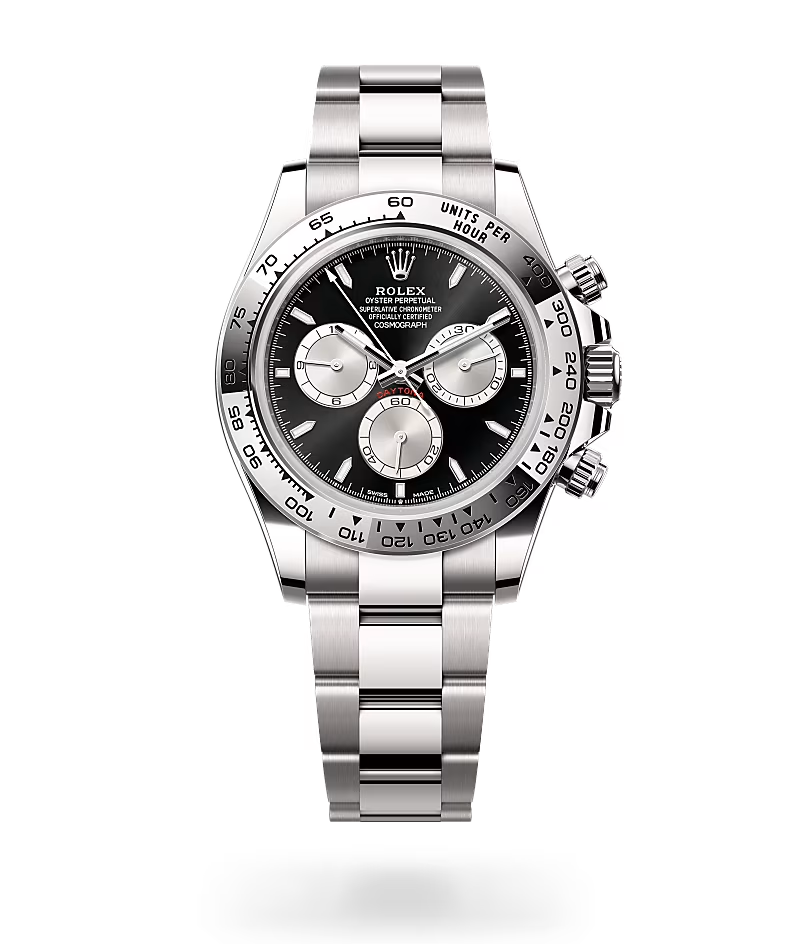
Rolex’s latest price hike may not surprise seasoned collectors, but its impact is difficult to ignore. Average Rolex prices climbed by seven percent in the U.S. and 5.2 percent in the U.K., reinforcing the Crown’s long-standing practice of adjusting prices at the beginning of each year and occasionally again mid-year.
The brand raised prices in January 2025 and followed with another increase in May, underscoring how closely it tracks currency movements and material costs. In 2026, however, one of Rolex’s most coveted models absorbed the most dramatic change.
The white-gold Cosmograph Daytona, a grail watch for many, saw its retail price rise from $51,800 in 2025 to $56,400 in 2026, excluding tax. The increase highlights Rolex’s confidence in sustained demand, particularly for precious-metal sports models that continue to command global attention.
Audemars Piguet Targets Demand Where It’s Strongest

Audemars Piguet followed a similar trajectory, implementing a 7.5 percent price increase in the U.S. and a more modest 2.5 percent rise in the U.K. However, AP’s approach appears more targeted than uniform.
According to WatchPro, Royal Oak models absorbed significantly larger increases than pieces from the CODE 11.59 collection—an adjustment that mirrors where demand and brand momentum remain strongest. Interestingly, the data shows little correlation between price hikes and material type or complication level, suggesting that desirability, rather than production cost alone, is driving AP’s pricing strategy.
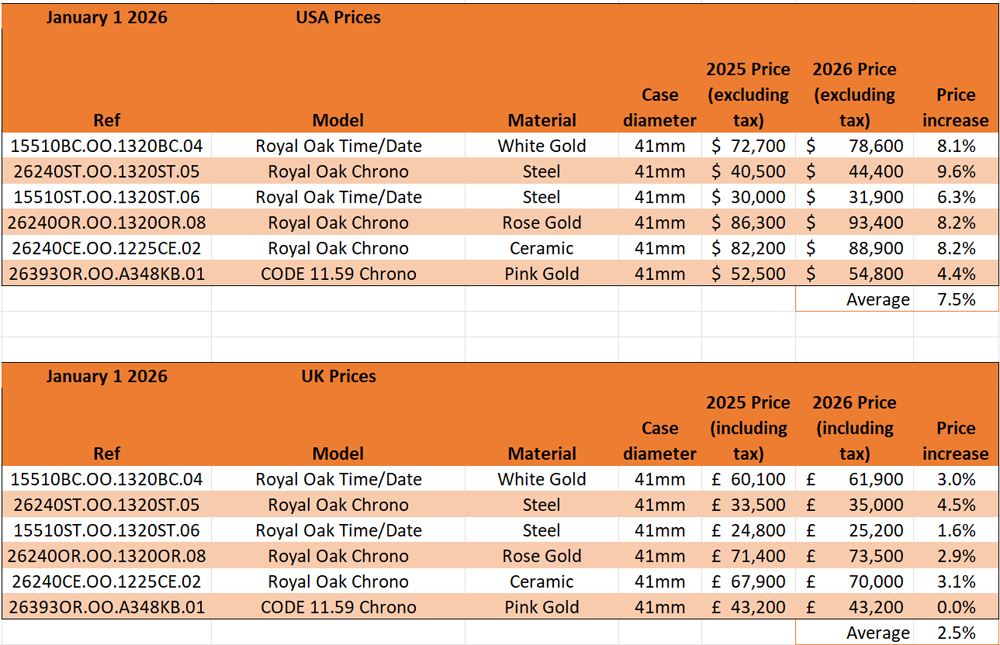
The steel Royal Oak Chronograph experienced the steepest adjustment, with its retail price climbing from $40,500 in 2025 to $44,400 in 2026. The move further cements the Royal Oak’s status not merely as a sports watch, but as a modern luxury icon whose value trajectory continues upward.
Tudor Softens the Blow, But Not Entirely

Compared with its sister brand, Rolex, Tudor adopted a slightly gentler approach. Prices rose by an average of 5.6 percent in the U.S. and 5.8 percent in the U.K.—still substantial, but more restrained. This moderation likely reflects Tudor’s positioning as a more accessible entry point into Swiss luxury.
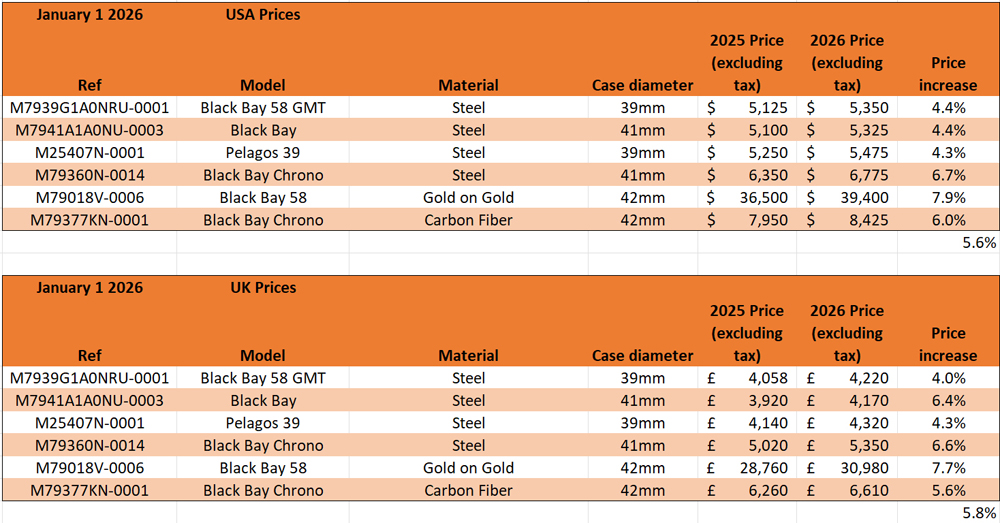
That said, Tudor was not immune to the pressures of rising material costs. The brand produces relatively few all-gold models, yet the gold-on-gold Black Bay 58 was hit hardest. Its retail price increased from $36,500 in 2025 to $39,400 in 2026, reinforcing the reality that even Tudor’s most value-driven offerings are feeling the strain.
For collectors who view Tudor as a refuge from aggressive pricing, the increases may sting, but they remain less severe than those seen at the top of the luxury hierarchy.
What This Means for Collectors and the Industry
Taken together, these early moves set the tone for how watch prices in 2026 may continue to evolve. While not every major brand has acted yet, Rolex, Audemars Piguet, and Tudor moving first could trigger a broader ripple effect across the industry. Historically, when market leaders raise prices, others tend to follow.
For collectors, the message is increasingly clear: waiting rarely pays off. As production costs climb and demand remains resilient, luxury watches are shifting further into investment territory. It’s less about impulse purchases and more about timing, access, and long-term value.
Whether additional watchmakers will follow suit remains to be seen. Still, if early January is any indication, watch prices in 2026 are already telling a familiar story where hesitation comes at a premium, and decisiveness carries its own reward.
Featured image: Rolex
What We Learned From Rolex CEO Jean-Frédéric Dufour At Dubai Watch Week 2025

