


As humanity seeks to expand its presence at and around the Moon, researchers have been hard at work fine-tuning small details that could make or break a lunar mission. One team says it has mathematically mapped out the most fuel-efficient route to the Moon yet.
According to a recent Astrodynamics paper, the new route lowers the costs of fuel consumption by 58.80 meters per second (m/s) compared to known calculations. For the analysis, the team employed the theory of functional connections, a mathematical framework that solves constrained optimization problems without requiring costly spaceflight computer simulations. The team behind the new study simulated 30 million different routes, comparing its calculations with hundreds of thousands of previous simulations from other groups.
“When it comes to space travel, every meter per second equates to a massive amount of fuel consumption,” Allan Kardec de Almeida Júnior, the study’s lead author and a researcher at the University of Coimbra in Portugal, said in a statement.
Trekking the skies
Needless to say, sending a spacecraft to the Moon isn’t as simple as asking Google Maps for the shortest route from your location to the nearest subway station. According to NASA, planning the flight path of spacecraft takes careful consideration of many factors, such as trajectory design, orbit reconstruction, tracking the spacecraft’s position and velocity, predicting its future path, and the tools navigators use to control the spacecraft once it’s in space.
Accordingly, the latest study isn’t a comprehensive solution to every requirement for spaceflight planning, but it does offer a decent starting point. The team began by mapping out a two-part trajectory from Earth’s orbit to the Moon. First, the spacecraft leaves Earth and enters the Moon’s orbit around the L1 Lagrange point, where the gravitational pull of the two bodies cancels out. That enables the spacecraft to naturally drift along a “variate,” a “natural trajectory” leading toward the L1 orbit while conserving fuel, the researchers explained.
Contrarian solutions
The team’s simulations showed that the most economical route contradicts existing models of the most efficient path. Current models assume that it’s better to enter the variate at a branch closest to Earth, but the new simulations suggest otherwise: that it was better to enter from a route closer to the Moon.
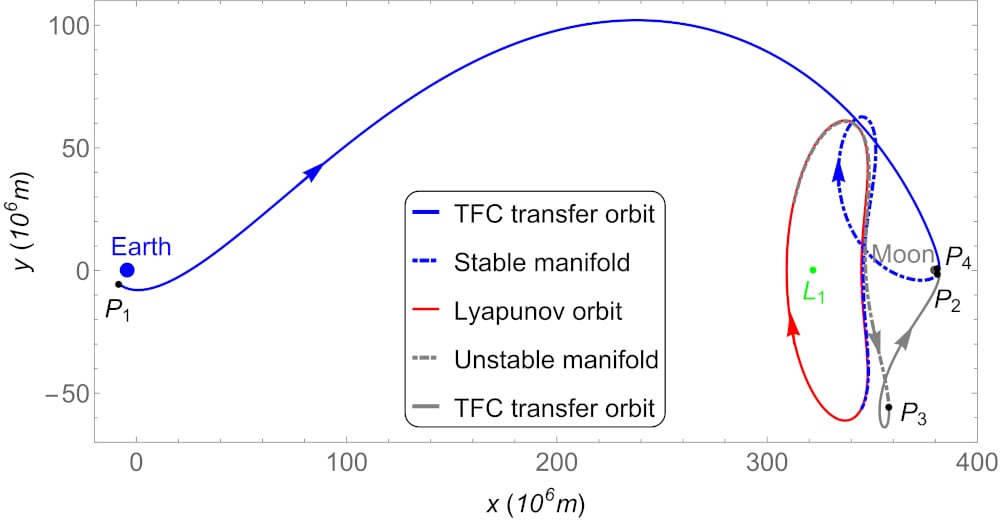
In fact, this route lowers the chances of interruptions in communication, said Vitor Martins de Oliveira, the study’s co-author and a postdoctoral researcher at the University of Coimbra. “The Artemis 2 mission, for example, lost communication with Earth for a while because it was directly behind the moon,” he added. “The orbit we propose is a solution that maintains uninterrupted communication.”
More work to be done
Again, planning for a real mission would require more complex procedures. To be clear, the researchers aren’t claiming that their model can single-handedly decide everything. For one, the simulations only took into account the gravity of the Moon and Earth, not other celestial bodies. Their proposed route also isn’t necessarily the cheapest, although it is the most cost-efficient.
That said, the team is still confident that this method could be leveraged by mission planners in performing large numbers of simulations to get an idea of what the best trajectory could be. Of course, each trajectory would have to be tailored to the details of that particular launch.
“For example, if we simulate the mission’s launch date as December 23, we’ll obtain results valid only for a mission launched on that date,” Almeida said. At the same time, this also means that the method is quite flexible; it’s “something that could be adopted more widely going forward,” he added.
Related article: Astronomer Finds a Shortcut to Mars by Following an Asteroid’s Journey Through Space

