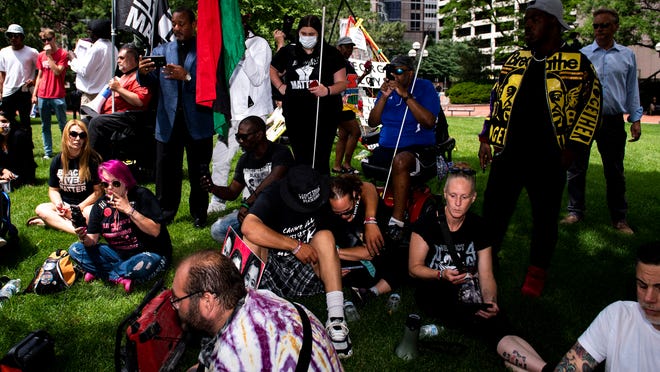
- New Hidden Common Ground survey highlights stark partisan differences over issues of race.
- Americans of all political persuasions agree that overcoming racism is more important than ever.
- Republicans are less likely to see racism as barrier to participation in political process.
- Overwhelming majority of Democrats believe overcoming racism requires systemic change.
WASHINGTON – Americans of all political persuasions overwhelmingly agree that overcoming racism is now more important than ever.
But views on racism’s impact reflect the nation’s deep political divide.
A new Hidden Common Ground survey by Public Agenda and USA TODAY shows stark partisan differences over whether racism is a barrier to participation in the political process and whether addressing racism requires systemic change.
A majority of Democrats, independents and politically unaffiliated Americans surveyed say racism can make it difficult for some Americans to participate in civic and political life. But an overwhelming number of Republicans say all Americans have an equal opportunity to participate regardless of race.
“For sure, it’s a barrier,” Haleigh Mooney, a 26-year-old Democrat and freelance artist in Orlando, Fla., said in a follow-up interview with USA TODAY.
Frank Dorr, 61, a Republican from New Gloucester, Maine, doesn’t see race as an impediment to political participation.
“I’m a person who believes that someone’s qualified, that’s all that matters,” said Dorr, a network engineer. “That’s the most important thing. If you’re qualified to do something, you should do it. So I can’t see why that would be a barrier (to) politics or any other occupation.”
Racial justice in the workplace: In-depth look at diversity’s struggle to crack corporate boardrooms
More:About the Hidden Common Ground poll
The differences are even more striking on whether systemic change is needed.
An overwhelming majority of Democrats (88%) agree that overcoming racism requires more than changing people’s attitudes, it requires fundamental changes in laws and institutions. Strong majorities of independents (67%) and politically unaffiliated Americans (70%) share that view.
In contrast, just under half of Republicans (46%) believe that to be the case. The 42-percentage point difference between Republicans and Democrats is one of the largest partisan gaps in the survey.
“I think the gap testifies to the fact that the U.S. is politically broken – I think it has been for a long time,” said Marcus Board, an assistant professor in the Department of African American Studies at Georgetown University.
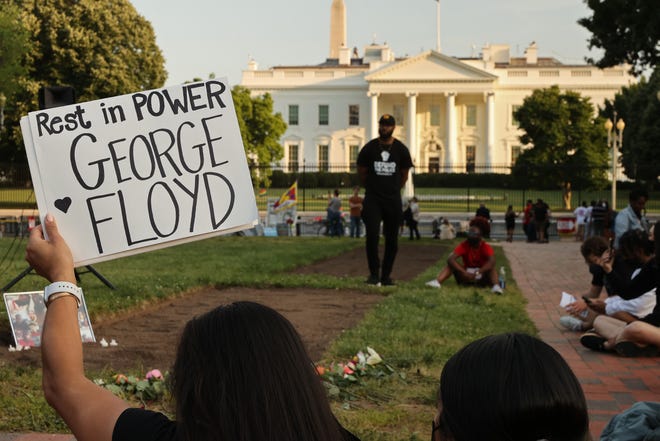
America’s racial divisions catapulted into the headlines over the past year, with the rise of the Black Lives Matter movement and protesters taking to the streets in cities across the country to demand racial justice following several high-profile police killings of Black Americans, such as George Floyd in Minneapolis and Breonna Taylor in Louisville.
But the biggest divisions in how Americans see the issue are not among race but party affiliation.
Three-quarters of Americans strongly or somewhat agree that overcoming racism is now more important than ever. There are only modest differences of opinion by race on the question, with 83% of Black Americans, 74% of white Americans and 72% of Latino Americans agreeing with the proposition.
The gaps are wider when the data are broken down by partisanship. An overwhelming 91% of Democrats say overcoming racism is now more important than ever, compared to smaller majorities of Republicans (60%), independents (71%) and politically unaffiliated people (76%).
Partisan differences are starker on questions about the impact of racism on political participation.
A majority of Democrats (58%) and similar percentages of independents and politically unaffiliated people say racism can make it difficult for some Americans to participate in civic and political life. But only 20% of Republicans agree. The remaining 80 percent of Republicans say all Americans have an equal opportunity to participate regardless of race.
“This data shows what we have long said – rooting out racism and achieving the American dream of freedom and opportunity for all is something that should transcend partisan divides,” said Wade Henderson, interim president and chief executive officer of The Leadership Conference on Civil and Human Rights.
“We can all agree that every individual deserves the opportunity to go to work, raise their families, and live their lives free from prejudice, discrimination, or antagonism based on the color of their skin,” Henderson said.
“Yet the harsh reality is that people and institutions continue to perpetuate racism and white supremacy, inflicting tremendous harm on communities of color across the country. We can and we must continue to expose and root out racism in order to achieve our American ideals.”
Exclusive: Stark divide on race, policing emerges since George Floyd’s death, USA TODAY/Ipsos Poll shows
Racial bias is always going to be a problem, said Payton Wellington, 22, who lives in San Antonio, Texas, and holds apolitical views.
“It’s been unintentionally passed through generations,” Wellington said.
Mary Sheridan, 77, an independent and a retiree from St. Clair Shores, Mich., doesn’t see racism as a barrier to voting.
“I don’t think racism has anything to do with voting,” Sheridan said. “People have had the right to vote of every race. If only you’re a citizen of the country, you can vote.”
Racism’s toll:Racial discrimination has cost American economy trillions. Tulsa, massacres just a start.
On the question of whether systemic change is needed to address racism, differences by political affiliation are once again more substantial than are differences by race.
Eighty-one percent of Black Americans agree that overcoming racism requires fundamental changes, compared with 65% of white Americans and 73% of Latino Americans.
Stafford Keels, 53, a retired Democrat who lives in Florence, S.C., said new laws enacted by at least 17 states that restrict voting access need to be overturned.
“If they’re not overturned, then it’s going to be pretty much that a lot of the same people are still in power,” he said. “We can’t have change if we aren’t able to vote.”
Panu Lansiri, a Democrat who works as a treatment plant operator in Chicago, said new voting restrictions appear to be targeting Blacks, Hispanics and Asians and other demographic groups who may not work traditional 9-to-5 shifts and would benefit from expanding voting hours.
“It just seems that they’re trying to narrow away with where the Republicans can be able to keep control by just keeping certain demographics out,” said Lansiri, 42.
Stephanie Johnson, 68, who lives in Dallas and views herself as a Republican on some issues and an independent on others, said the partisan fights over voting restrictions like those under consideration in Texas are confusing.
“When the Republicans talk about it, it seems right – it doesn’t seem that bad, you know?” said Johnson, who is retired. “And when the Democrats talk about it, it seems terrible. … I don’t see, really, the real big problem of it because it doesn’t seem like it’s all bad.”
Board, the Georgetown assistant professor, said the political parties aren’t doing a good enough job of educating voters or giving them a clear direction on how to accomplish the changes that people are calling for.
“A lot of that work is being done through the social justice movement,” he said. “Social movement work is actually bridging the gap between what vulnerable communities need in this country – from systemic change all the way down to interpersonal change.
“The parties – they have a whole bunch of people who’ve done a great job of identifying people who want these things. But the information, the education, the knowledge and the access are actually being driven on the ground by local community organizers.”
Race in America:Juneteenth is a celebration of freedom from slavery. But it didn’t mean freedom for all.
The poll shows that Americans also are wary of engaging on the topic of race.
Just over half (56%) say that sometimes it is best to ignore race altogether because it is too divisive. While four in 10 Democrats (44%) feel that way, a significantly greater share of Republicans (65%) do. The same holds true for Black (52%), white (55%) and Latino Americans (57%).
Sixty-one percent of Americans feel that accusing someone of racism is often a way to silence debate. While more white Americans (63%) and Latino Americans (67%) share that view, more than four in 10 Black Americans (44%) agree.
Seventy-three percent of Republicans express that view, compared to just 51% of Democrats, 61% of independents and 60% of politically unaffiliated people.
Perhaps more hopeful for the prospects of productively addressing racism: Two-thirds of Americans believe that most people have good intentions even if they are sometimes racially biased. That includes statistically identical shares of Black, white and Latino Americans, as well as Republicans, Democrats and independents.
The online poll of 1,260 Americans 18 years and older was taken May 24-27.
Michael Collins covers the White House. Follow him on Twitter @mcollinsNEWS.
Reach Chelsey Cox on Twitter @therealco.