


Saudi Arabia has just unveiled the NEOM Sky Stadium, and the world is already looking up in awe. Suspended 350 metres (about 1,150 feet) above the desert floor, this arena is part of the sprawling The Line mega-city and carries a price tag of roughly $1 billion USD. Beyond its staggering scale, the stadium is a statement that embodies ambition, sport, architecture, and Saudi Arabia’s global vision.
Yet the NEOM Sky Stadium is more than just a venue for football. It serves as a central pillar in the Kingdom’s bid to host the 2034 FIFA World Cup, demonstrating how sport, design, and sustainability can intersect seamlessly. With a seating capacity of 46,000, the stadium promises panoramic views, carbon-neutral operations, and full smart-city integration.
Already, architects and sports business insiders are drawing comparisons to other visionary projects—from the Emirates’ desert ski resort to China’s floating skyscrapers. Clearly, the NEOM Sky Stadium isn’t just a structure; it’s a symbol of how bold design and forward-thinking ambition can transform both sport and urban planning on a global stage.
NEOM Sky Stadium: Saudi Arabia’s Daring Leap Into the Future

The scale of the NEOM Sky Stadium is nothing short of breathtaking. Rather than simply resting above the city, it is positioned within the vertical spine of The Line, fully integrated into the futuristic urban landscape. The concept of “a stadium in the sky” comes alive here, as elevation itself becomes part of the spectator experience. Seats offer views not only of the game but also of the city’s mirrored walls, creating the impression of floating above the action. Designers deliberately play with contrasts, weight and suspension, mass and void, to make every angle feel dynamic and immersive.
Sustainability lies at the core of the project. The stadium is planned to operate entirely on renewable energy, drawing from solar and wind resources, in line with Saudi Arabia’s Vision 2030 initiative to reduce oil dependency. High-speed electric transport will usher fans along a seamless path into the arena. Inside, biophilic design principles merge indoor comfort with the harsh desert climate, creating a balance between nature and architecture. Yet questions remain: how will temperatures be controlled 350 metres above the ground, and what effect will the mirrored façade have on local bird migration?
The engineering demands are immense. Maintaining structural stability at this height requires pioneering solutions for seismic and wind loads. Access must accommodate both vertical and horizontal movement, combining elevators, pods, and high-speed rail to ensure smooth circulation. Every element, from the roof and seating bowl to the façade, must harmonize elegance with safety. Experts note that stacking 46,000 seats in a suspended environment is unprecedented, making the NEOM Sky Stadium not just a venue, but a bold statement in architectural innovation and human ambition.
Sport, Architecture, and Saudi Arabia’s Global Pivot
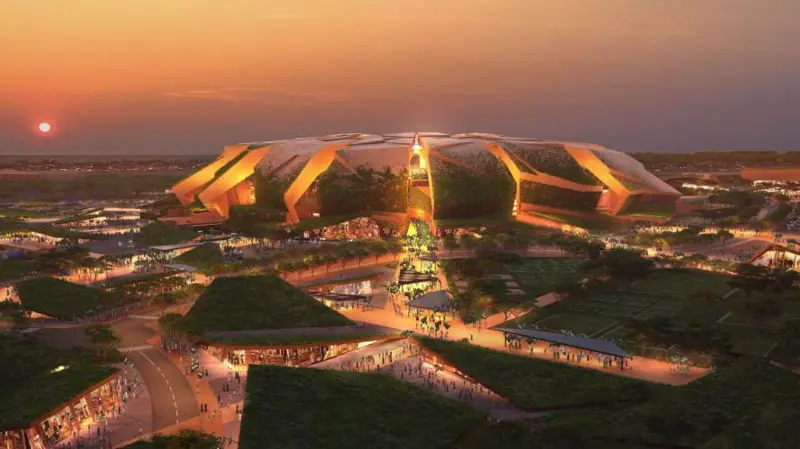
The Sky Stadium sits at the intersection of sport diplomacy and national branding. It is a cornerstone of Saudi Arabia’s push to host the 2034 FIFA World Cup, one of the world’s largest sporting events. Official bids list the arena among 15 stadiums across five host cities, eight of which are newly constructed.
Beyond football, the stadium embodies the broader goals of Saudi Arabia’s Vision 2030 agenda. It signals the kingdom’s commitment to economic diversification, spanning tourism, sports, entertainment, and urban innovation. The venue is designed not just for the World Cup but for life afterward: concerts, professional football, esports, and global events. In this sense, it functions as a city anchor rather than a one-time showcase.
Yet not everyone is convinced. Critics describe The Line as a “mirrored maze,” raising questions about human-rights concerns related to evictions and labor. Others debate whether the stadium’s elevated format is more symbolic than practical. Many of the viral images depicting the floating arena are, in fact, AI renders, further blurring perception and reality.
Still, Saudi officials maintain a clear vision. “No change in scale for The Line,” a minister affirmed in 2024, referencing a projected population of nine million by 2045. In this context, the Sky Stadium emerges as both emblem and experiment—a fusion of architecture as aspiration and sport as spectacle.
The Road to 2034: NEOM Sky Stadium and the Future of Global Events

If completed as envisioned, the NEOM Sky Stadium could fundamentally reshape how we imagine sports infrastructure. Elevation becomes ambience. Integration becomes seamless mobility. Renewable energy systems set a new standard. Other cities will inevitably look to this project for lessons in sustainability, engineering, and fan experience.
By 2032, when the venue opens ahead of the World Cup, the world will be watching closely. Will it operate flawlessly? Can it truly accommodate 46,000 spectators as planned? If successful, the stadium will do more than host matches. It could redefine how we experience football on a global scale.
Moreover, its impact may extend beyond sport. Smart cities, vertical planning, and transit-rich design all converge here. In this way, the Sky Stadium could become a blueprint for future urban development, where function meets form high above the ground.
Featured image: Ai-Generated
Game On: The Ultimate Guide To 2025’s Top Sports Destinations


