


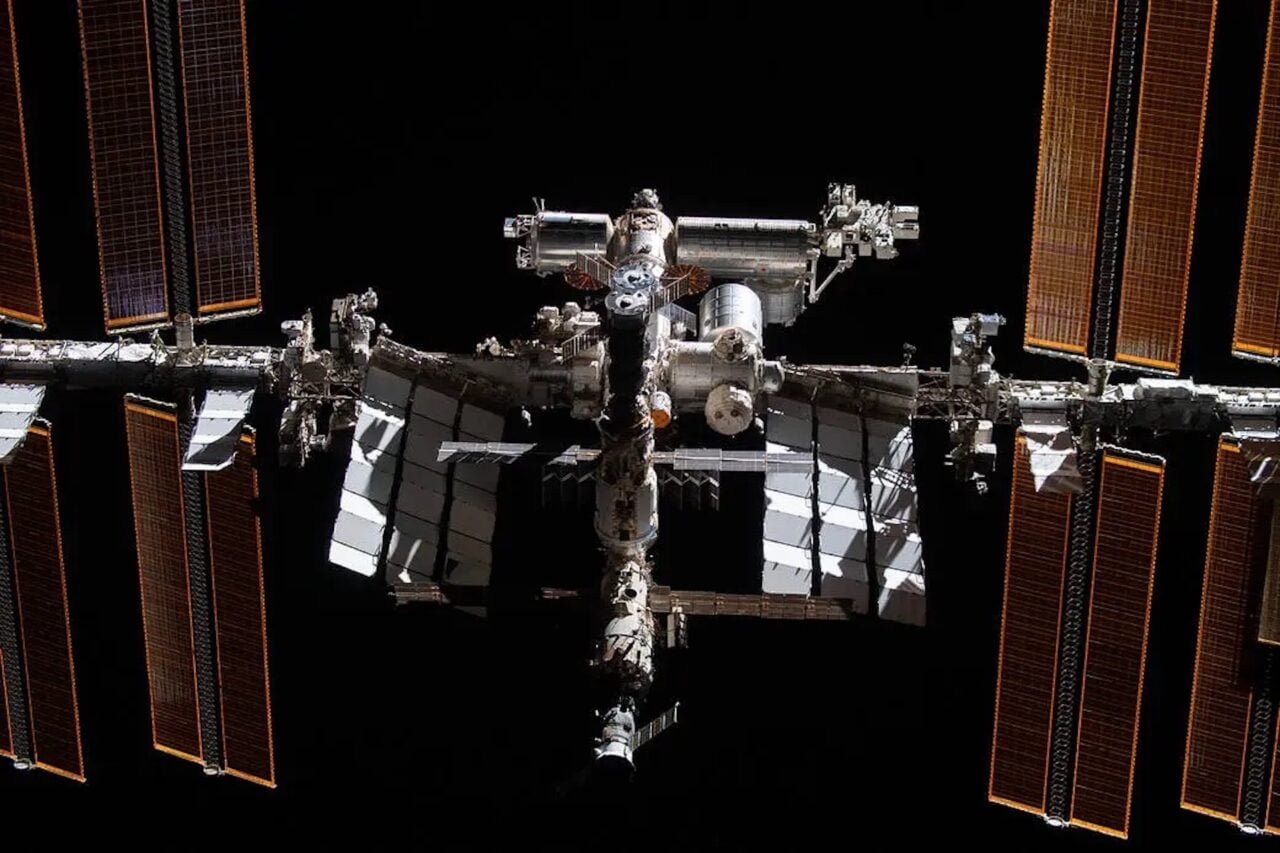
The dreaded air leak on the International Space Station (ISS) has gotten so bad that Russian cosmonauts were preparing to use a saw to access a suspected leak area in the Zvezda module’s transfer tunnel.
NASA released an update on the long-running leak from the Russian segment of the space station, revealing details of the plan that prompted five crew members to shelter in place on Friday, June 5. According to NASA, Roscosmos had come up with a plan that involved cutting a bracket to better access an area that may have been contributing to the leak.
This new strategy “could have resulted in elevated risk to the structure in the area,” NASA wrote. The Russian space agency put its plan on hold for now to gather more data and further inspect the suspected areas.
The only way out is through
Roscosmos first reported a leak on board the ISS in September 2019, tracing it to the vestibule (named PrK) that connects a docking port to the Russian Zvezda module. For nearly seven years, the leak has not only persisted but has also grown more severe.
Last week, the Russian space agency identified new suspected leak areas in PrK and noted an increase of the previous leak rate from a pound of air per day to two pounds. In response, Roscosmos put together a more aggressive strategy to tackle the growing air leak.
On Friday morning, NASA mission control ordered four Crew 12 astronauts (NASA’s Jessica Meir, Jack Hathaway, the European Space Agency’s Sophie Adenot, and Russian cosmonaut Andrey Fedyaev) as well as NASA astronaut Chris Williams to shelter inside the SpaceX Dragon spacecraft docked to the ISS.
Inside the space station, two Russian cosmonauts, Sergey Kud-Sverchkov and Sergei Mikaev, were in charge of carrying out the repair efforts on the PrK transfer tunnel in the Zvezda service module. NASA officials reportedly disagreed with the method proposed by Roscosmos to use a saw to gain better access to the crack leaking air, Reuters reported.
NASA reversed its safe-haven orders around two hours later after Roscosmos paused its efforts to repair the leak. The Russian space agency will conduct additional measurements and data assessment, including inspection of suspected areas and reviewing other areas where sealant was previously applied, before taking further steps.
NASA wrote that it “strongly supported that decision,” perhaps breathing a sigh of relief that Roscosmos was no longer planning on hacking through the space station.
The air leak lives
Now that the cosmonauts have put down their saw, the air leak is unfortunately still alive and well. Roscosmos did note that one of two suspected cracks on the service module was sealed, although upcoming measurements could probably confirm that.
The bigger issue is that NASA and Roscosmos can’t seem to agree on a strategy to tackle the growing air leak on board the ISS. A 2024 report by NASA’s Office of Inspector General also highlighted that the two space agencies can’t seem to agree on the point at which the leak should be considered unsustainable.
Roscosmos has previously stated that the air leak poses no threat to the safety of the ISS crew. At some point, however, the two space agencies should be prepared to permanently close off the hatch to the service module in order to minimize the amount of air lost and isolate the leak itself from the rest of the space station.
Until then, there will likely be more attempts to repair the pesky leak; hopefully they don’t involve an aggressive remodeling of the space station.

