


With a firm handshake, say hello to Business of Beauty—an exclusive, inside look at each of the incomparable journeys of entrepreneurs of color in the beauty industry. This series is anything but business as usual. It’s a raw, honest look at the unique and often overlooked challenges that people of color face when starting their own beauty brand. Each founder will reveal the biggest hurdles they’ve overcome, their internal struggles, and their deepest thoughts about what needs to change in the beauty industry (and the world, really) to make it a more inclusive space for everyone.
This time around, we’re diving deep with former beauty journalist and brand founder Brianna Arps. Arps credits her extensive background in investigative journalism for giving her all the tools she needed to start her own fragrance brand, Moodeaux. Read all about her experience below.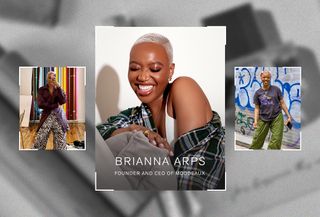
It’s rare I get to chat with a fellow beauty journalist, but I was in for a treat this Black Business Month. (While the month of August is an incredible time to celebrate Black and Brown entrepreneurs, it’s important to support them year-round too!) Luckily, I got the chance to get to know Moodeaux founder Brianna Arps. Arps has created something very special. Moodeaux is a fragrance brand rooted in self-care, authenticity, confidence, and comfort. Not sure how those things relate? Trust me—you can smell it in every mood-boosting scent. They’re all an instant dopamine hit, and they’ll leave you feeling so uplifted the rest of the day. My favorite is Brand New.
The idea was born out of a turbulent time in her life, so Arps decided to take a risk and completely carve her own path, uplifting other Black and Brown entrepreneurs along the way. This was one of my favorite interviews to date, as Arps dug deep about why Black people are underrepresented in the fragrance category, what we can do to change it, and how the loss of a job turned into a hugely successful career pivot. For our full conversation, keep reading below.
I would love to talk about your background as a journalist. How do you think that shaped your path, and how did it help open the door for you to start Moodeaux?
My time in media has definitely played a pivotal part in me launching this brand. I think a lot of people don’t realize the value of transferable skills—just in any industry. Having been on the inside, [it made me more] aware of the beauty industry and what it was missing. It was a good chance for me to plug a hole, and also, I love to storytell. I think a winning formula that we’ve been able to capitalize on at Moodeaux is not only do we have a compelling brand story, but I also know how to tell a really cool product story. I don’t think that I would be here or Moodeaux would exist in the way in which it does without having had a career in media. I really leaned on those transferable skills for storytelling but also fine-tuned and sharpened my inquisitive nature. I’m curious—I love to ask questions.
That’s just what we do as journalists. We talk to people, and we’re able to have productive conversations. All of that has been really helpful in not only determining how we’re going to market this brand and how we’re going to bring it to fruition but also how I ask questions to my manufacturers and how we’re going to talk to our customers and find ways in which they feel like the industry is not serving them. I wouldn’t be here without my first love of storytelling and just connecting with people.
What planted the seed in your mind that you wanted to start a fragrance brand?
My last full-time role, I was coming out of the gym, and I got this random meeting put on my calendar. I thought, “Oh, that’s weird,” but I knew the person who put it and though she might just want to catch up. Come to find out, I was sitting in HR’s office waiting in line alongside 40 other people who also lost their job that day, and it completely blindsided me. All I ever wanted to do was tell stories and become a beauty writer. It felt like my world just crashed, and I had an identity crisis. I wasn’t exactly sure if I was going to go back into media or if there was some other way that I could help people pursue and find their purpose. I’ve always loved fragrance. Obviously, I’ve always loved beauty, but fragrance in particular. During that time, I was really low, and it was my beauty routine that brought a sense of normalcy to my life.
It wasn’t until I did more research around the scientific connection between our sense of smell, memory, and emotion, etc., that I realized that this could actually be a tool for wellness—not only helping me just feel better but also just to manifest the life of my dreams and to wear products that I truly believe in and not products that perhaps other editors were putting me on to or other brands. It just really changed my way of thinking. I also realized that there’s a lack of mainstream attention toward Black-owned fragrance labels who are aspiring to compete with the Chanels, Louis Vuittons, Le Labos, and Diptiques [of the world]. I think it really made for a perfect storm—losing my job and then rediscovering my love of fragrance and honing in on that. I decided that was the time. I clearly had a lot of time on my hands being laid off, but I thought, “Now is the perfect time to work on something that I truly believe in.” That was back in October of 2018, and then we launched officially on October 1, 2021, so [it was] almost three years to the date, and we’ve been rocking and rolling ever since.
I love that! It’s so fun talking to a fellow beauty journalist, and I’m glad you found your way after a shake-up like that. Talk to me about the meaning of the name Moodeaux. How did that come about?
Fun fact: We weren’t always Moodeaux. We were initially building a brand called Moody Beauty. From the beginning, I knew that I wanted to focus on moods and feelings and evoking memories. I knew that was going to be really important, and this was a newer concept. It was 2018, and people weren’t really talking about self-care or beauty products in this particular way. In a lot of ways, we were ahead of that curve, and I knew there would be some sort of shift. We unfortunately didn’t get the name Moody Beauty. Someone beat us out for the trademark by two weeks, and I remember sliding down the wall, crying [laughs].
When I was thinking about it, I thought, “Okay, this is Moody Beauty times two. What are ways that you can say ‘two’ in other languages?” I thought about the French word “deux” and put an “A” in there to form Moodeaux. It just had some sort of mysterious nature.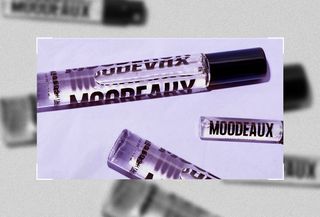
What do you want people to think of when they think of Moodeaux?
I really want people to feel and see themselves within the brand. Going back to my journalism days when I was writing about fragrance brands, unfortunately, I always had to ask, Where were we Black and Brown people when it came to celebrity spokespeople or models? Now, you have Lupita [Nyong’o] and Zendaya, but before, we weren’t even in fragrance advertising. Yet Black and Brown people continuously have overindexed in terms of spend compared to our white counterparts. It’s like we’re this hidden figure that is driving the sales and success for these brands, yet we don’t see ourselves. I knew that was going to be really important for us.
I want people to feel seen and represented, but I also want people to feel invited to accessorize their own mood. I want people to trust their own nose, and we want to help train people’s noses to identify things that they like and not necessarily something that TikTok is telling them they should like or the beauty industry in general. We want people to really understand that at the core of self-care is self-expression, and it all starts with them. I want them to be able to accessorize their mood and, in turn, how they feel and manifest the life of their dreams on their own terms.
I want to go back to your earlier point about Black and Brown folks being underrepresented in the fragrance category. I’d love to hear more of your thoughts on that because I agree. Why do you think that is, and what can we do to change it?
I think it’s layered. One of the first things I always tell people is that we have always been here—not just as consumers. I lived in New York for seven years, which is where the idea for Moodeaux came to me. You walk down the street in Harlem. There’s an incense man, an oil man, and a candle man. We have long been fragrance entrepreneurs, yet we are not respected as artisans and creators at the highest of levels because we don’t come from Grasse, France, or because we’re not European. Make no mistake—when you go to other parts of the world, we are respected for our noses, and we are respected for our creativity.
I feel like there’s just been an undercurrent of that lack of respect that has then turned into a lack of representation, and it just has trickled down to what we see on shelves. We’re not inspired to pursue these types of fields from the school system, and then it trickles down to the fact that our products don’t end up on shelves. If someone would have told me in high school that, if I really studied and worked hard at chemistry, I could have became a cosmetic scientist and then a perfumer and eventually have my own line… That pipeline does not exist for us.
A lack of access has led to the lack of representation, and it’s really a passion point for me to show people that it isn’t necessarily where you start. It’s where you finish. I’m hoping that, through Moodeaux, people are inspired to try something different—even if it’s beauty.
That leads me to my next question. I would love to talk a bit more about Black in Fragrance, your philanthropic arm. Can you tell me about that and how it ties in?
The rationale behind Black in Fragrance is really rallying everyone who has a stake in this industry, from Black perfumers and fragrance entrepreneurs to the retailers to media like yourself to organizations such as The Fragrance Foundation. We want to rally everyone together under the guise that we know there’s an issue here. How can we foster greater awareness about the issue and create viable solutions for generations to come? We launched it at the same time that we launched Moodeaux because I felt like I didn’t necessarily need to reach a certain pinnacle [of success] to help people. How come people feel like, “Now that I’m Bill Gates, I’m going to have a foundation”? If I’m learning something, why not reach to the left and to the right of me and help someone along their journey as well? It doesn’t hurt or hinder me to give what I can when I can. [Black in Fragrance is on a hiatus], but while we were active, we were fortunate enough to provide three micro-grants for three other Black founders in the fragrance space.

