


As he has racked up a string of endorsements, former state Treasurer Alexi Giannoulias has also been collecting campaign cash and he holds a significant financial advantage over three rivals with little more than a year until the Democratic primary for secretary of state, campaign finance records showed.
On the Republican side, the mandated reports covering the second quarter of 2021, from April through June, show the three Republican announced candidates for governor to challenge billionaire Democratic Gov. J.B. Pritzker’s expected reelection bid spent heavily as they sought to build their fundraising operations.
Illinois State Sen. Darren Bailey, R-Xenia, announced Monday that he will run for governor in 2022.
The Democratic contest for secretary of state, to replace retiring longtime officeholder Jesse White, and the GOP race for the governor’s nomination are the marquee statewide races on next year’s primary ballot with the election moved to June 28 to accommodate delayed federal census results for drawing new congressional districts.
Giannoulias, who was state treasurer from 2007 to 2011 and an unsuccessful U.S. Senate candidate in 2010, has been the early leader in gathering endorsements, including from labor unions and influential officeholders including U.S. Rep. Jesús “Chuy” García.
People are also reading…
The union endorsements were reflected in Giannoulias’ fundraising, receiving $59,900 in contributions from various entities of the Laborers’ International Union, the Teamsters and the Service Employees International Union on the way to raising nearly $860,000 in the second quarter plus another $91,900 since June 30.
After he started the quarter with more than $2.1 million in cash available, the reports showed Giannoulias had more than $2.9 million at the start of July.
Chicago City Clerk Anna Valencia and Aldermen Pat Dowell, 3rd, and David Moore, 17th, are also vying with Giannoulias for the Democratic nomination.
Valencia reported raising more than $226,000 and had nearly $594,000 in cash available on July 1, the reports showed. Dowell raised nearly $400,000 and had $416,381 available while Moore reported raising more than $16,200 and had $64,219 in cash on hand.
In the GOP race for governor, state Sen. Darren Bailey of Downstate Xenia reported $490,700 in cash on hand on July 1, raising more than $165,000 but spending nearly $185,000. Businessman Gary Rabine of Burr Ridge listed $287,325 in available money after raising nearly $345,000 while spending nearly $295,000. Former state Sen. Paul Schimpf of Waterloo raised $83,235 in the quarter but spent almost $137,000, leaving him with $116,280 in available cash, reports showed.

Rabine
Since July 1, Rabine reported raising another $32,500 while Schimpf added another $2,000 in contributions.
Pritzker has not formally announced seeking a second term, but he put $35 million of his own money into his campaign fund in March. A wealthy heir to the Hyatt Hotels fortune and worth $3.5 billion, according to Forbes, Pritzker spent $171 million of his own money to defeat one-term Republican Bruce Rauner in 2018. He reported nearly $32.9 million in cash available on July 1.

Gov. J.B. Pritzker speaks to the media at the formal opening of the K-Town Business Centre on West Polk Street in Chicago, June 28.
Among the two party organizations, Democrats raised only $5,000 in the quarter as they awaited a Federal Election Commission ruling, issued Thursday, which prevented the state party’s new chair, U.S. Rep. Robin Kelly of Matteson, from raising or spending money for state and local races. As a member of Congress, Kelly is bound by federal campaign limits, which are more restrictive than state campaign laws.
The FEC ruled Kelly could keep the title but Democrats will have to set up a panel independent of Kelly to raise and direct the spending on state contests.
That new panel had $2.4 million to work with at the start of July, while Illinois Republicans — pointing at the fundraising issues surrounding Kelly — had $167,759 in cash on hand in the party’s state account. Of the $131,270 it raised, about $50,000 was attributable to food distributor Dot Foods, where state GOP Chair Don Tracy of Springfield is part of the company’s founding family.
On the federal level, U.S. Rep. Adam Kinzinger from Channahon, who has become increasingly critical of House GOP leadership and was one of 10 Republicans to support former President Donald Trump’s second impeachment, reported raising $806,475 in the second quarter. He began July with more than $3 million in his campaign.

Rep. Adam Kinzinger, R-Ill., speaks to the media, Wednesday, March 6, 2019, at the White House in Washington.
Among a group of Republicans looking to challenge Kinzinger in the primary, Catalina Lauf has the most cash on hand. Lauf unsuccessfully sought the GOP nomination against Democratic U.S. Rep. Lauren Underwood last year and was featured in Trump’s renominating convention videos.
Lauf reported raising $192,982 and had $141,399 in cash to begin July.
With the legislature looking to redraw congressional boundaries to reflect the loss of one House seat due to the federal census, many congressional contests have not formed or are premature.
Underwood, of Naperville, who narrowly won a second term against former state Sen. Jim Oberweis, reported raising $875,667 and had nearly $1.5 million in cash on hand.
U.S. Rep. Sean Casten of Downers Grove, who defeated Republican Jeanne Ives of Wheaton for a second term, reported raising more than $476,000 and had $832,487 in cash on hand.
U.S. Sen. Tammy Duckworth, who is seeking a second term next year and faces no major Republican opposition at this point, reported raising nearly $2.4 million in the second quarter. Her cash on hand total to begin July was nearly $5 million.
See the new Illinois laws that took effect July 1
665 bills
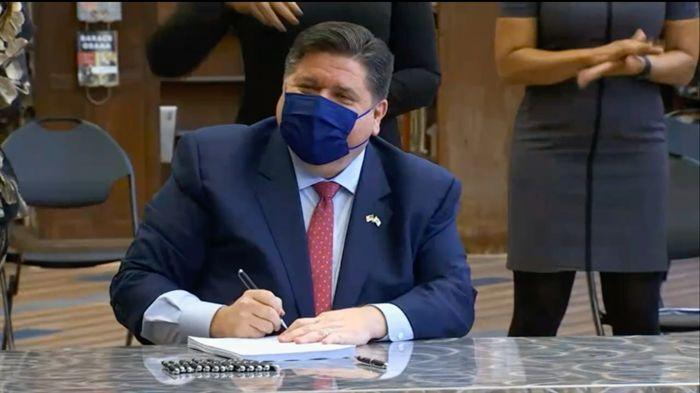
The Democrat-controlled Illinois General Assembly approved 665 bills this legislative session, with the vast majority awaiting Gov. J.B. Pritzker’s signature.
But, Pritzker has signed 42 bills into law. A handful of those will take effect Jan. 1, 2022, but most went into effect immediately upon signing or will take effect this Thursday.
Here are some notable new laws in effect now or on Thursday that Illinoisans should know.
Election reform

With pandemic-related delays to U.S. Census redistricting numbers, lawmakers moved back the state’s 2022 primary election from March 15 to June 28. The legislation also makes Election Day a state holiday, requires every county to have at least one universal voting center and allow people to be added to a permanent vote-by-mail list. (SB825)
Vote by mail

Some pandemic-induced changes to voting for the 2020 general election, such as vote-by-mail and curbside drop-off, will now be permanent features of future elections. (House Bill 1871)
State legislative redistricting

As they are tasked with doing every 10 years, lawmakers approved new district boundaries for the Illinois House and Senate. The Democrat-drawn maps, which utilized the U.S. Census’ American Community Survey instead of waiting for the decennial census numbers that will arrive later this year, have been challenged in court by Republicans and some other groups. (HB2777)
Illinois Supreme Court redistricting
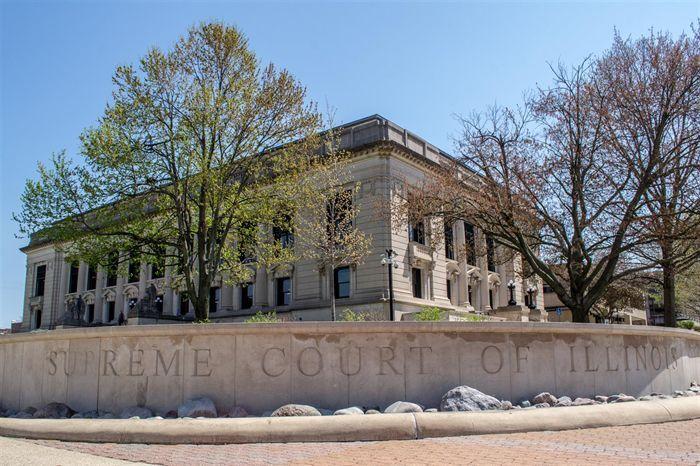
The seven-person Illinois Supreme Court’s district boundaries were successfully redrawn for the first time since the 1960s. (SB642)
Police reform

There was no more controversial bill that passed this year than House Bill 3653, also known as the SAFE-T Act, which passed during the lame duck session this January. The provisions ending cash bail and requiring all police to wear body cameras will not take effect until 2023 and 2025, respectively. But starting Thursday, police will be required to render aid to the injured, intervene when a fellow officer is using excessive force and and be limited in use of force. It also offers stricter guidelines for the decertification of officers and would allow people to file anonymous complaints of police misconduct. (HB3653)
Payday loans

Lenders are now prohibited from charging more than 36% annual percentage rate on consumer loans. The average rate in Illinois was nearly 300% prior to the law’s signing. (SB1792)
Vaccine lottery

Tucked into the state’s fiscal year 2022 budget is $10 million for a “vaccine lottery.” All Illinois residents vaccinated by July 1 will be automatically entered into the contest. It includes $7 million in cash prizes to vaccinated adults, ranging from $100,000 to $1 million, and $3 million in scholarship awards to vaccinated youth. (SB2800)
COVID-19 emergency housing

Created guidelines for distributing more than $1 billion in federal stimulus funds for COVID-related housing relief. Also creates automatic sealing of evictions during the pandemic. (SB2877)
Pretrial interest

Victims in personal injury and wrongful death cases will be allowed to collect interest from defendants from the time a lawsuit is filed. It is meant to incentivize settlement of these cases. It was supported by the trial lawyers and opposed by business groups. (SB72)
Casino labor

All casino applicants in Illinois are now required to enter into a project-labor agreement when seeking a new or renewed license. (SB1360)
Crime victims compensation

Provides that a victim’s criminal history or felony status shall not automatically prevent compensation to that victim or the victim’s family. Extends the applicant’s period for submitting requested information to 45 days from 30 days and provides that a final award shall not exceed $45,000, up from $27,000, for a crime committed on or after August 7, 2022. (HB3295)
Electronic signature

Provides that a contract, record, or signature may not be denied legal effect or enforceability simply because it is in electronic form or an electronic record was used in its formation. Provides that if a law requires a record to be in writing, an electronic record satisfies the law. (SB2176)

