


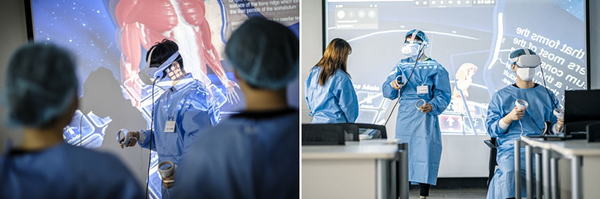
Imagine medical students wearing surgical gowns and vinyl head coverings and holding virtual reality equipment instead of scalpels at an anatomy lab.
That is what happens at the anatomy laboratory of Kyung Hee University College of Medicine, which has introduced a “hybrid anatomy class” for the first time in Korea. It also shows how the Covid-19 pandemic has sped up changes in medical training over the past two years.
Kim Do-kyung, a professor of anatomy and neurobiology, introduced the “metaverse-based” anatomy practicing scene in the latest issue of the “E-Newsletter” published by the Korean Academy of Medical Sciences.
According to Professor Kim, Kyung Hee University has formed a committee related to EduTech and multimedia education to graft virtual reality, augmented reality, and metaverse to medical training. It has offered anatomy training using VR since 2021 – the “hybrid anatomy class” that combines cadaver practice and VR practice.
In the first semester of 2021, 100 hundred freshmen in the regular course of the medical school took part in the anatomy practice in 12 groups. The students had time to dissect cadavers as in general anatomy dissection.
They also checked the inside of a human body, including bones, muscles, and blood vessels, in a 3D model using Oculus Quest 2 VR equipment distributed to each group. The trainers used the VR anatomy programs “Sharecare You” and “Anatomy Explorer.” Sharecare You is good to learn about internal organs and disease models, while Anatomy Explorer is good to learn about bones, muscles, blood vessels, and nerves.
As the school grafted VR to anatomy training, it also changed the way of teaching. That’s because the new method has enabled “Flipped Learning.” Students learn beforehand online and have offline discussions with professors later. Then, after watching related videos on the “e-Anatomy” and “e-Neuroanatomy” websites, the students participated in the practice.
After the practice, the participants made and submitted presentation materials, including cadaver pictures and photos and videos they had captured in VR programs.
“VR-based practical training can maximize the quality of experiences thanks to strong immersion as the technology can create ‘experience’ itself with five senses,” Professor Kim said. “It can overcome the limitations of time and space and enable teachers to offer repeated exercises as the quintessential condition for education.”
Kim also explained that the new method enables remote learning and is advantageous for three-dimensional visualization and interaction as it facilitates the delivery of spatial and structural information delivery.
“There is an old saying, ‘A thousand hearings are not worth one seeing.’ Now, it should be, ‘A thousand seeings are not worth one trying,’” he said. “VR education is ideal for the class that you learn by doing it yourself.”
Explaining that contents used in present anatomy classes include textbooks, body models, practice videos, and cadaver dissection, Kim said these auxiliary teaching materials are two-dimensional, making it difficult for students to understand three-dimensional structures and learn something repeatedly. He added that these are not active but passive educational contents, pulling down educational efficiency and failing to allow teachers and students to communicate with each other.
“Our school plans to expand classes making the most of VR and metaverse. It is also developing its new contents,” Professor Kim said. “As we keep educating professors about new teaching methods in primary and clinical medicine, the scope of its application will continue to expand.”
Kim pointed out that education is the area that spearheads the new trend in which walls between reality and virtual reality disappear.
“Various edu-techs are introduced in basic medicine, including anatomy and clinical subjects,” the professor said. “Such a trend will likely continue for the next several years. Therefore, we must ceaselessly try to meet the learning desire of MZ-generation students familiar with edu-tech.”

