


Officials across the Icelandic government convened in mid-October to conduct a scenario exercise of paramount importance to the Nordic country’s national security. But their goal wasn’t to game out a response to, say, a hypothetical cyberattack against Iceland’s core infrastructure or the possible penetration of its territorial waters by a Russian sub.
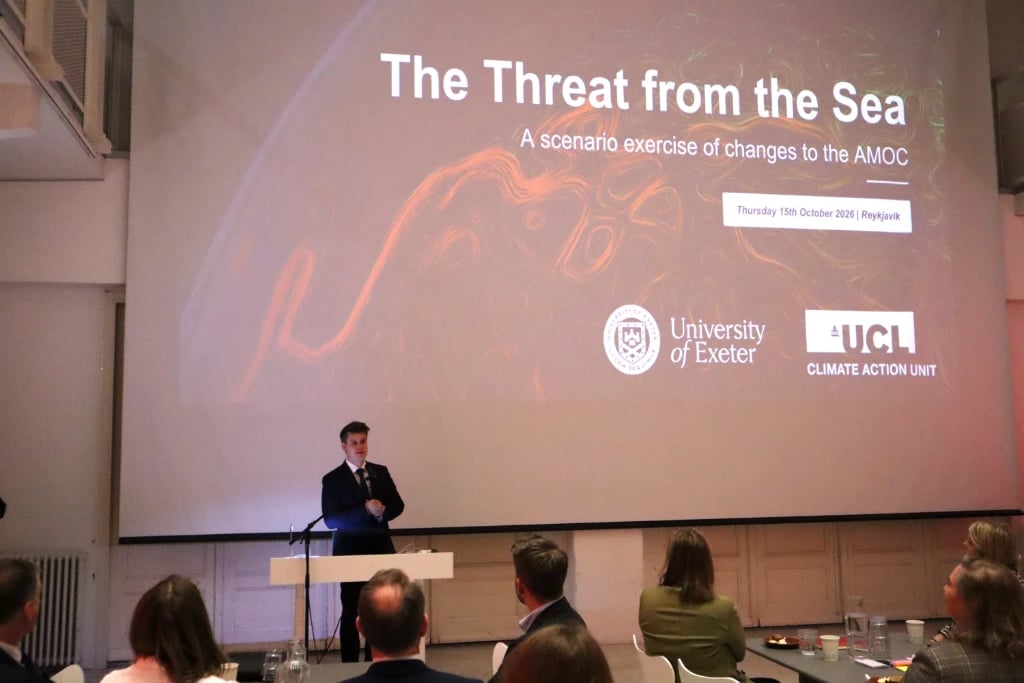
Iceland’s policymakers met on October 15th, at an event hosted by the nation’s Ministry of the Environment, Energy, and Climate, to prepare for the increasingly likely collapse of the Atlantic Meridional Overturning Circulation (AMOC) due to rising global temperatures. This circulation dredges up cold, salty, nutrient-rich seawater from the deep Atlantic near the tropics as its warmer surface water churns northward, where this cycle pivots—pushing colder, saltier water down and southward guided by thermal convection and differences in ocean salinity.
To provide some context on what a serious reduction in AMOC might do, some climate modelers predict that the loss of heat it carries north could plunge Scandinavia into routine winter extremes of -58 degrees Fahrenheit (-50 degrees Celsius). But even as its disruption leads to drops in average monthly winter temperatures across northern Europe, an end to AMOC would also bake regions closer to the equator, weakening monsoon seasons in West Africa and India and raising the specter of drought across lower latitudes.
“One of the key roles of government is to identify threats and prepare society for them. This is how we approach volcanic eruptions and epidemics, and the same should apply to climate risks,” Iceland’s Minister of the Environment, Energy, and Climate Jóhann Páll Jóhannsson explained in a statement, translated via Google.
“By reviewing scenarios, mapping vulnerabilities and practicing responses, we can better see where we stand and what needs to be strengthened most urgently,” Jóhannsson continued.
Ice Age mindset
Only two of the 91 countries to supply national adaptation plans to the United Nations’ climate convention have thus far bothered to mention AMOC in their considerations, according to University of Oxford climate researchers Jim Hall and Brenden Jongman.
“Brazil’s plan devotes a dedicated box to warning that [AMOC’s] shutdown could push the Atlantic rain belt southwards, tipping the Amazon rainforest towards collapse,” Hall and Jongman noted in a piece for The Conversation last week.
“Ireland—which relies on the Amoc to sustain its mild climate—mentions that ‘reliance solely on adaptation may prove insufficient,’ […] concluding that no national plan can prepare.” (Despite its national security exercises, Iceland has yet to submit its own adaptation plan to the UN.)
Hall and Jongman acknowledged that radical changes to these Atlantic currents are not entirely new. A previous disruption, according to one 2004 study, nearly or completely halted AMOC beginning about 17,500 years ago. A separate sharp, brief decline occurred around 12,700 years ago during the Younger Dryas.
But, that said, another collapse is not something they feel humanity should take lightly either, particularly for developing countries near the equator where climate change already worsens food insecurity and threatens access to clean water. As is, Hall and Jongman wrote in their new risk analysis for Nature Sustainability, “climate-related disasters alone push an estimated 26 million people into poverty each year.”
Overturning points
Although the frigid fallout from an AMOC collapse would look markedly different in Iceland, its planners are also looking at issues like food security, as well as threats to infrastructure and international transportation, according to a Reuters report on prior scenario exercises.
This “is the first time a specific climate-related phenomenon has been formally brought before the National Security Council as a potential existential threat,” Jóhannsson told Reuters in 2025 via email. “It is a direct threat to our national resilience and security.”
This October’s exercise was reportedly the fourth in a series, produced in collaboration with University College London’s Climate Action Unit and the University of Exeter’s Global Systems Institute.

