


Hermès has filed a lawsuit against the individual behind a collection of 100 MetaBirkins non-fungible tokens (“NFTs”) that include images that depict furry renderings of its famous Birkin bag. In the complaint that it filed in a New York federal court on Friday, Hermès claims that MetaBirkins creator Mason Rothschild is “a digital speculator who is seeking to get rich quick by appropriating the brand MetaBirkins for use in creating, marketing, selling, and facilitating the exchange of digital assets known as non-fungible tokens,” which simply “rip off Hermès’ famous BIRKIN trademark by adding the generic prefix ‘meta’ to the famous trademark BIRKIN.”
Setting the stage in its 47-page complaint, Hermès asserts that beginning on December 2, 2021, Rothschild “has advertised the MetaBirkins NFTs under the MetaBirkins trademark and using the Hermès federally registered trademarks” – including its “globally recognized” BIRKIN word mark and trade dress – without its permission and in violation of its trademark rights. In the wake of the launch of the NFTs, the first of which sold on December 3 for $42,000, Hermès states that it notified both Rothschild and the NFT platform OpenSea on December 16, 2021 about “the blatant violation of [its] intellectual property” by Rothschild, prompting OpenSea to remove the NFTs from its platform.
Rothschild has “flatly refuse[d] to stop selling the MetaBirkins NFTs,” according to Hermès, which declares that “when OpenSea denied him continued access to its platform, [he] moved the MetaBirkins NFTs to the MetaBirkins Rarible Store and further commenced plans to create his own decentralized exchange for the MetaBirkins NFTs.” (Hermes claims that Rothschild is actively looking to “build a market for the resale, trade, and exchange of his MetaBirkins NFTs” by way of “a market referred to … as the MetaBirkins “community.”)
While Rothschild has refused to cease his offering or advertising of the NFTs, including on his domain metabirkins.com, in the wake of receiving Hermès’ letter, he did update the website to add a disclaimer, stating: “We are not affiliated, associated, authorized, endorsed by, or in any way officially connected with the HERMÈS, or any of its subsidiaries or its affiliates. The official HERMÈS website can be found at https://www.Hermès.com.” However, instead of remedying the situation, Hermès claims that the disclaimer makes matters worse, as it “excessively uses the HERMÈS mark three times,” and also “unnecessarily links to Hermès’ website and capitalizes the HERMÈS mark,” thereby, creating “a confusing impression among consumers as to Hermès’ sponsorship of the MetaBirkins NFTs and the MetaBirkins website.”
At the same time, after receiving the cease-and-desist letter, Hermès contends that Rothschild has attempted “immunize himself from the legal consequences of his appropriation of Hermès’ famous trademarks by proclaiming that he is solely an artist,” and thereby, protected by the First Amendment. Again, Hermès pushes back, asserting that no such protections apply for a number of reasons. “Although a digital image connected to an NFT may reflect some artistic creativity, just as a t-shirt or a greeting card may reflect some artistic creativity, the title of ‘artist’ does not confer a license to use an equivalent to the famous BIRKIN trademark in a manner calculated to mislead consumers and undermine the ability of that mark to identify Hermès as the unique source of goods sold under the BIRKIN mark.”
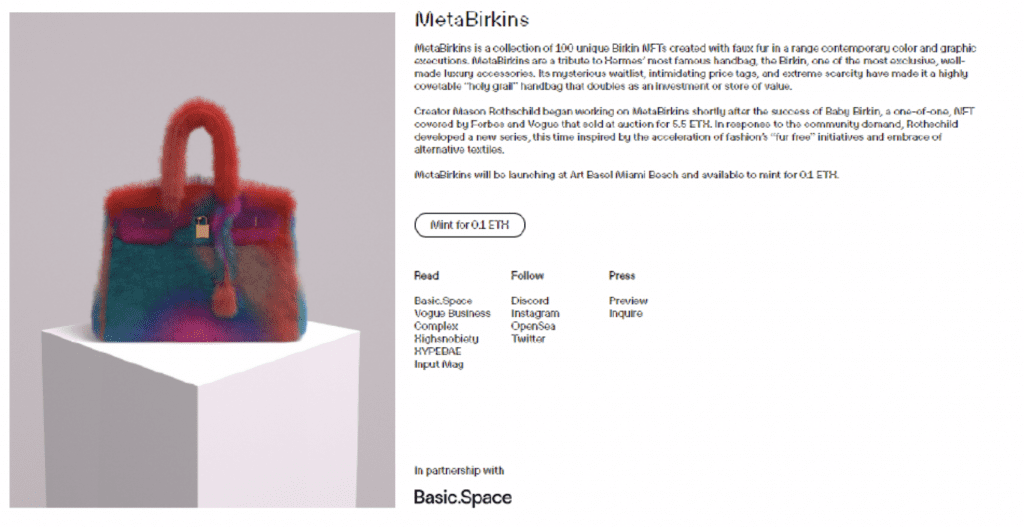
In reality, Hermès states that Rothschild’s “widespread use of the MetaBirkins mark constitutes trademark infringement and dilution of the famous BIRKIN mark,” claiming that “there can be no doubt” that the “success” of the MetaBirkins NFTs “arises from his confusing and dilutive use of Hermès’ famous trademarks.” Specifically, counsel for Hermès argues that Rothschild’s extensive use of Hermès’ trademarks, including in connection with the NFTs, themselves, as well as his use of the “infringing” metabirkins.com domain, is commercial in nature (which likely conflicts with his claims of fair use protections).
Also standing in the way of Rothschild successfully claiming that he enjoys fair use protections, according to Hermès? The fact that he is using the MetaBirkins term as a trademark of his own. (As we noted last month, a potential snag to Rothschild successfully claiming fair use protection, such as parody, is the fact that the parody defense does not provide protection when the allegedly infringing use is a designation of source of the defendant’s own goods.) According to Hermès, Rothschild “has repeatedly claimed trademark rights in the infringing MetaBirkins trademark by complaining of ‘counterfeited’ MetaBirkins NFTs on NFT marketplaces,” with “the existence of ‘fake’ or ‘counterfeit’ MetaBirkins NFTs indicat[ing] that MetaBirkins is a trademark as an indicator as source.”
Taken together, the Birkin bag-maker argues that Rothschild’s use of its marks for the purpose of “marketing, [selling], and distribut[ing] the MetaBirkins NFTs” infringes its trademarks, as such unauthorized use is “likely to cause confusion and mistake in the minds of the purchasing public, and, in particular, tends to and does falsely create the impression that the goods sold by [Rothschild] are authorized, sponsored, or approved by Hermès when, in fact, they are not.” Beyond that, Rosthchild’s “willful and intentional” activities “dilute the distinctive quality of the BIRKIN Mark and the goodwill associated with it.”
With the foregoing in mind, Hermès sets out claims of federal and common law trademark infringement, false designation of origin, trademark dilution, cybersquatting, and injury to business reputation and dilution under New York General Business Law. In terms of remedies, the company is seeking monetary damages, including Rothschild’s profits, and injunctive relief to bar him from making further use of its trademarks, such as by “using any reproduction, copy, counterfeit, or colorable imitation of Hermès’ Federally Registered Trademarks to identify any goods or the rendering of any services not authorized by Hermès.”
Hermès has asked the court to require Rothschild to “deliver up for destruction to Hermès all unauthorized products and advertisements in his possession or under his control bearing any of Hermès’ Federally Registered Trademarks or any simulation, reproduction, counterfeit, copy or colorable imitation,” which will inevitably raise some novel and interesting questions – particularly from a remedies perspective – given that the infringing goods at issue consist of NFTs and thus, are stored on the blockchain. (Because blockchain transactions are linked to every transaction record that came before them, the records generally cannot be changed once they are entered; although, there is a process by which an NFT can be sent to an inaccessible address, thereby, presumably removing its value.)
“Unless enjoined by this court,” Hermès claims that Rothschild “will continue to advertise and sell NFTs under the MetaBirkins brand, build a company offering a range of virtual products and services under the MetaBirkins brand, and ultimately, preempt Hermès’ ability to offer products and services in virtual marketplaces that are uniquely associated with Hermès and meet Hermès’ quality standards.”
For a deep dive into the merits of Rothschild’s fair use claims, you can find that here, and for a look at the likelihood that consumers are confused by the MetaBirkins, you can find that here.
The case is Hermès International, et al. v. Mason Rothschild, 1:22-cv-00384 (SDNY).

