


The Night Gaming Stopped Needing a TV
There was a moment in the mid-2000s when gaming quietly broke free from bedroom desks and heavy consoles. You didn’t need a TV anymore. You didn’t need to sit still. You just needed a charger, a pair of headphones, and something that felt almost magical at the time: a PlayStation Portable.
Suddenly, gaming lived on bus rides, in school hallways, on long flights, under blankets after midnight. The world didn’t stop when you left home. Your game came with you. And for a generation, that changed everything.
Fast forward nearly two decades. Screens got sharper. Chips got absurdly powerful. Entire gaming PCs shrank into devices that fit in your hands. And today, we’ve arrived at a point where a handheld can do what once required a full desktop rig.
That’s the world the ASUS ROG Ally X enters.
Not as a toy. Not as a casual side device. But as a serious, unapologetic gaming machine that flips the script entirely:
What if the device in your hands became the best gaming PC you own?
And that question shapes everything about the Ally X from the way it feels in your hands, to how it performs under pressure, to how long it can actually stay unplugged.
To answer that, we need to look at what the Ally X changes not just on paper, but in the way it actually feels to use day after day.
Design & First Impression: The First Ally That Feels Finished
Pick up the ROG Ally X, and the first thing you notice is that it no longer feels like a flashy gadget. It feels like actual hardware meant for long, serious play.
The glossy white shell of the original Ally is gone. In its place: a matte black body with deeper, more rounded grips that sit naturally in your palms. Yes, it’s a bit heavier at around 678 g, but that weight is better balanced. Instead of feeling front-heavy, it feels planted, like a solid controller with a screen attached.
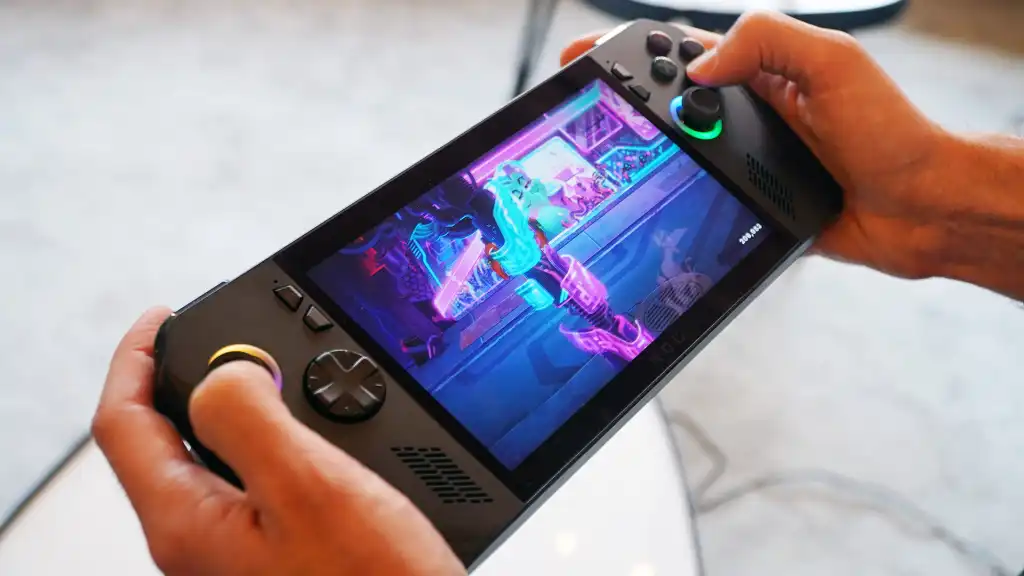
Image Credits: PC World
Imagine playing Hades II or Vampire Survivors for two hours straight on the couch. With the original Ally, your hands might start to cramp or you’d shift your grip a lot. With the Ally X, the thicker handles and redistributed weight make it much easier to just lock in and forget about the hardware.
ASUS also quietly refined almost every physical input:
- ABXY buttons are snappier and more tactile.
- The D-pad has a cleaner, more distinct 8-way feel, which is great for platformers and fighting games.
- The thumbsticks use new modules with concave caps and stronger springs for better precision.
- The triggers now use Hall-effect sensors, meaning smoother analog control and less wear over time.
- The rear macro buttons are smaller and better positioned to reduce accidental presses.
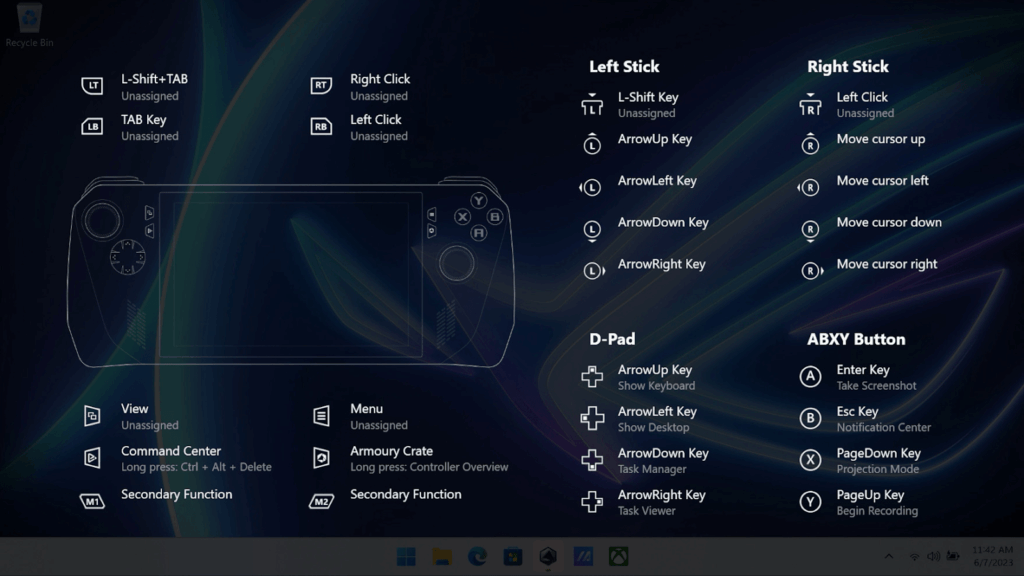
Image Credits: ASUS ROG
All of this is important because it sets the stage: this isn’t just about higher specs. It’s about making the device something you actually want to hold for hours, which leads directly into the next question: how much power is this new body hiding?
The Plain Language About The Specs That Actually Matter
On paper, the Ally X looks like a refresh. In practice, it’s closer to a full-on second generation.
Here’s what you’re actually getting, translated into what it means for you:
- CPU/GPU: AMD Ryzen Z1 Extreme
- 8-core / 16-thread Zen 4 CPU
- RDNA 3 iGPU up to 2.7 GHz
- Same chip as the original Ally, but now allowed to breathe more thanks to better cooling and higher power limits.
- Memory: 24 GB LPDDR5X-7500 RAM
- More headroom for modern games, background apps, and Windows itself. Less stutter, especially in open-world titles.
- More headroom for modern games, background apps, and Windows itself. Less stutter, especially in open-world titles.
- Storage: 1 TB PCIe Gen 4 NVMe SSD (M.2 2280)
- Fast load times, and enough space to install multiple big AAA games without immediately needing an upgrade.
- Fast load times, and enough space to install multiple big AAA games without immediately needing an upgrade.
- Battery: 80 Wh
- Literally double the original Ally’s 40 Wh, and you feel that every single day in how often you don’t need a charger.
- Literally double the original Ally’s 40 Wh, and you feel that every single day in how often you don’t need a charger.
- Display: 7″ 1080p IPS, 120 Hz, 500 nits, 100% sRGB, FreeSync
- Sharp, smooth, and bright enough to use outside of a dark room.
- Sharp, smooth, and bright enough to use outside of a dark room.
- Ports:
- 1× USB4 / Thunderbolt 4 (USB-C)
- 1× USB-C 3.2 Gen 2
- UHS-II microSD, 3.5 mm jack
- More flexibility for docks, eGPUs, external storage, and charging.
On its own, that’s a nice spec bump. But specs don’t tell you the most important thing: what the games actually feel like.
Performance: This Is What 40-60 FPS Feels Like in Your Hands
Forget benchmarks for a second. Imagine this instead:
You’re playing Cyberpunk 2077 on a handheld. Not the cloud version. Not a cut-down console port. The full PC game.
You’re standing in Night City at night – rain on the pavement, neon signs reflecting off cars, dense crowds all around you.
On the ASUS ROG Ally X, you can run Cyberpunk at 720p or 1080p with medium-ish settings and AMD FSR, and it feels… surprisingly natural. In Turbo mode (up to 30 W when plugged in), you’re looking at around 40-60 FPS at 720p, and roughly 30-40 FPS at 1080p depending on the exact settings. It’s not ultra/maxed-out, but it doesn’t feel compromised the way handheld ports used to.

Image Credits: YouTube
Now switch to something like Forza Horizon 5. On the Ally X, you can cruise through Mexico at 60 FPS on more balanced settings, with stable performance and no constant hitching. Load times are short thanks to the Gen 4 SSD, and quick resume between races feels snappy.

Image Credits: YouTube
In competitive games like Fortnite, Valorant, CS2, Rocket League, the Ally X really leans on its 120 Hz display. Even when you’re not hitting 120 FPS, the combination of higher frame rates and variable refresh keeps motion smooth and responsive enough that you can genuinely play seriously, not just casually.
So what changed vs the original Ally?
- Higher power envelopes:
- Silent: ~13 W (up from 10 W)
- Performance: ~17 W (up from 15 W)
- Turbo: up to 25–30 W (30 W plugged in)
- More and faster RAM: 24 GB LPDDR5X-7500 vs 16 GB LPDDR5
- Better cooling (we’ll come to this next)
Here’s what stood out on a more personal, day-to-day level:
1. Windows Still Isn’t a Handheld OS
Even with the improved Armoury Crate SE, you’re still working with a desktop operating system that was never designed for 7-inch touchscreens.
There will be moments like updates, pop-ups, weird scaling issues, when the illusion of a console-like handheld breaks, and you’re reminded: oh right, this is still Windows.
For some users, that’s fine. For others, especially those coming from the Steam Deck’s seamless interface, it can feel like a step back.
2. Performance Isn’t “Max Settings”. It’s “Smart Settings”
The Ally X runs modern games well, but this is not a “ultra-settings at 1080p” machine.
You’ll still:
- tweak FSR settings
- adjust graphics presets
- balance 40-60 FPS targets
- manage power modes
If you’re the kind of player who wants zero configuration, the experience may feel a bit too hands-on.
3. The Price Creeps Toward Gaming Laptop Territory
A few people will do the math and think:
“For this price, I could get a starter gaming laptop.”
And that’s true.
You can. Though it won’t be nearly as portable, silent, or flexible.
Still, the psychological comparison is real. Handheld PCs are no longer novelty gadgets; they’re premium purchases. That shifts expectations.
4. Accessories Add Up
A dock, a high-quality microSD card, a protective case, a USB4 hub… if you want the “full ecosystem,” the cost climbs quickly.
This isn’t a dealbreaker, but it’s worth acknowledging that the Ally X invites a bit of accessory spending.
5. It’s Better… but Not a Leap
If you already own the original ROG Ally, this isn’t a mandatory upgrade. It solves the biggest complaints like battery, ergonomics, thermals, but the performance uplift isn’t dramatic enough to justify upgrading solely for FPS gains.
When a Handheld Finally Feels Like a Real PC
The ASUS ROG Ally X doesn’t revolutionize handheld gaming, it refines it in all the ways that matter. Better battery, better comfort, better cooling, and smarter hardware choices turn it into a device that finally feels ready for long, serious play.
It’s not perfect.
Windows still has its quirks, and the price sits high enough that some people will compare it to gaming laptops. But when you’re playing a full PC title comfortably in your hands without feeling limited, rushed, or plugged to a wall, the value becomes clear.
If you want a handheld that feels more like a real gaming PC than a companion device, the Ally X is the closest the category has come so far.
Handheld gaming hasn’t changed overnight, but with the Ally X, it has definitely grown up.
See More

