


Amanda Davis holds flowers as she protest the Russian invasion of Ukraine March 5 outside the White House in Washington.

Demonstrators hold Ukrainian and U.S. national flags in front of the Georgian Parliament March 7 during an action against Russia’s attack on Ukraine in Tbilisi, Georgia.

Rachel Momotok, 5, waves a Ukrainian flag March 5 while participating in a rally in downtown Atlanta in support of Ukraine.
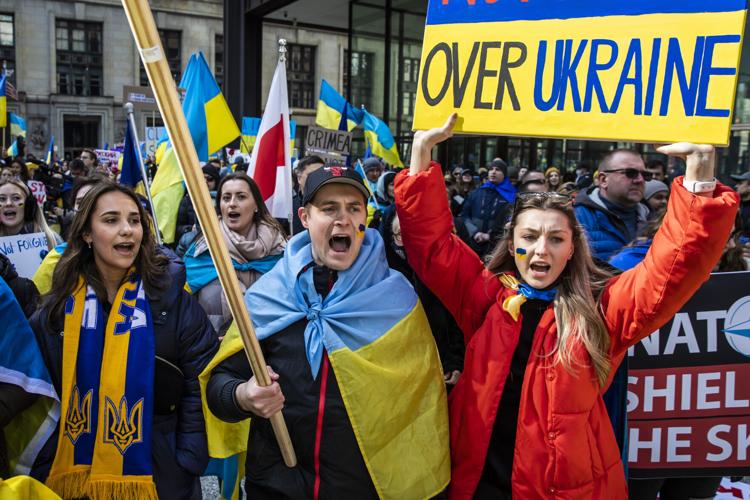
Thousands call for peace and protest Russia’s invasion of Ukraine during a rally March 6 in Chicago.

A woman wears paintings of the Ukrainian flag during a demonstration march March 5 against the Russian invasion of Ukraine, in Paris, France.
‘Mom, have you seen the news?” my son asks between mouthfuls of cereal at the breakfast table. He is reading an article about the Ukrainian nuclear plant fire. He then turns to another article, this one about refugees pouring into Poland.
He’s clearly alarmed. I don’t know what to say to him. There seems so little we can do.
A friend once told me a story: Anthropologists visiting an aboriginal village showed them an article about an earthquake destroying a town halfway across the world. Seeing the images of destruction and devastation, the local villagers began to pack. The anthropologists assured them that they were safe — the earthquake was very far away. But the aborigines knew that; they were packing for a different reason.
“Why would you share that unless you were asking us to help?”
On the sidelines
Americans have an insatiable desire for news and consume it in 24-hour cycles. Fox News is on at the mechanic shop, CNN at the doctor’s, New York Times alerts on my phone. In 2020, cable news reached all-time viewership highs as we were glued to coverage of the pandemic, racial justice protests, and, later, the election. But is being informed the same as being engaged?
Most people in my community are “highly politically active” in the colloquial sense of the phrase. They are likely to be knowledgeable about what’s happening and to have strong, informed opinions on current events. But as hearty as our dinner table debates may be, how many of us are turning this knowledge into impacting change?

