


Everyone is talking monetary policy as though they have been
watching the Federal Reserve closely for years. Some people are
even claiming to have had lunch with Paul Volcker in the ’80s.
Inflation and rising rates are a frequent topic among private
equity professionals these days. Everyone seems to be auditioning
for a CNBC segment (if CNBC is reading this, my professional email
is in my bio).
We all have seen incredible growth in the fund finance product
over the last several years. With the rapid increase in interest
rates in the United States and elsewhere, it’s prudent to ask
what is the future of the fund finance product in a rising rate
environment. To help gain some insight, Cadwalader sent out a
client survey to our bank clients, “The Cadwalader Fund
Finance Decision Maker Survey.” Here is what we have
found.
Among respondents, 21% of banks predicted that their allocation
to fund finance will be meaningfully higher in 2023, with 43% as
somewhat higher. Another 21% forecasted unchanged outstanding
commitments and 14% anticipate somewhat lower commitments. That
means that out of our respondents, 86% are holding steady or
increasing their exposure in 2023.
On the whole, these results point to a greater growth
orientation among lenders than we would have anticipated. We see
two qualifiers to the raw data:
First, a survey by count of respondents doesn’t
correspond to total commitments − it is possible, and even
likely, that a larger number of smaller and medium-sized players
are “risk on” whereas other banks may be facing a more
challenging balance sheet environment. If correct, we could see a
further extension of an in-place trend in the fund finance market
whereby the top lenders’ market share recedes as the lender
base diversifies.
Second, we surveyed group heads, a sample that is
probably oriented towards growth, whereas the realized outcome for
commitments may be dependent on macro variables and balance sheet
constraints outside the control of fund finance decision makers.
Even with these qualifiers, we see the result as expressing a
strong growth signal that runs counter to some market sentiment
conversations we’ve had recently.
Exhibit 1: Higher Interest Rates Expected to Show Up in
Lower Utilization
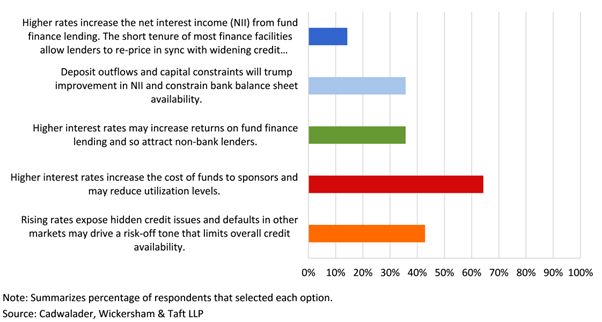
In assessing the likely effects of higher interest rates,
respondents zeroed in on utilization levels (Exhibit 1). According
to our survey, 64% of respondents expect utilization levels to
decline as borrowers face a higher cost of funds. This is also
something we have heard anecdotally and have solved for by, for
example, setting unused fees higher at a 30 bps/35 bps toggle
rather than the traditional 20 bps/25 bps. There’s also been
some discussion of minimum usage requirements and offsetting lower
utilization through higher fees. A more straightforward solution
might simply be smaller facility sizes − fundraising trends
and general partner behavior in reaction to rising rates may drive
this as a natural solution that solves for lower utilization
rates.
There is also a standout in terms of disagreement: only 14% of
respondents thought higher rates would attract more bank capital,
given subscription facilities are a floating-rate product with a
short loan term that allows for frequent revisiting of margins.
While moving capital to new floating-rate loans in a rising rate
environment makes intuitive economic sense, most banks don’t
think this is significant to the outlook for 2023.
Exhibit 2: Margin and Unused Fees Expectations Point
Higher

We also asked for any general thoughts on the direction of
margins and unused fees. As rates increase and liquidity tightens,
a little more than half of respondents agree that margins will
increase with higher yields and wider spreads across other credit
products. We read this as a general expectation for further
possible widening, extending what has already been a trend to
higher margins in recent months. Consistent with the discussion on
utilization levels, half of respondents thought unused fees would
move higher.
The takeaway is that banks remain bullish on the product
generally, subject to significant balance sheet headwinds that are
independent of the true health and demand for the product. This
implies that increasing interest rates do not make the product less
attractive but will instead affect utilization rates. Utilization
rates are likely to reflect a higher cost of funds to borrowers,
and behavioral changes at funds as fund finance facility pricing
approaches the 8% pref return (the cost of LP capital). Our
editorial comment on this would be that the treasury product
characteristics of subscription facilities − the immediate
access to funds, the operational efficiencies, multi-currency
availability, etc. − will also come into play and may buffer
some of the anticipated decline in utilization.
One might think that when restricted supply (via internal cost
of funds increasing and balance sheet pressure) meets continued
healthy demand, we would see new non-bank entrants into the market.
Indeed, 35% of respondents saw some possibility of increased
non-bank lending as interest rates rise. That may very well happen,
but also query whether sponsors are comfortable with a private
credit fund as its lender. We could very well see new insurance
companies and even LPs enter the space as liquidity providers, but
the ability to execute remains key. Agent banks with a demonstrated
track record of executing facilities will remain in strong
demand.
While rising rates are key variables in our outlook for 2023,
the pro-cyclical nature of regulatory pressure is also critical.
Many key players in the fund finance market are global systemically
important banks (GSIBs) who are facing increasing GSIB surcharges
(that is, additional capital buffer they are required to hold in
addition to the baseline required capital reserves). Rising capital
requirements are an added constraint that comes in the context of
potential fair value depreciation in securities portfolios and
potentially higher and earlier loss provisioning in other products
under the current expected credit loss (CECL) framework − all
pointing to a tightening in balance sheet availability and more
sensitivity to adding risk weighted assets (RWA).
In such an environment, we would expect banks with RWA pressures
to pursue three strategies. First, we expect to see an emphasis on
core sponsor relationships. Second, banks are likely to pursue
capital relief trades to help manage their RWA proactively (see our
discussion of Cadwalader’s capabilities in this area here). Third, we expect a continued
re-evaluation of all facets of deal economics, as is apparent from
the survey responses.
Of course, banks are just half of the market equation. Perhaps
in a future article, we could solicit general partners and CFOs.
Fund Finance Friday would look forward to presenting other
perspectives. Any takers?
The content of this article is intended to provide a general
guide to the subject matter. Specialist advice should be sought
about your specific circumstances.

