


For nearly three centuries, the politics of India has been entwined with those of the United Kingdom, with the balance of power firmly in the hands of the latter. However, incrementally, the all-encompassing British Empire now is a shadow of its former self, with the political landscape of the country evolving.
The most recent example of this is former British finance minister Rishi Sunak, a grandchild of British Indian immigrants, who is in the running to replace Boris Johnson as the next UK Prime Minister.
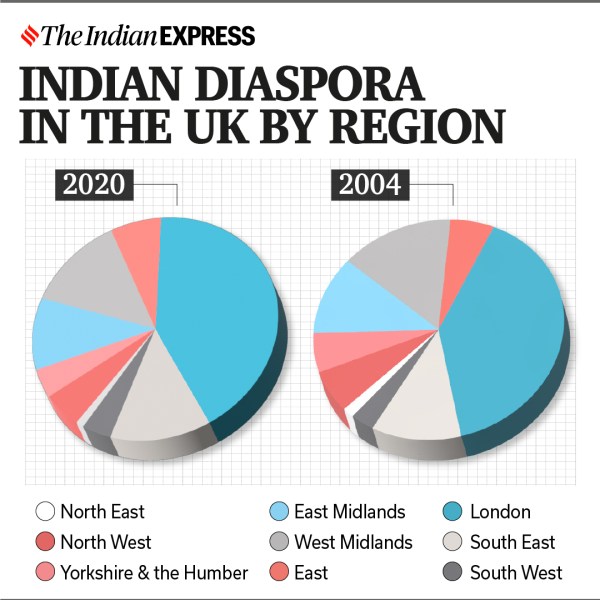
According to the 2011 census of England and Wales, there were 1.4 million people of Indian origin residing in the UK, accounting for 2.5 per cent of the overall population. Indians have been migrating to Britain for centuries, but the two most significant waves occurred after Independence.
The first wave was in the late 1940s and 50s when migrants were recruited from India to fill the labour shortage resulting from World War II. The second wave took place in the 1960s and 70s, when the so-called ‘twice migrants’ arrived from East Africa after being forced or encouraged to leave countries like Uganda, Kenya and Tanzania. The families of the Home Secretary, Chancellor and Attorney General are all part of this latter group.
Despite having lived in the UK since the 1700s, British Indians emerged as a political force only recently. Back when they first arrived, they had neither the status nor the resources to launch political campaigns.
Early migration
Beginning in the 18th century, the British had contact with Indians through the East India Company. According to American historian Richard T Schaefer, “the nature of this contact was typical of that between a migrant superordinate people and an indigenous subordinate population.” He adds that this imperial-colonial relationship is still significant as racist feelings in the UK today “may be reinforced by the arrogance of the colonial period and the racist theory that was often developed to rationalise it.” Namely a theory in which Indians would always be subservient to the British.
The first Indians to settle in Britain were mostly poor sailors employed by the East India Company. These sea workers or lascars were exploited by the natives and each other, according to Schaefer, and they often ended up as beggars or menial workers. A 2021 Gateway House report notes that despite these meager conditions, lascars were forced to remain in the UK as the East India Company, despite having a duty of care, often abandoned them once they had completed their task of bringing supplies to England.
Following in the footsteps of these early migrants, merchants began to migrate to the UK as well, eventually setting up valuable trade lines, and, according to an Oxford University report, playing key roles in the British Empire within India and the larger Indian Ocean economy. These merchant classes were primarily made up of the Gujaratis and Parsis of Bombay, and the Chettiar financiers from the south.
During the First World War, thousands of Indians travelled to England to fight alongside the allied forces. Sikhs, who were considered a superior race by the Victorians, made up 20 per cent of the British Indian army, and after the war ended, many families stayed behind. Speaking to the prominence of Sikh migrants, one historian notes that “by 1939, almost every large English city seemed to have had a small number of Sikh residents.”
Lastly, early Indians in the UK frequently resided there temporarily while pursuing higher education. This trend stems back to British politician Thomas Macaulay’s ‘Minute on British Education.’ During his famous 1835 speech, Macaulay argued that Indians should participate in the governance of India but should only be allowed to do so if they had received a ‘proper’ European education.
Macaulay’s suggestion eventually laid the seeds for Independence as most of the early members of the All India Congress had been educated in or lived in Britain. This list includes Allan Octavian Hume, Phereozeshah Mehta, Dadabhai Naoroji, Mahatma Gandhi, Jawaharlal Nehru and Subhas Chandra Bose. By 1830, India accounted for 87 per cent of all colonial students at British Universities.
Despite these early settlers, before Independence, the Indian population in Britain was negligible. In fact, between 1830 and 1930, Britain was not even in the list of top 16 countries for Indian immigration. This changed radically after the collapse of the British Empire.
Post-Independence migration
In 1951, the Indian population in Britain was just above 30,000, by 1961, it was 250,000, and a decade later, stood at 483,000. This started with the end of World War II, where, like with World War I, the Sikh community fighting in the British Indian army remained behind. Punjabis and Sikhs who were displaced by Partition also migrated in large numbers, particularly those who had previously been employed by the British army or police forces. These migrants filled the labour shortage in Britain, taking up employment in the manufacturing and textile sectors as well as in the aviation industry.
The second large wave of migrants arrived after Idi Amin expelled all Asians from Uganda in 1972. Amin’s actions sent shockwaves across East Africa with fears that other countries may follow suit. Instead of returning to India, Asians from East Africa chose to settle together in north-west London and Leicester. Harrow alone took 1,500 refugees from Uganda. These relatively wealthy ‘twice migrants’ went on to build temples, Bollywood cinemas and Indian restaurants. Their attempts to create a community in Britain appealed to working class Indians, many of whom would be arriving later.
During these decades, the experience of Indians in Britain is linked to the policies of the British government. Before 1962, Indians and other commonwealth citizens were allowed to migrate to the UK freely. However, following allegations that Indians were stealing British jobs, in 1961, the Conservative party passed a bill that would restrict immigration to people who could demonstrate long-term employment in the UK.
This in turn changed the profile of migrants that arrived. On one hand, it encouraged students and high-skilled professionals to migrate, but on the other, it sparked fears of more restrictive immigration policies to come, leading to an increase in family reunification.
An extension of the 1961 bill, the Race Relations Act of 1968, forbade employment discrimination towards Indians born in the UK but allowed it for those born outside of the country, in order to maintain the ‘racial balance.’
That drew the early distinction in opportunities offered to Indians born in the UK and those born in India.
According to the Gateway House report cited above, migration patterns remained fairly stable until conflict broke out in Punjab. It states that “the aftermath of the 1980s insurgency in Punjab saw immigration rise from this state to the UK due to unemployment at home, an established overseas community and family network, the continued market demand for labour in small restaurants, shops and manual work in the UK.”
During this time in particular, we can see the impact of communities set up by early generations of migrants. North Indians and Gujratis were more likely to migrate to the UK as there were already established North Indian and Gujarati communities there. However, while these migrants may have been able to secure housing and other comforts from relatives, they were not always assured jobs.
As a result, according to Gateway House, there was a “proliferation of proactive travel agents who could ‘manage’ the logistics, border agencies and immigration checks, establishing the migration corridor of ‘irregulars’”. These agents included youth from Haryana, Himachal Pradesh, and Jammu and Kashmir.
Status of Indians in the UK
It is important to distinguish between legal migrants and irregular migrants when determining the status of Indians in the UK. The irregular migrants, estimated by the UK government to comprise 100,000 people as of 2021, are mostly unskilled and semi-skilled youth. Being in the country illegally, this group is more likely to be unemployed or living in poverty.
In contrast, the legal migrants occupy a much higher economic status than their irregular counterparts, and for that matter, than the immigrant community as a whole. According to Schaefer, this is because Indian migrants have a much different image among the British than the Africans or West Indians. He writes that unlike those communities, British Indians were seen as a group that “could be educated, cultivated and capable of doing a relatively senior job.”
The UK’s Office for National Statistics (ONS) found that while on average ethnic minorities earn 3.8 per cent less than white ethnic groups, the same cannot be said of the Indians and Chinese. The data, based on earnings between 2012 and 2018, shows that Indian ethnic groups earn on average GBP 13.4 per hour and have an employment rate of 75.9 per cent. This is the highest relative to the employment rate registered for the White category, which stands at 81.7 per cent. The same study also found that non-UK born Indians earn 4 per cent less than Indians born in the UK.
This data tells us three things. The first is that the Indian community is relatively well integrated on a socio-economic level. The second is that family wealth increases over time, with a first generation immigrant setting the foundation for future success. Lastly, we can extrapolate that Indians are successful in the UK because racially, they are seen as subservient, non-threatening and similar to the native white population.
The person standing at the intersection of these three points is Rishi Sunak. As a third generation, highly educated, anglicised Indian, Sunak is the perfect example of the type of British Indian who typically succeeds and is now increasingly likely to succeed in politics. But Sunak’s success is also a product of many that came before him, starting out with India’s earliest political export, Dadabhai Naoroji.
Indians in British politics
To begin with, as long as you are a citizen of a Commonwealth Nation and have indefinite leave to stay in the UK, you may stand for election to any political office. Until last week, Indian politicians in Britain included two members of the four Great Offices of State, the COP26 President, 15 members of the House of Commons and 25 peers in the House of Lords. Back in the late 19th century, British Asians together accounted for only one Member of Parliament.
That Member was Naoroji, an Indian Parsi by origin, who contested the 1892 parliamentary elections from Central Finsbury. Mancherji Bhownaggree, another Indian Parsi, was the second person to be elected to Parliament. While both advocated for Indian interests, Naoroji favoured Independence, whereas Bhownaggree believed that British rule was best suited for India. Naoroji was therefore far more popular in India and treated with more suspicion and contempt in the UK.
Bal Gangadhar Tilak, another prominent freedom fighter, said of Naoroji, that “if we twenty eight crore of Indians were entitled to send only one member to the British parliament, there is no doubt that we would have elected Dadabhai Naoroji unanimously to grace that post.” The Prime Minister of the UK on the other hand, said that a ‘black man’ was not ready to represent an English constituency. Despite losing reelection 3 years later, Naoroji was the first non-white member of parliament and remained an ardent activist for the rights of Indians living under British rule.
Apart from contesting elections, Indians were also active in other political capacities. Lal Mohan Ghose advocated for Indian causes, carrying out multiple campaigns against the social and cultural policies of the British in India. Additionally, Madame Bhikaji Cama was very active in socialist circles, vehemently demanding a British withdrawal from India during the 1907 International Socialist Congress.
However, unlike those early Indians, current British Indian voters care much less about UK-India relations.
Before getting into their voting patterns, first we should establish just how important a vote they are.
Leading up to the 2015 parliamentary elections, the number of Indian voters was estimated at 615,000, with more than 95 per cent eventually casting their votes. According to a research conducted by the Carnegie Endowment, British Indians represent the biggest swing vote in politics.
Recognising this importance, even political parties are starting to pay attention. In 2015, the far right British National Party amended its constitution to accommodate its first Sikh member. The Conservative party, which had once opposed Naoroji’s candidacy, released a campaign video in Hindi on behalf of then candidate David Cameron.
So having said that, how are British Indians likely to vote?
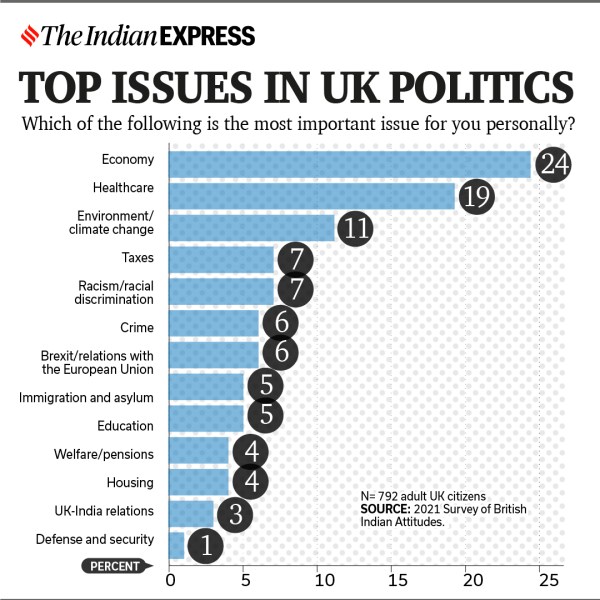
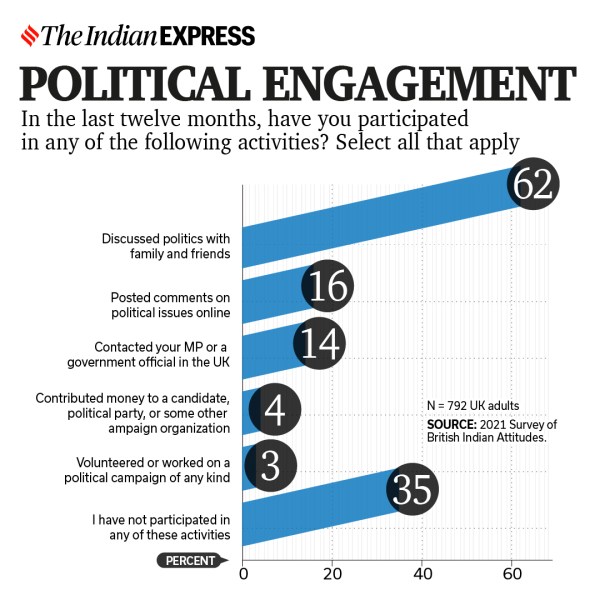
According to the Carnegie survey, which was conducted in 2021, in terms of an issue they care most about, the economy ranks highest at 24 per cent, while UK-India relations lingers at 3 per cent. Moreover, only 12 per cent say that it is very important to have a British Indian representing them as a member of parliament, whereas 33 per cent say it was not too important, and 21 per cent say that it was not important at all.
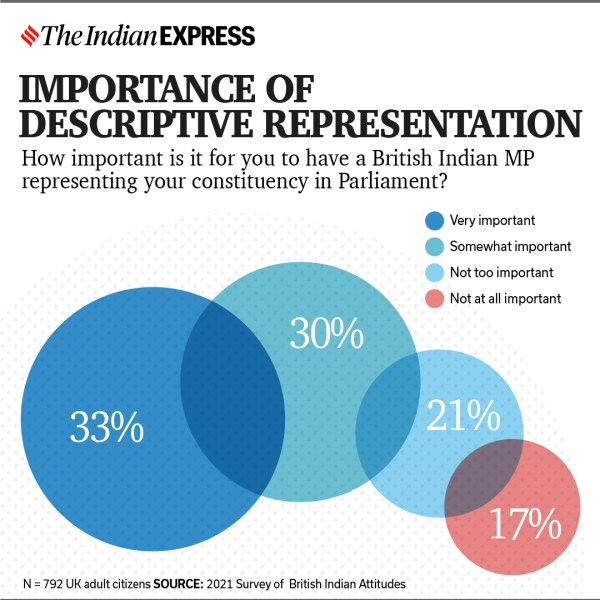
This could be taken to mean that British Indians care little about political relations with India and about Indian representation at a local level.
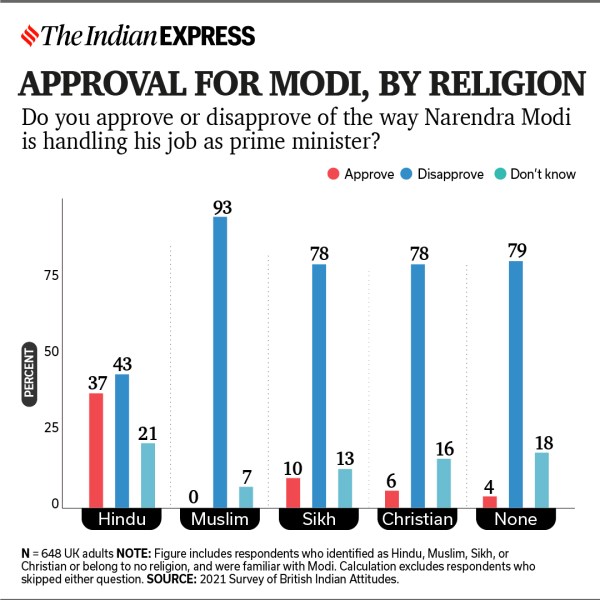
These numbers can further be examined in terms of religion. While 39 per cent of British Indian Hindus opposed the Labour Party’s decision to call for external observers in Kashmir, only three per cent of Muslims and 15 per cent of Christians agreed. Hindus are inclined towards politicians that are supportive of the BJP’s Hindutva policy in India and by extension, their attitudes towards Muslims in general. This split is seen most prominently in the preference between Labour or Conservative.
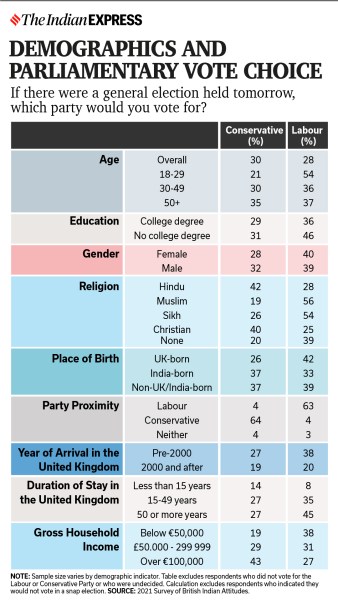
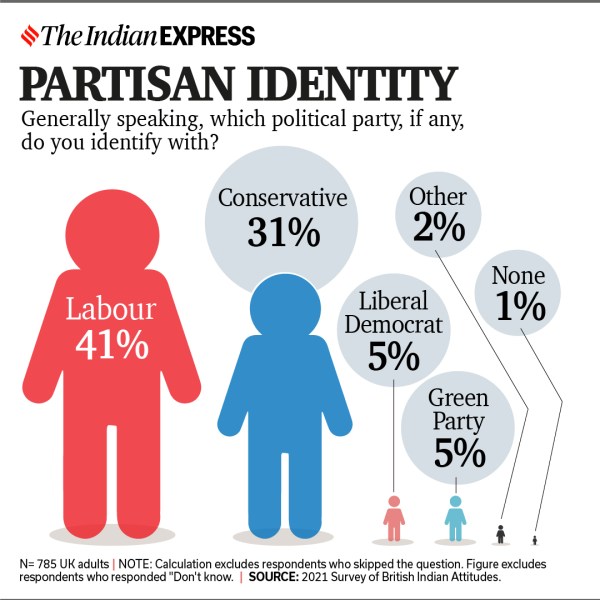
Indians have been staunch supporters of Labour since the early days of migration. However as the party becomes more multicultural, British Indian Hindus are discovering more common ground with the Conservative party.
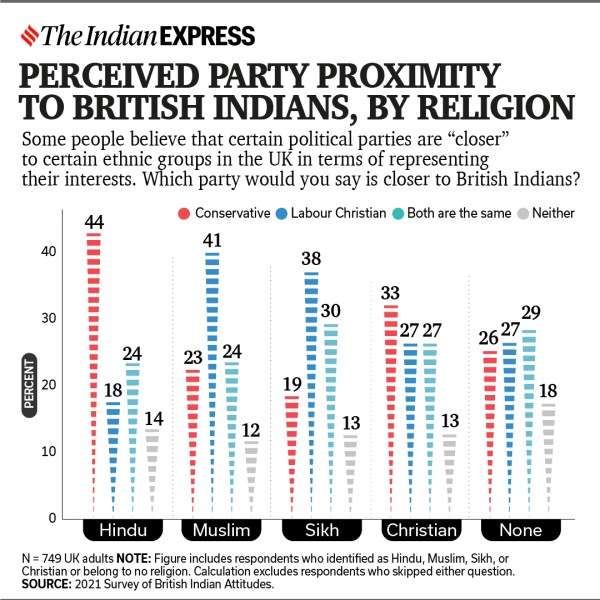
Amongst all Indians, Labour still commands a sizeable lead. The Carnegie survey found that in the event of a snap election, 24 per cent of British Indians would want to see Labour leader Kier Starmer as the UK’s next prime minister whereas 21 per cent would like to see Sunak.
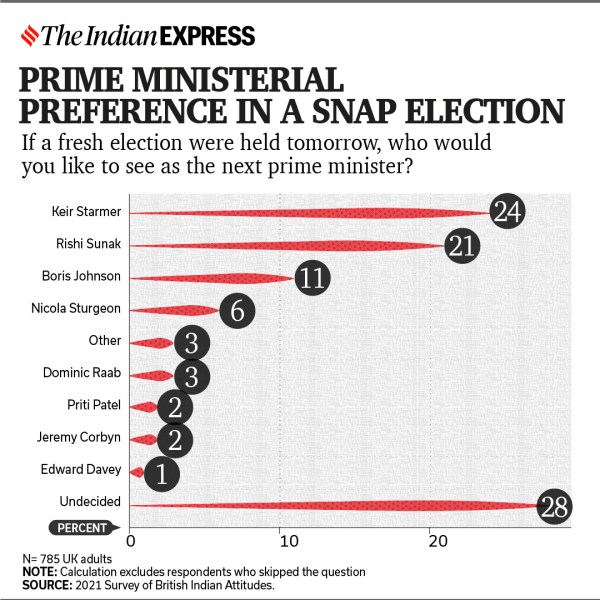
The fact that Starmer would nudge aside Sunak amongst Indian voters shows the Labour still retains some of its original grip but the gaps are shrinking.
The survey states that the support for Labour seems to have eroded over time, with the shift “largely driven by Hindus and Christians, many of whom have drifted away from the Labour Party, even as their Muslim and Sikh counterparts have remained steadfast supporters.”
This can be explained somewhat by the Narendra Modi government’s support for the Conservative party, but also by the party’s willingness to play up racial tensions. For example, in Harrow East, a small constituency where Indians make up 25 per cent of the vote, Conservative MP Bob Blackman retweeted a post that highlighted Muslim violence against Hindus. His Twitter picture is one of him standing next to Prime Minister Modi and in 2019, he took oath of office holding the Bhagavad Gita.
So British Indians increasingly like the Conservative party which would explain their support for Sunak but there are also other factors that work to his advantage.
Indian immigrants are more likely to be wealthier today than they were in the 1970s. They therefore have more in common with the likes of Sunak, than their middle class parents or grandparents would have. Sunak was born into a wealthy family, was educated in an Ivy League University and raised with domestic help. He is far more relatable to the rich British Indians of today than the members of the Labour party who accuse him of elitism.
All of this explains why Sunak is the frontrunner for the position of Prime Minister. However, while his candidacy is a crucial step in representation for Indians, it should not necessarily be seen as a victory for India. The British Indian diaspora is less, as Prime Minister Modi described, a “living bridge” to India, and more of a unique political identity on their own.
This identity aligns closer towards Macaulay than Prime Minister Modi. As the former once famously said, “we must at present do our best to form a class who may be interpreters between us and the millions whom we govern- a class of persons Indian in blood and colour, but English in taste, in opinions, in morals and in intellect.” Nearly two centuries after Mccaulay’s project began, Britain has finally created the class of Indians he so badly coveted. Ironically, that class are not the leaders of India, but that of Britain instead.

