


Hublot has been making fully sapphire watch cases since 2016, when the original Big Bang Sapphire debuted and surprised an industry that had largely treated the material as a case component rather than a case construction. The years since have produced increasingly ambitious sapphire interpretations, the striking orange Big Bang of 2021, the Meca-10 lineup’s own transparent expressions, and the glacier-blue Big Bang MP-11 with its fourteen-day power reserve.
The latest addition to this family is the Big Bang Sapphire Sky Blue, a limited edition of 100 pieces built on the Meca-10 platform and introducing a new color to a lineup that has consistently demonstrated what is possible when a brand commits seriously to machining sapphire rather than simply using it. Priced at aboy $85,000, it is available through Hublot website directly.
The sky blue color decision is more specific than it might initially appear. The Big Bang’s sandwich case construction, layers of material assembled in a way that creates depth and dimension in the dial architecture, translates exceptionally well into sapphire, and a transparent blue sapphire case adds a chromatic quality to that construction that an opaque material cannot produce.
The matte sky-blue skeleton dial and matching movement bridges visible through the case contrast with the clear sapphire in exactly the way the design requires, creating a watch that reads as coherent rather than simply colorful. A matching sky-blue rubber strap completes the color theme from case through strap, while Hublot’s signature H-shaped titanium screws hold the bezel in position, the one structural element that requires titanium rather than sapphire to function correctly.
The HUB1201 Movement
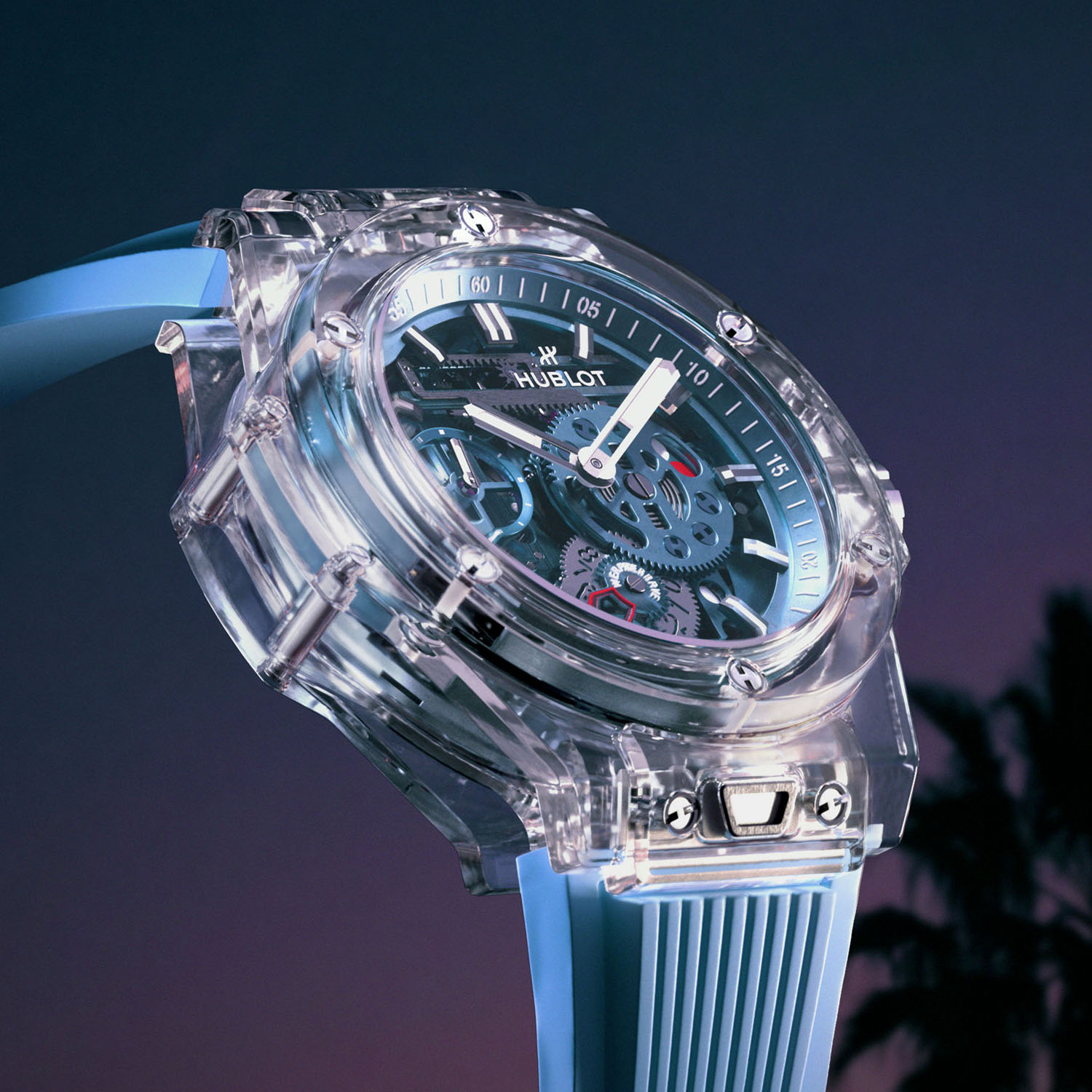
The Caliber HUB1201 that powers the Big Bang Sapphire Sky Blue debuted in 2016 inside the original 44mm Big Bang Meca-10, and its design philosophy remains as visually compelling in 2026 as it was at introduction. The movement is fully skeletonized in a Meccano-inspired style that puts its mechanical architecture almost entirely on display, an appropriate choice for a watch whose case is transparent and whose entire visual proposition is based on showing rather than hiding.
Two parallel mainspring barrels working in tandem deliver the Meca-10’s signature ten-day power reserve, a specification that remains genuinely impressive in a manually wound movement and a practical advantage for a watch of this complexity and price. The rack-and-pinion mechanism that moves two sliding racks along a 9 to 3 o’clock axis to create the dual power-reserve display is the movement’s most distinctive functional feature, a mechanism that reads as engineering made visible rather than engineering hidden behind a dial.
The movement beats at 21,600 vibrations per hour, a rate suited to the manual winding architecture, and is visible through the sapphire caseback as well as through the skeletonized dial.
Shop editor’s picks
Reading the Dial and the Case Specification
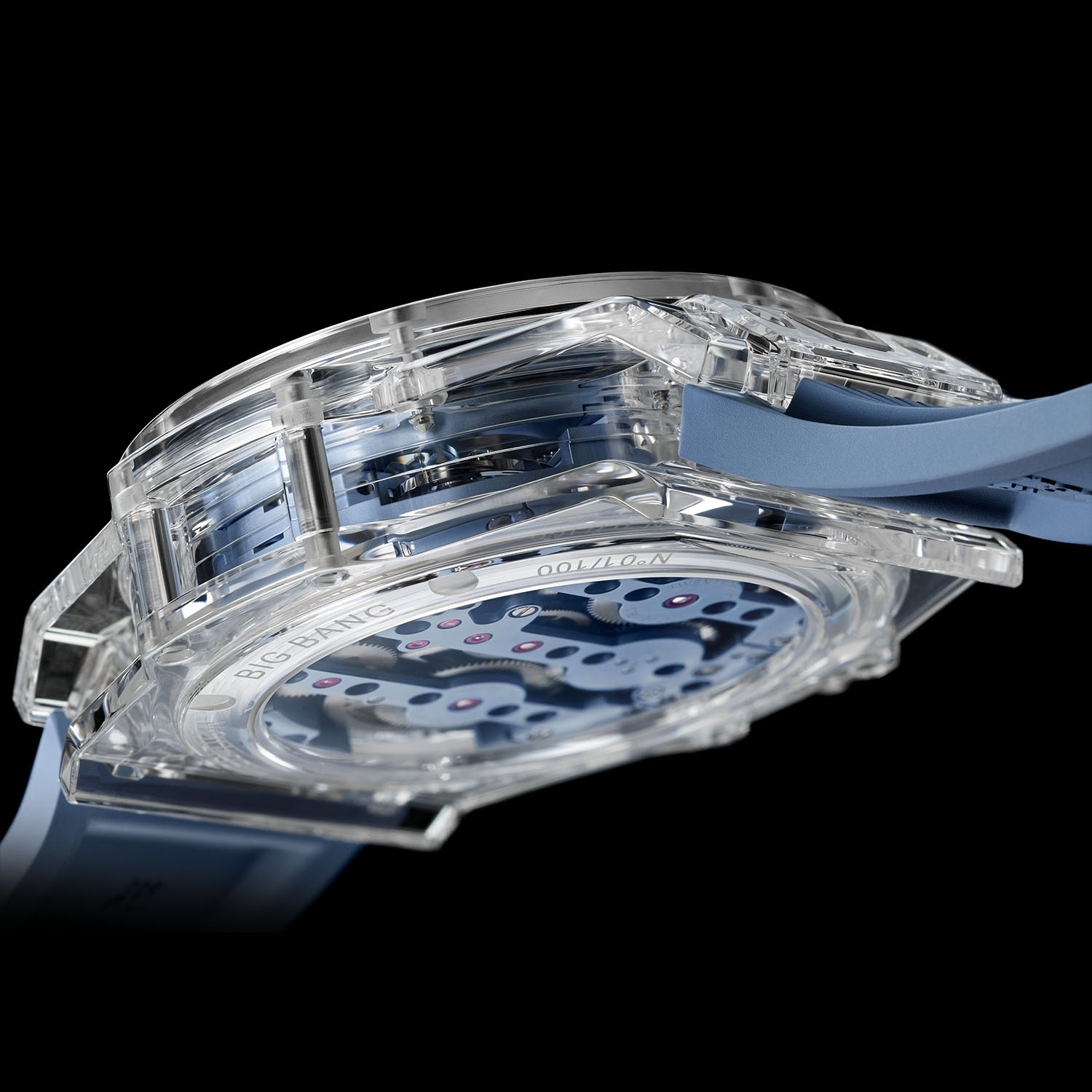
The Big Bang Sapphire Sky Blue measures 44mm in diameter in a fully polished sapphire crystal case with 50 meters of water resistance. The case dimensions place it comfortably within the Big Bang’s established proportions, and the polished finish interacts with the sky-blue color in a way that matte finishing would not. Running seconds appear at 9 o’clock. The power-reserve display sits at 6 o’clock, while the indicator at 3 o’clock includes a red zone that signals when the movement has approximately two days of reserve remaining, a practical warning system that adds function to what could have been a purely decorative complication.
The 100-piece production limit is the release’s most commercially significant specification alongside the price. At EUR 82,700, the Big Bang Sapphire Sky Blue occupies the upper tier of Hublot’s Big Bang lineup, where the combination of sapphire case machining, limited production, and the HUB1201 movement’s ten-day reserve collectively justifies the positioning. For collectors who have followed Hublot’s sapphire work since the original 2016 Big Bang, the sky blue adds a color vocabulary to the Meca-10 platform that fills a gap between the earlier orange and the glacier-blue MP-11, and does so with the same commitment to the material that has defined every Hublot sapphire release before it.
Featured image: Hublot


