


Ford Motor: Maintaining Revenue Scale
Ford Motor (F +9.22%) primarily generates revenue by developing, manufacturing, delivering, and servicing trucks, commercial vans, and luxury vehicles for consumers and fleets worldwide.
It established a new product creation organization to consolidate vehicle development and signed a framework agreement to provide battery energy storage systems, and it reported an approximately 6% net income margin for the quarter ended March 31, 2026.
Tesla: Navigating Revenue Fluctuations
Tesla (TSLA +1.95%) primarily earns revenue by designing, manufacturing, leasing, and selling electric passenger vehicles and solar energy storage systems to residential and commercial customers internationally.
It transitioned its Full Self-Driving software to a subscription-only model and announced workforce reductions at its Texas facility, while reporting an approximately 2% net income margin for the quarter ended March 31, 2026.
Why Revenue Matters for Retail Investors
Revenue serves as a fundamental indicator of how much total money a business brings in through its core operations before accounting for any expenses. Tracking this metric helps investors to gauge raw business scale and growth.
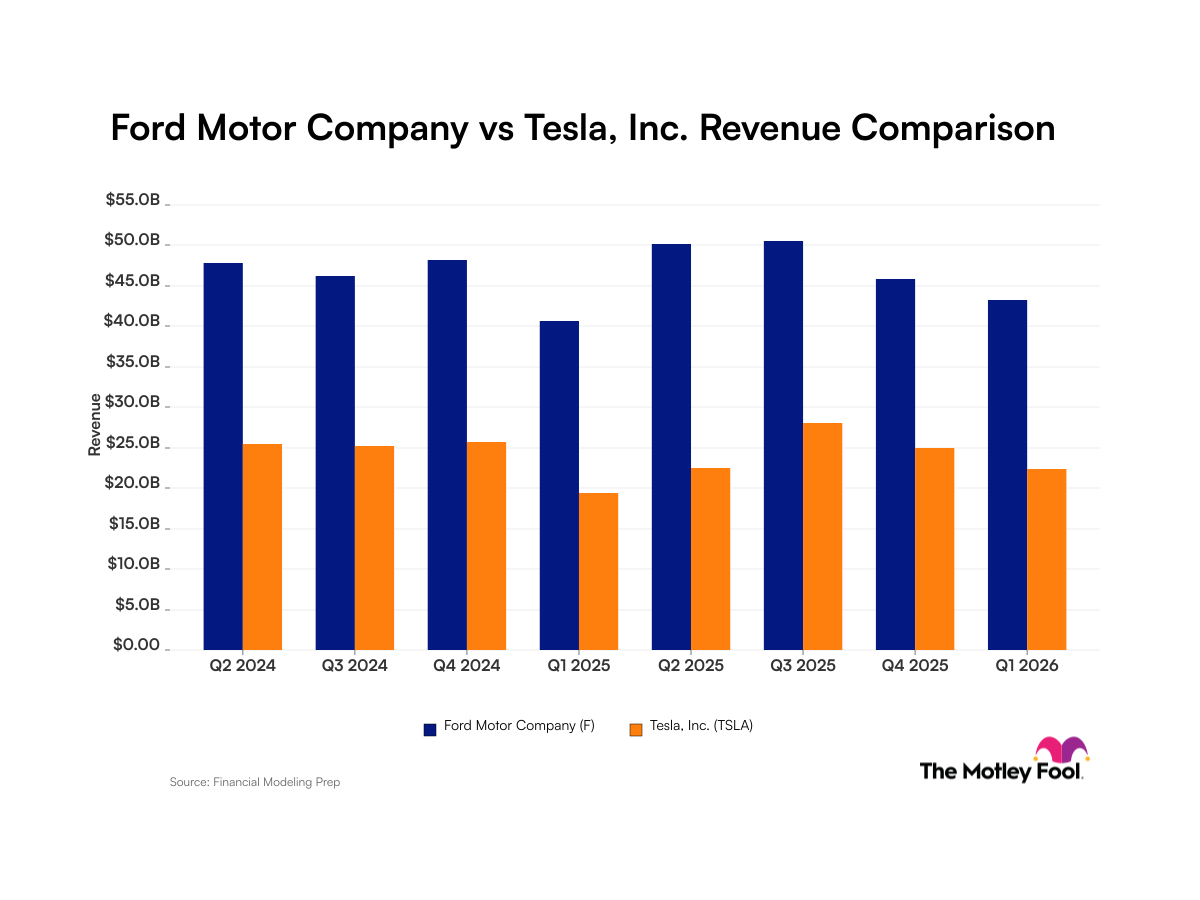
Image source: The Motley Fool.
Quarterly Revenue for Ford Motor and Tesla
| Quarter (Period End) | Ford Motor Revenue | Tesla Revenue |
|---|---|---|
| Q2 2024 (June 2024) | $47.8 billion | $25.5 billion |
| Q3 2024 (Sept. 2024) | $46.2 billion | $25.2 billion |
| Q4 2024 (Dec. 2024) | $48.2 billion | $25.7 billion |
| Q1 2025 (March 2025) | $40.7 billion | $19.3 billion |
| Q2 2025 (June 2025) | $50.2 billion | $22.5 billion |
| Q3 2025 (Sept. 2025) | $50.5 billion | $28.1 billion |
| Q4 2025 (Dec. 2025) | $45.9 billion | $24.9 billion |
| Q1 2026 (March 2026) | $43.3 billion | $22.4 billion |
Data source: Company filings. Data as of May 19, 2026.
Foolish Take
As the veteran automaker, naturally, Ford’s sales tower over Tesla’s. Yet you wouldn’t know that by comparing their stock prices. Both companies saw shares jump higher recently. In fact, Ford hit a 52-week high of $14.95 on May 22. However, that pales in comparison to Tesla’s stock, which exceeded $400 per share in May, although it did not reach its high of $498.83.
The vast difference in share price reveals that the amount of revenue alone doesn’t necessarily move the needle for a stock. One factor in Tesla’s larger share price is that its sales are growing faster than Ford’s. In Q1, Tesla’s $22.4 billion represented 16% year-over-year growth, while Ford’s $43.3 billion was a much smaller 6% increase.
Moreover, Tesla has expanded beyond its roots as an electric vehicle manufacturer. It extended into autonomous cars, and is working to deliver a driverless ride-hailing business. Meanwhile, Ford’s stock got a shot in the arm when it announced its new Ford Energy division, which will deliver battery storage solutions, a business Tesla has operated in for years.
Tesla’s ride-hailing service is a natural extension of the self-driving tech its cars have used for years. This allows it to boost revenue without significant new operational costs, while Ford’s announcement is a pivot for the company, and the expenses involved could eat into its profits.

