


With more than half of 2026 in the books, it’s shaping up to be another stellar year for the stock market. Since early June, the ageless Dow Jones Industrial Average (^DJI 0.77%), broad-based S&P 500 (^GSPC 1.01%), and growth-stock-fueled Nasdaq Composite (^IXIC 1.40%) have all powered to record highs.
However, Wall Street’s major stock indexes don’t always paint a complete picture of what’s going on behind the scenes. While several catalysts lie in wait to upend a historically expensive stock market, few if any are drawing as much attention as inflation.
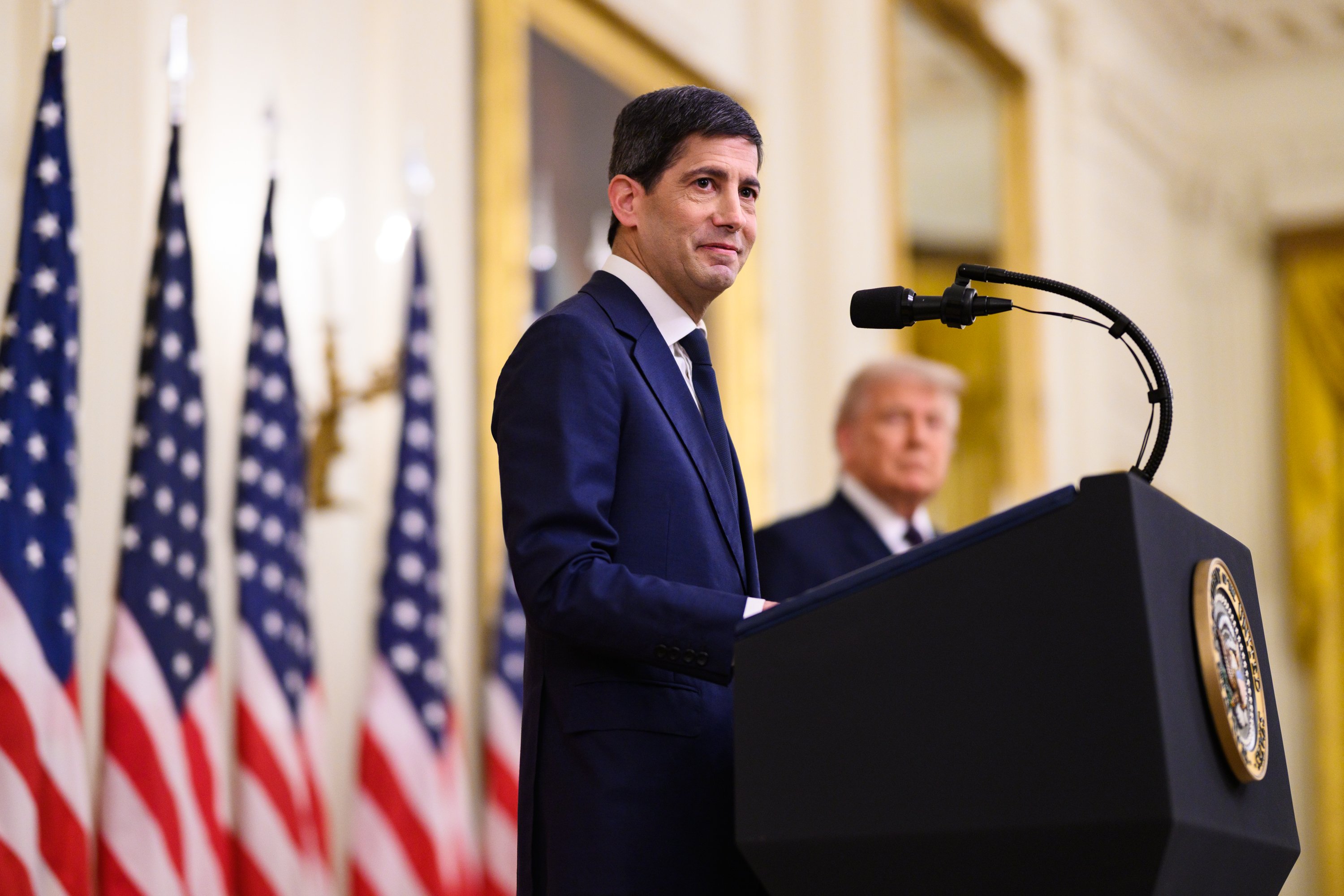
Fed Chair Kevin Warsh delivering remarks from the White House. Image source: Official White House Photo by Daniel Torok.
Fed Chair Kevin Warsh, who officially succeeded Jerome Powell on May 22 as head of the central bank, is being challenged out of the starting gate. In May, trailing 12-month (TTM) U.S. inflation reached a three-year high of 4.2%, prompting questions of whether Warsh and the Federal Open Market Committee (FOMC) — the 12-person body responsible for setting the nation’s monetary policy — will raise interest rates.
Though no one ever said that overseeing monetary policy for the world’s largest economy would be easy, Warsh has ascended into a veritable no-win scenario, courtesy of President Donald Trump.
President Trump pushes for rate cuts, even as his policies fan the flames of inflation
As recently as five months ago, inflation wasn’t a top concern on Wall Street. Although Trump’s tariffs were modestly pushing up prices in the goods sector (something former Fed Chair Powell alluded to in several FOMC meetings), TTM inflation in February was just 2.4% and moving toward the FOMC’s long-term inflation target of 2%.
By May, everything had changed.
Trump’s decision to attack Iran on Feb. 28 resulted in the latter shutting down the Strait of Hormuz to most maritime traffic. This essentially halted the flow of a fifth of the world’s petroleum liquids, sending energy prices soaring. Over three months, TTM inflation had jumped to 4.2% — more than double the Fed’s long-term target.
BREAKING: May CPI inflation rises to 4.2%, the highest level since April 2023.
Core CPI inflation also rises to 2.9%, the highest since September 2025.
Inflation in the US is officially back above 4% and more than double the Fed’s target.
Odds of Fed rate hikes are rising.
— The Kobeissi Letter
Despite the president’s policies having a clear inflationary impact, Trump has been publicly calling for the FOMC to slash interest rates for more than a year. Although Powell and the FOMC lowered the federal funds target rate six times from September 2024 to December 2025 to its current range of 3.50% to 3.75%, Trump has opined that interest rates should be cut to 1% or lower.
There are probably several reasons for the president to aggressively push for rate cuts:
- Lower borrowing costs can spur hiring and reduce the unemployment rate.
- Lower interest rates should fuel the stock market’s No. 1 catalyst, the artificial intelligence (AI) data center build-out.
- Cheaper lending rates would make it easier for the federal government to service its $39.4 trillion in national debt.
Even though the Federal Reserve is an independent financial institution operating within the U.S. government, President Trump’s ongoing public criticisms have steered his handpicked successor, Kevin Warsh, into a no-win scenario.
Image source: Getty Images.
Heads, Warsh loses — tails, Warsh loses
The next two FOMC meetings, in late July and mid-September, will be especially challenging for the new Fed chair and his peers. Even with crude oil prices notably retracing from their Iran war highs, Core Personal Consumption Expenditures (PCE) — one of the central bank’s favorite inflationary measures, which exclude volatile food and energy costs — are still climbing.
If Warsh, a historic monetary hawk, and his colleagues choose to reverse some (or all) of last year’s rate cuts, they’ll likely endure a double whammy from President Trump and Wall Street.
Mere hours after Kevin Warsh was sworn in as Fed chair, Trump was touting the prospect of lower interest rates during a speech at a New York community college. If the FOMC raises rates in July or September, it’ll almost certainly draw the ire of Trump and potentially ramp up his criticism of policymakers.
Additionally, rate hikes may put an end to Wall Street’s historic AI-driven rally. The AI infrastructure build-out is being partially financed through corporate debt offerings. If Warsh and his peers make borrowing capital more expensive, the pace of the AI data center build-out could slow, forcing Wall Street professionals and everyday investors to rethink AI stock growth rates and premium valuations.
There is now a 50% chance of a July rate hike according to Money Market Traders 🚨 🚨
— Barchart (
But if Fed Chair Warsh and the FOMC stand pat on interest rates in July and September, Warsh still loses.
Although economic data is constantly evolving, the persistent climb in Core PCE, coupled with Middle East uncertainty, AI-driven inflation, and Trump’s tariffs, all provide ample evidence that a rate hike is necessary to stabilize prices.
If Warsh and his peers choose not to act with this bounty of inflationary evidence in front of them, Wall Street and investors may interpret this inaction as something of a capitulation to President Trump’s interest rate demands. Even the perception that Donald Trump is influencing the Fed’s monetary policy decisions can destroy the credibility the central bank holds dear.
As Berkshire Hathaway‘s now-retired billionaire boss once said, “It takes 20 years to build a reputation and five minutes to ruin it.” Even if Kevin Warsh and the FOMC have reasonable justification to hold rates steady in July and September, Trump’s ongoing public calls for rate cuts will make it appear as if he has sway with the new Fed chair.
Regardless of whether the coin comes up heads or tails in July and September, Kevin Warsh will end up upsetting Donald Trump and/or Wall Street.

