


Weeks of anticipation over whether the Federal Open Market Committee (FOMC) would raise interest rates were recently put to bed when the committee unanimously voted at its September meeting to raise the federal funds rate by a quarter point to a range of 3.75% to 4%.
While the market had widely anticipated such a move, I’m not sure anyone expected the vote to be 12–0 among FOMC members, largely because the committee has been divided at recent meetings.
The decision is a defiance of President Donald Trump, who nominated Kevin Warsh to become Federal Reserve chair earlier this year and who has desperately wanted the Fed to cut rates since his second term began.
The rate hike also comes just about seven weeks before the midterm elections, as the country grapples with affordability issues. Warsh has now gone against the president’s wishes, and 17 words during his press conference after the FOMC meeting indicated he may do so again, potentially later this year.
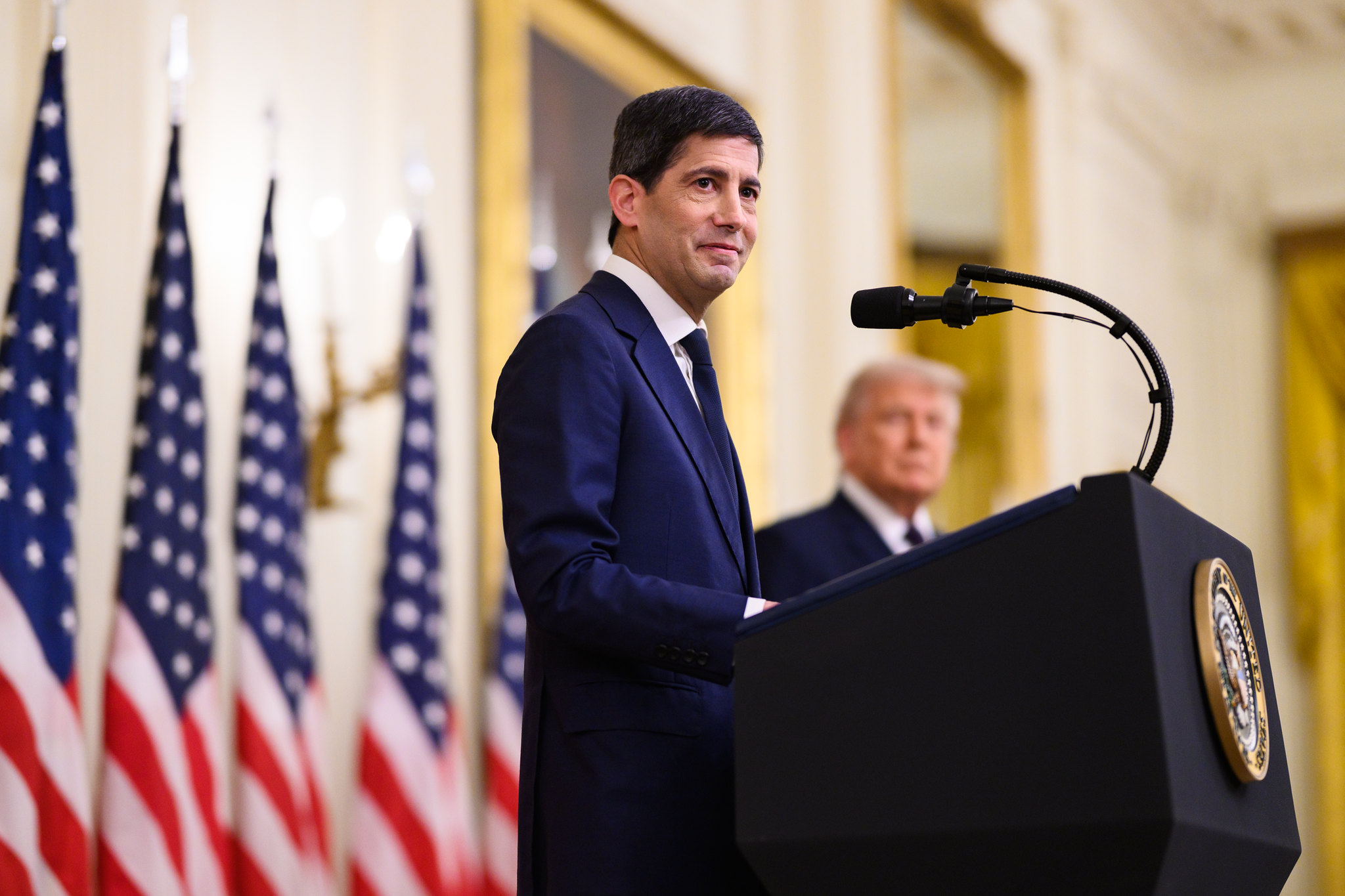
Fed Chair Kevin Warsh. Image source: Official White House photo by Daniel Torok.
Warsh clears the air
When Warsh took over as Fed chair earlier this year, there was much debate over whether Warsh would be a dove (lower interest rates and an expansionary monetary policy) or a hawk (higher rates and a tight monetary policy). Even at the FOMC’s most recent meeting, it was tough to know.
Warsh had said on multiple occasions that prices were too high and that the Fed would bring down inflation. But prior to being confirmed as Fed chair, Warsh had also said that he thought the Fed could measure inflation differently.
Warsh previously suggested that he might favor a “trimmed mean” methodology, which essentially removes the most extreme price movements at both the top and bottom of a basket of prices before taking a weighted average.
Interestingly, the Federal Reserve Bank of Dallas publishes a trimmed mean personal consumption expenditures (PCE) price index. In July, the trimmed mean PCE inflation rate came in at 2.2%.
The PCE, which the Fed currently focuses on, was 3.7% in July. Core PCE, which strips out more volatile food and energy prices, came in at 3.3%. So if Warsh was actually looking at the trimmed mean, that would suggest inflation in his eyes is much closer to the Fed’s 2% target.
Warsh also created a task force early in his tenure to examine how the Fed measures inflation.
Some investors also wondered how willing Warsh would be to raise rates, given how much pressure Trump applied to former Fed Chair Jerome Powell when he didn’t lower rates this year. After all, how could Warsh have obtained the nomination from Trump had he come across as hawkish?
But at the September FOMC meeting, Warsh and the rest of the committee raised rates, much to Trump’s displeasure. On his social media platform, Truth Social, Trump wrote, “Interest Rates in the United States should be 1%, or less, because we are the Best Credit in the World — BY FAR.”
The 17 words that show Warsh may defy Trump again
Now, Trump has seemingly been more patient with Warsh than he was with Powell.
Earlier this year, while Powell was still chair, the Justice Department subpoenaed him over comments he made regarding the renovation of Fed buildings. Powell, along with many critics, claimed the subpoena was retribution for the Fed’s failure to cut interest rates, as Trump desired.
Following the hike, Trump said that he “still has confidence” in Warsh. But his patience may once again be tested if the Fed goes on a hiking cycle. Whether that will happen remains unclear, but the FOMC may very well raise rates again this year.
CME Group‘s FedWatch tool currently places the chance of a hike at the FOMC’s October meeting at close to 58%. According to this tool, there is over an 90% chance that rates will be either a quarter or a half point higher in December than they are today.
And Warsh seems on board with this, especially if the data doesn’t show that inflation is slowing, as evidenced by these 17 words in his post-meeting press conference: “We must be confident that underlying inflation is moving to our objective clearly and at sufficient speed,” he said.
Given that oil prices have been elevated this month, September inflation data may not look good. Furthermore, Warsh’s use of the phrase “sufficient speed” suggests that the FOMC may not be as patient as it has been. There needs to be clear, meaningful progress of inflation back down toward 2%.
We haven’t been able to see a real trend like that all year. Obviously, conditions in this economy can change very quickly, but Warsh’s comments indicate he would be willing to defy the president once again, if needed.

