


LOS ANGELES — It took place three years before the fateful Jeff Fortenberry fundraiser that has the nine-term Nebraska congressman facing a federal trial this week.
But it was singed on Alexandra Kendrick’s brain.
The political fundraising consultant — who counts Fortenberry among her many elected clients — testified Monday that she will never forget taking a phone call in 2013.
From the other end of the phone, the host of a fundraising party for then-Rep. Jack Kingston relayed some horrifying news to Kendrick: All the money they raised at a fundraiser was dirty, siphoned to the campaign through a foreigner. Different nationalities had been at the fundraiser. The FBI was involved.
And she remembers precisely where she was when she got the phone call: at an Atlanta T.J. Maxx, the discount department store. In the purse section. Because of course she was.
That call “felt like an hour — it was probably five minutes,” Kendrick said. “It’s just a worst-case scenario. It’s like a betrayal.”
People are also reading…
It stuck with her. So much so that in early 2016, she hesitated over several factors connected with a fundraiser that was being thrown for Fortenberry in suburban Los Angeles.
“There were some red flags,” Kendrick said. “I had many concerns. For one, we weren’t given an RSVP list before the event. … That’s not normal. I was apprehensive.”
She said she shared that story as a sort of storm warning to Fortenberry. But she doesn’t remember his reaction. She just remembers her apprehension.

Dr. Eli Ayoub walks into the courthouse in Los Angeles on Monday, March 21, 2022. Ayoub testified in the case against Rep. Jeff Fortenberry, R-Neb.
Todd Cooper
Whether Fortenberry shared, or should have shared, that apprehension is the focus of a trial this week in a downtown Los Angeles courtroom. A jury will decide whether Fortenberry is guilty of three felonies: that he tried to conceal illegal foreign donations and that he lied during two interviews with FBI agents investigating such contributions to his campaign. The trial is expected to wrap up Wednesday or Thursday.
Monday afternoon, Dr. Eli Ayoub took the stand and admitted to funneling Nigerian billionaire Gilbert Chagoury’s cash to Fortenberry’s campaign. Monday, he gave a rich detail: the cash from Chagoury came in a brown paper bag.
A go-between handed the money to Ayoub. Ayoub set the bag of cash in the back seat of his car. After arriving for lunch following a funeral, Ayoub handed his keys to a valet and went inside the restaurant.
Then he remembered: the brown bag of $30,000 cash was still sitting on the seat.
So you left $30,000 cash in the back seat of your car? prosecutor Mack Jenkins asked.
“Yes, I remembered I forgot it in the car during lunch, and I was very nervous about it,” Ayoub testified.
Kendrick, a key witness for the government, was nervous about something else. Her client, Fortenberry, finally felt like he had gotten recognition for a cause he had been championing for years: the protection of Christians and other religious minorities who are subjected to religious persecution in the Middle East.
Kendrick said Fortenberry, a Republican representing Nebraska’s 1st District, felt his mission in Congress was acting on behalf of those folks. Among those religious minorities are the Yazidis, who were persecuted, abused and sometimes killed by ISIS members. About 3,000 Yazidis have resettled in Lincoln — and Fortenberry says Lincoln has the largest population of Yazidis outside of Iraq.
Fortenberry often said that it is a constituency that has no natural elected official.
Now, after introducing congressional resolutions of support for such religious minorities, Fortenberry was about to get financial recognition.
“He was excited because he finally had a group of people who were willing to financially support him to thank him for the work that he had done,” Kendrick said.
Whether Fortenberry should have sensed that he was getting dirty money was a subject for several of the trial’s witnesses.
Kendrick said the lead-up to the Feb. 20, 2016, L.A. fundraiser blared all sorts of sirens to her. Biggest thing: She couldn’t get the fundraiser’s host, Ayoub, to tell her who was attending. She knew the event involved a number of nationalities. The event for Kingston, a former Georgia congressman, involved several Palestinians, Kendrick said.
Fortenberry’s attorney, John Littrell, noted that many of the Fortenberry event’s attendees were U.S citizens of Lebanese descent. Littrell asked Kendrick if her real concern amounted to racial profiling. Was she simply concerned because the fundraiser involved Lebanese people?
“It was more than that,” Kendrick said. “Any time you can’t get a list of names and know where the money is coming from … it’s concerning for a multitude of reasons.”
Frustrated, she eventually sent a brief to Fortenberry outlining the upcoming fundraiser with this asterisk: “*We have been unable to get an rsvp list from the hosts.”
Kendrick referred in court Monday to that asterisk as one-part call for help, one-part “cover my bottom.”
She said her concerns were threefold: whether anyone would attend the fundraiser; whether any money would be raised after all the work to get to LA; and, most importantly, whether the fundraiser would comply with Federal Election Commission laws, especially against foreign money.
At the time, the limit on individual donations was $2,700 per individual or $5,400 from couples.
In turn, Kendrick set up a table at the back entrance of the home. Required campaign forms were there, she said, because she didn’t want a repeat of the Kingston episode.
She collected names and forms and money. Lots of it: $36,000.
“It was in the top tier of fundraisers,” Kendrick said.
Kendrick and Fortenberry were thrilled — until Fortenberry noticed something. At least a half-dozen of the donations came from either Ayoub or his relatives. Ayoub and his wife wrote a check for $10,000.
In the wake of that discovery, Fortenberry asked Toufic Baaklini, who described himself Monday as the “in-between” who passed along Chagoury’s money, if there was anything wrong with the fundraiser.
Baaklini said he assured them there was not.
Later Monday, Ayoub, 77, took the stand and described his long-ago connection to Nebraska. The ear-nose-and-throat specialist received his training at Creighton University, spending nine formative years of his career in Omaha.
Some 30 years later, the Los Angeles physician got involved with In Defense of Christians — the group supporting religious minorities in the Middle East.
Eventually, Ayoub doled out more of Chagoury’s money to other politicians’ campaigns: $50,000 to former presidential candidate Mitt Romney; $30,000 to California Rep. Darrell Issa; and $20,000 to former Nebraska Rep. Lee Terry.
Those elected officials disgorged the money — the official term for purging dirty donations from a campaign, usually by turning them over to charity. Fortenberry took more than two years to do the same.
Ayoub said he initially didn’t disclose anything about Fortenberry or the 2016 fundraiser to FBI agents. In fact, it wasn’t until he received a March 2018 text message from Fortenberry that he informed the FBI that he had funneled Chagoury’s money to a fourth politician: Fortenberry.
Jenkins asked Ayoub, now cooperating with prosecutors, if he knew what he was doing was wrong.
“At that time, I believed it was illegal, but I was too blinded by the events in the Middle East, by the persecution of the Christians in the Middle East,” Ayoub told jurors. “I failed myself, I failed my friends and I failed my values. What I did was against my values.”
Littrell did what the defense team has done with all prosecution witnesses. He tried to: 1) establish that Fortenberry was never expressly told about Chagoury’s money; and 2) get each witness to vouch for Fortenberry’s character.
Judge Stanley Blumenfeld Jr. blanched at those efforts. Typically, witnesses are not permitted to testify to the general character of a defendant. In other words, judges won’t allow “he’s a good guy” testimony, just as they won’t allow “he’s a bad guy” testimony.
Littrell: Fortenberry “is an honest person?”
Littrell: “He is a law abiding person?”
Littrell: “He is a devout Catholic. You are a devout Catholic?”
Kendrick: “Trying to be.”
Littrell: “He helped you on your faith journey?”
Finally, prosecutors objected. The judge sustained the objection, ordering jurors to disregard commentary on Fortenberry’s reputation.
“That is essentially (character) testimony by the defense,” Blumenfeld said sternly. “You should move on.”
Testimony Tuesday is expected to turn to prosecutors’ allegations that Fortenberry lied in two interviews with the FBI over the investigation into the fundraiser.
Fortenberry denies he lied. It is not yet clear whether he will take the stand.

For the first time Thursday, the public — and more importantly, jurors — heard an overview of U.S. Rep. Jeff Fortenberry’s defense in his court case.

A U.S. district judge begins questioning jurors Wednesday on their ability to be fair and impartial in deciding U.S. Rep. Jeff Fortenberry’s fate.

U.S. Rep. Jeff Fortenberry, Nebraska’s 1st District congressman, is set to go on trial in Los Angeles, facing three felony charges as he runs a reelection campaign.

A federal judge rejected U.S. Rep. Jeff Fortenberry’s attempts to suppress his two 2019 statements to the FBI and U.S. attorneys investigating illegal contributions.

A judge will not transfer Rep. Jeff Fortenberry’s trial to Nebraska, noting that a fundraiser that was the genesis of the criminal case against the nine-term congressman took place in California.

Rep. Jeff Fortenberry, R-Neb., faces three felony charges as he seeks his 10th term in Congress. His lawyers want the trial to be held in Nebraska, not California, and held before the May 10 primary.

Rep. Jeff Fortenberry’s attorneys are seeking to show that the congressman was simply confused, rather than lying to agents.

California’s federal courts have suspended jury trials through the end of February because of a surge in COVID-19 cases. U.S. Rep. Jeff Fortenberry’s trial had been scheduled to begin Feb. 15.

The judge in the federal case against U.S. Rep. Jeff Fortenberry blistered Fortenberry’s attorneys Tuesday for attacking an FBI agent’s reputation.

A federal judge has rejected U.S. Rep. Jeff Fortenberry’s first barrage of defense attacks on the indictment against the nine-term Nebraska congressman.

When federal prosecutors announced indictments against the Nebraska congressman, GOP operatives privately began discussing possible successors. But none have emerged.

Federal prosecutors are accusing lawyers representing indicted U.S. Rep. Jeff Fortenberry of smearing the reputation of an FBI agent by falsely claiming he was biased against Arabs and Muslims.

Federal prosecutors and lawyers for Rep. Jeff Fortenberry argued for an hour before a judge on Monday over three defense motions to dismiss the case.

Attorneys for indicted U.S. Rep. Jeff Fortenberry claim that a lead prosecutor misled the congressman into making incriminating statements.

In a motion filed Monday, Rep. Jeff Fortenberry’s lawyers asked a judge to force prosecutors to disclose what promises they made to a key informant in the case.

In court briefs filed Tuesday, the Central California U.S. District Attorney’s Office asked a judge to reject motions by Fortenberry’s defense lawyers to dismiss three felony indictments.

A spokesman for U.S. Rep. Jeff Fortenberry blasted federal prosecutors, saying they hadn’t shared “the whole truth” about why he had not returned illegal campaign contributions.

Prosecutors have turned over more than 11,600 pages of documents and more than 50 audio and video recordings to lawyers defending Rep. Jeff Fortenberry.

The motion argues that any misstatements made by Fortenberry to investigators were not “material” to crimes the FBI was investigating, so the felony charges against the congressman should be dismissed.

Fortenberry’s attorney accused federal prosecutors of “opportunistic venue shopping” and “gross abuse of power” for filing charges against the Republican congressman in California, far from his home in Lincoln.

A judge has barred Rep. Jeff Fortenberry from possessing or being left alone with evidence gathered by confidential informants during a federal investigation into illegal campaign contributions.

Toufic Baaklini, who resigned on Sunday, had served as president and a board member for several years for In Defense of Christians, an organization that fights persecution of Christians.
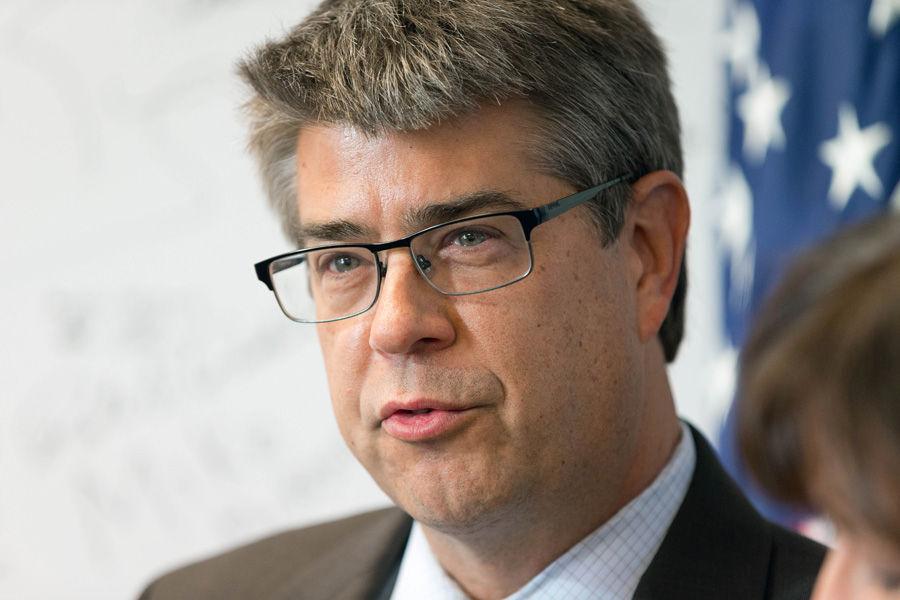
“You got to know these people … they tell you they’re citizens, and then all of a sudden they’re not,” said former Rep. Lee Terry, who said he donated the money that originated from Gilbert Chagoury.

The defense attorney representing Rep. Jeff Fortenberry against allegations that he misled and obstructed a federal investigation came out swinging during the congressman’s initial court hearing.

A federal grand jury indictment charges U.S. Rep. Jeff Fortenberry with one count of scheming to falsify and conceal material facts and two counts of making false statements to federal investigators.

Fortenberry has said the allegations, linked to a federal investigation into illegal campaign contributions from a Nigerian billionaire, are untrue and a betrayal after he cooperated with the FBI.

A source said an indictment could come as early as Tuesday. The nine-term Republican from Lincoln said he is being wrongly accused. “We will fight these charges. I did not lie to them,” he said.

Fortenberry hired a lawyer and set up a legal expense fund — but was not charged — after being named in reports about a foreign national who illegally gave money to U.S. campaigns, the spokesman said.
cooper@owh.com, 402-444-1275, twitter.com/CooperonCourts

