


It’s pretty much impossible for investors not to have noticed that technology stocks — and artificial intelligence (AI) stocks in particular — have dominated the headlines for a while now. You may even own a couple of these names.
Smart investors know, however, that headlines are often backward-looking. If you really want your portfolio to grow, you need to step into the market’s next top opportunities before the rest of the crowd discovers them.
To this end (and after a fairly lengthy period of just so-so performance), a handful of industrial stocks look primed for above-average results. Here’s a closer look at two of this sector’s best bets right now.

Image source: Getty Images.
Vertiv Holdings
Making a quick review of Vertiv Holdings‘ (VRT -4.57%) portfolio of products is indeed a boring endeavor. Industrial-scale power supplies, high-capacity HVAC solutions, and facilities-monitoring tech of all types just aren’t exciting.
Now dig deeper and look at who this company’s top customers are right now, and will be for the foreseeable future. That’s artificial intelligence data center owners and operators who need to make the most efficient use of whatever electricity they can get, and then deal with the enormous heat AI accelerators generate — two challenges the modern AI industry wasn’t fully prepared to tackle in its infancy.
And the numbers prove as much. Vertiv’s Q1 revenue grew 30% year over year to $2.65 billion because, in CEO Giordano Albertazzi’s words, “We’re seeing data center infrastructure requirements evolve significantly, with customers prioritizing optimized design, deployment speed, and operational efficiency — reshaping their approach to deployment.” The company is guiding for comparable sales growth through the rest of the year as well.
The underlying opportunity, however, is far greater in its scope and duration. The data center cooling market is likely to grow at an average annual pace of nearly 12% through 2035, according to an outlook from Precedence Research, which adds that the power management aspect of the business is expected to grow at a slower but steady yearly average of 7% for the same time frame. With partnerships like its one with Nvidia to develop the 800-volt DC (direct current) platforms that are increasingly in demand (due to their heightened efficiency), in addition to its liquid-cooling tech that reduces the consumption of cooling energy by up to 80% (because it makes direct contact with AI processing chips), Vertiv is quietly positioned to win a lot of this growth.

Today’s Change
(-4.57%) $-13.89
Current Price
$290.15
Key Data Points
Market Cap
Day’s Range
$288.60 – $301.89
52wk Range
$118.70 – $379.94
Volume
244.7K
Avg Vol
5.9M
Gross Margin
35.00%
Dividend Yield
0.08%
This might help get you on board: Despite the stock’s strong performance over the course of the past couple of years — in the midst of artificial intelligence mania — the vast majority of the analyst community still rates this ticker as a strong buy, with a consensus price target of $376.99, which is 24% above Vertiv shares’ present price.
Fluor
Fluor (FLR -2.01%) is in the construction business, but not in the way you might think. Rather than residential housing, this company designs and builds semiconductor manufacturing facilities, chemical factories, nuclear power plants, airport infrastructure, and more.
Although lucrative, it’s a complicated and sometimes unpredictable business. Such large-scale projects typically take time to fund, years to plan, and then years to execute. Much can change during construction, too, including expected costs. That’s a problem that came to something of a head in 2023 and has weighed on the stock off and on ever since.

Today’s Change
(-2.01%) $-1.07
Current Price
$52.19
Key Data Points
Market Cap
Day’s Range
$51.70 – $53.38
52wk Range
$37.62 – $57.50
Volume
3.3M
Avg Vol
2.8M
Gross Margin
-162.66%
Nevertheless, Fluor’s big enough and has been around long enough to navigate such twists and turns. Since that point in 2023, for instance, the company has successfully fought to make more of its projects reimbursable at Fluor’s cost rather than use the flat-price contracts that pose a greater degree of risk. As of March, 82% of its $25.7 billion backlog is reimbursable, versus only 63% as of the end of 2022. This should smooth out bottom-line results for the company and, by extension, for shareholders.
In this vein, although this year’s projected revenue of just under $15.9 billion is only a little more than 2% better than last year’s top line, analysts are calling for 7.5% sales growth next year, which should boost per-share profits by 27%.
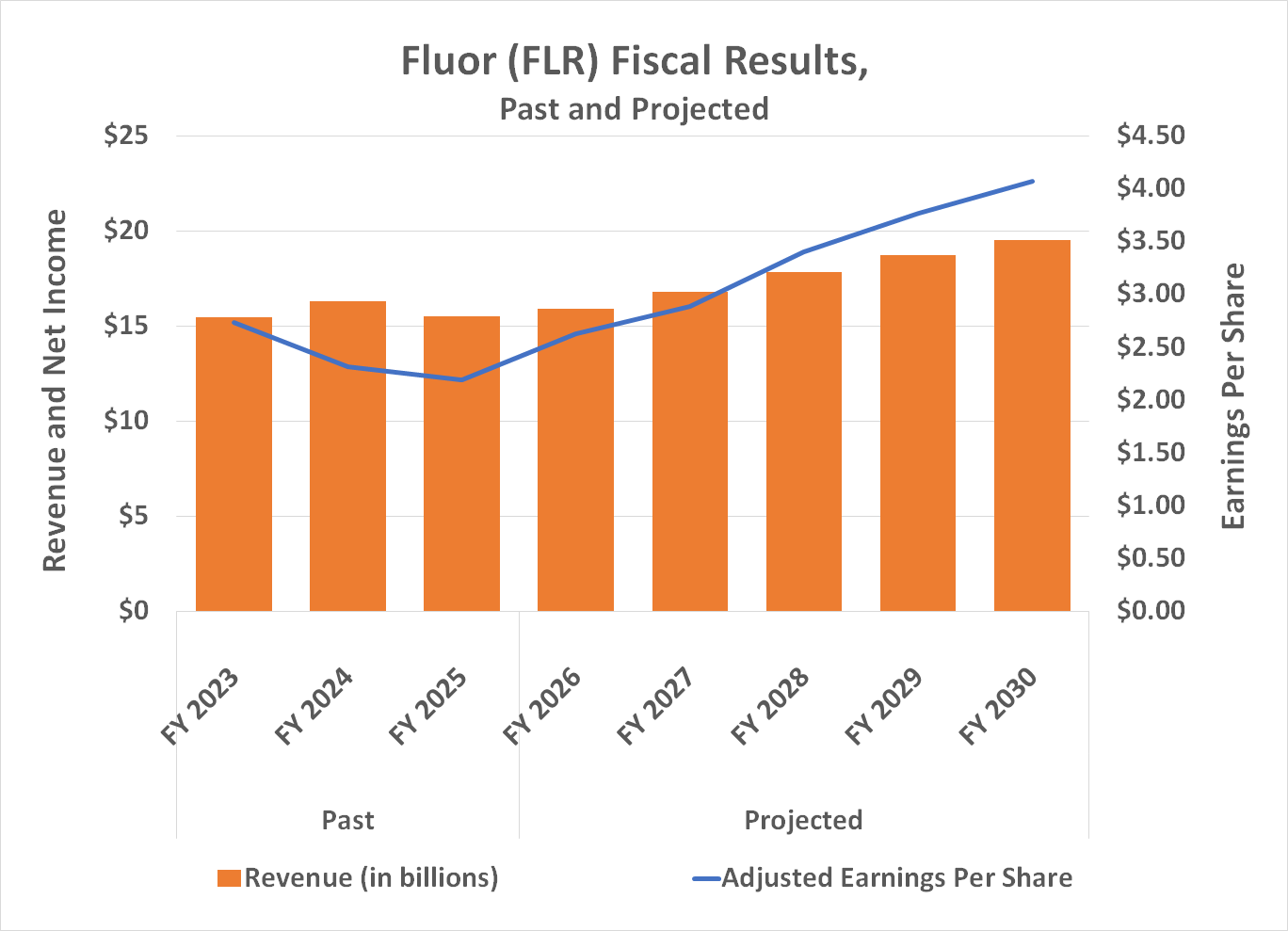
Data source: Morningstar. Chart by author.
Why such a swell of sales growth and outright explosion in profit growth? That’s when several sizable, higher-margin projects are expected to fall into place, and some of its older, lower-margin projects will finally be completed. As Standard & Poor’s notes, “Over the past few months, Fluor announced several awards it expects will accelerate growth in the second half of 2026 and 2027, including the limited notice to proceed on LNG Canada Phase 2 and TeraWulf’s large-scale data center campus.” S&P goes on to say, “If moved to execution phase, awards could potentially convert to multiyear mega projects that would fuel revenue growth over the next several years.”
This long-term future potential isn’t yet priced into the stock. Just know that Fluor should really be viewed only as a long-term, buy-and-hold prospect.

