


Many investors keep close tabs on Berkshire Hathaway‘s (BRKA 0.57%) (BRKB 0.59%) stock holdings, and understandably so. Copying these picks gives investors a chance to benefit from former CEO Warren Buffett’s wisdom.
The fact is, however, the secret of Berkshire’s long-term success has never been its individual equity holdings alone. These stock holdings are simply an add-on to the recurring profits the conglomerate’s several dozen private, wholly owned businesses generate, making it much easier to stick with the stocks it already owns.
And their operating profits just reached a new record.

Image source: Getty Images.
Still more conglomerate than a mutual fund
Berkshire Hathaway owns a wide range of businesses, including Dairy Queen, Duracell batteries, Fruit of the Loom, and Shaw flooring, among others.
Its biggest moneymakers, though, are insurance, its railroad arm BNSF, and utility name Berkshire Hathaway Energy. These businesses produced nearly $6.9 billion in net earnings last quarter. Everything else combined contributed almost another $3.2 billion to the bottom line, pushing the company’s operating profit up to nearly $10.1 billion. (Note that Berkshire also suffered realized and unrealized investment losses of over $1.2 billion in Q1, dragging its net reported earnings lower.)
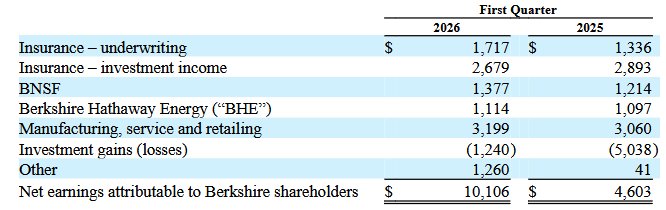
Data source: Berkshire Hathaway’s Q1-2026 report.
That’s a record amount of operating earnings from Berkshire Hathaway’s privately owned businesses, by the way. Moreover, it’s ongoing improvement that makes a world of difference to current and future shareholders.
A structure that allows Buffett, and now Abel, to think differently
At the risk of waxing too philosophical, it’s much easier to be patient with stocks when you also own a bunch of cash-generating businesses that don’t require you to worry about their market value. That’s not a luxury most investors — retirees in particular, who may need to sell stocks from time to time — enjoy.
This hasn’t prevented Berkshire shares from ebbing and flowing with the broad market, even though only about one-third of the company’s total value reflects the value of its publicly traded equities. Another third is the aforementioned wholly owned outfits, such as Dairy Queen and BNSF. The rest, right now, just reflects Berkshire’s current cash stash of nearly $400 billion, waiting to be put to work.

Today’s Change
(-0.59%) $-2.84
Current Price
$474.58
Key Data Points
Market Cap
$1.0T
Day’s Range
$472.30 – $477.29
52wk Range
$455.19 – $516.85
Volume
206.6K
Avg Vol
4.9M
Gross Margin
23.70%
Regardless, knowing your $1 trillion company will be clearing on the order of $40 billion in reliable, accessible cash every year, no matter how the stock market is performing, changes how you buy and hold stocks. Namely, it allows you to remain patient, sticking with positions that most ordinary investors might dump in a panic. And that was arguably the secret to Warren Buffett’s historical, market-beating success over his 60 years as CEO.
New CEO Greg Abel is embracing the same philosophy, adding proven but volatile stocks like Alphabet to Berkshire Hathaway’s holdings last quarter.
Use Berkshire to do what you can’t on your own
Most investors can’t outright buy cash cows like Berkshire Hathaway Energy and Duracell, of course. They are largely limited to stocks and forced to make buy/sell decisions knowing the prices can and will change … sometimes in unpredictable, irrational ways.
That’s what makes Berkshire such a compelling investment in and of itself. There’s little out there quite like it, and nothing else out there that’s exactly like it.
More to the point for interested investors, this structure and strategy make Berkshire Hathaway a compelling long-term prospect pretty much anytime at any price.

