


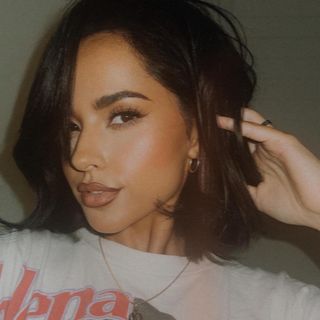
Make no mistake. Becky G. is a modern-day beauty icon. Scroll through her Instagram posts, and it becomes clear that her 37.2 million followers would agree (her comments are brimming with adoring fan messages and gushing heart-eye emojis). While the singer-songwriter is known for inventive, experimental, and ever-changing makeup looks, there’s usually razor-sharp cat-eye liner involved.
It’s no wonder she’s one of three female artists featured in an exciting new limited series, called Faces of Music. Sephora and Hulu teamed up on the project with one shared goal: celebrating and exploring the deep connection between beauty and music. It launches today, January 22, on Hulu. Each of the three episodes will feature iconic beauty looks from artists like Chappell Roan, Victoria Monet, and yes, Becky G.
Ahead of the series debut, we connected with Becky G. to talk about all things beauty. Keep scrolling to read the full interview and learn about everything from her past red-carpet blunders to the makeup hacks that she learned from her long-time friend and makeup artist, Gilbert Estrada, and how her Mexican-American heritage continues to inform her self-expression.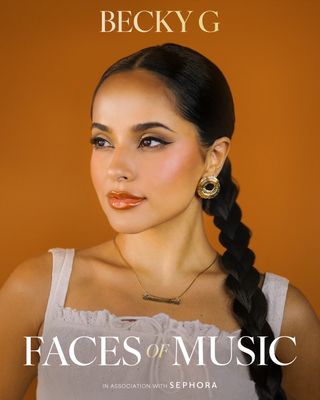
Faces of Music highlights the deep connection between beauty and music. How does beauty inform your music and vice versa?
I feel like all forms of creativity are about connection. For me, personally, it’s about like storytelling. It’s a form of expression that I think, since I was very little, I naturally gravitated towards. It was generational too, seeing my mom get ready for family events, and seeing my grandmothers get ready for church on Sunday because those were their big events. I think it’s a process of connection with yourself, but then I realized, in my generation, it became a process of connection with others in the beauty space and makeup in particular. For me, it goes hand in hand with my artistry in music, because a big part of what I do in music is connection with my audience and storytelling. It just feels like an extension of me, if that makes sense.
Absolutely. I love that you said it’s a generational connection. How does makeup help you connect with other people, whether that’s in real life or online?
I think it has a lot to do with the internet. The way that you can find recommendations for certain products. You can walk into a Sephora and be totally clueless, and then walk out a lot more informed and a lot more educated just by asking the people around you what to look for. I think back in the day, it used to be like, ‘What’s your secret?’ And some people would totally gatekeep. There was not a lot of sharing information or whatever that secret was.
I feel like today it’s much more communal. Everybody wants to share what works for them in hopes that it can help someone else. I grew up as that generation was transitioning and coming around.
I had a lot of acne growing up. I had all kinds of things that, to be honest, I would try to cover with makeup. I talk about this in the episode—how makeup has evolved in my self-discovery. It used to be this thing that I used to hide behind, and now I use it to amplify and empower what’s already there. I think that’s also a reflection of how much more communal the space has become. We’ve become more empowered. We empower one another, and it’s really cool to see.
I agree. That’s my favorite part of my job as a beauty editor—the connection. In the episode, you speak about your background. You’re a proud Mexican-American artist. How has your heritage informed your beauty routine and philosophy?
I think it goes back to the whole space being more communal. For me growing up, it was very much ‘sharing is caring.’ That’s what my godmother would say. She was an early intervention preschool teacher, and she would bring all of her school songs home. One of the biggest things that we would practice was ‘sharing is caring.’ I feel like that is how our culture is. We share everything. We share our food, we share our drinks, we share our music, we share our homes if someone is in need.
I think that’s coincided with how my beauty philosophy is today, and how open I am about my beauty journey and my beauty products and routines and things like that. It’s that side of my culture that inspires it. Also, just stylistically, I think there’s a lot in Chicano culture… Because my mom, being a young Latina growing up in LA just naturally inherited from her. My mom in high school is for sure my style icon—the way she would style her curly hair to the types of lip liners that she would wear, the style of clothes…Nobody else in my industry grew up wanting to rock [Timberlands]. I wanted to because my mom did in high school. Our culture is very much about passing something down and about generational traditions and things like that. I feel like the beauty traditions from watching my mom and my grandmothers…they’re very present in my beauty habits.
Justice for moms for being the original beauty icons. One part of the episode that really struck me was when you referenced your beauty icons, like Penelope Cruz, Salma Hayek, and J.Lo. How does it feel to be a beauty icon for the younger generation?
That’s wild. It’s actually really crazy, especially coming from somebody who, like many, over-plucked their eyebrows and wore foundations that were never color-matched because they didn’t know how to make olive undertones for brown girls like me. Any kind of beauty-go-wrong that I can think of, I tried growing up. It’s funny to think that somebody who’s messed up so much and walked onto carpets without brushing off setting powder could be considered an icon.
I think it’s because I’m not afraid to play. Since I was very young, my first interactions with makeup were literally playing dress up. My mom was a young mom. She was never the mom that was like, ‘You’re too young to wear makeup.’ She was like, ‘Have at it, kid.’ It was fun. It was a space to be creative and a space to play. Everybody comes to me, and they’re like, ‘I’m not good at eyeliner. I could never.’ I’m like, ‘You’re not good at eyeliner because you don’t practice!’ You’re not just naturally good at something. Clearly, if I over-plucked my eyebrows and didn’t know how to color-match foundations…I also was not very good at eyeliner. Play was so important and practice was so important for me. You don’t just get good at something overnight. You kind of have to find yourself and find your style. I hope that that inspires somebody else to do the same for themselves.

