


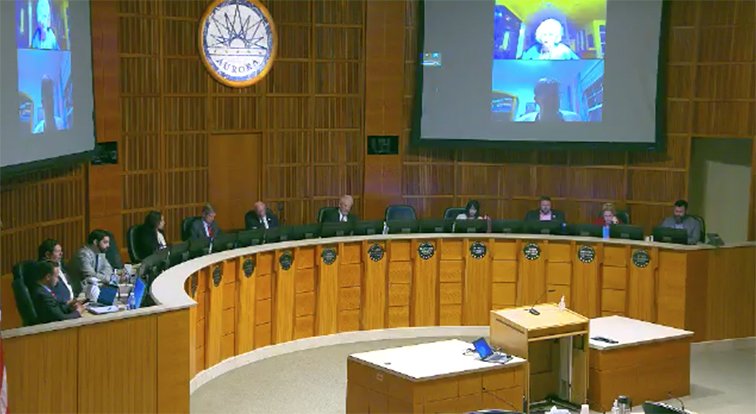
AURORA | Every other year, a new crop of city lawmakers are elected by the fraction of Aurorans who turn out to vote — less than 31% of registered voters in 2021.
Odd-year local elections can be where the direction of policing, education, road maintenance and more are decided by city councils and school boards. But unlike even-year elections, which install congresspeople and presidents, local contests tend to draw a much smaller sample of the population, which tends to be older and wealthier than the jurisdiction as a whole.
It’s a situation that may tilt elections in favor of conservatives — a fact that one progressive council member didn’t dwell on while sharing proposals to increase voter turnout with lawmakers last week, including shifting council elections to even years and noting candidates’ party affiliation on ballots.
Councilmember Juan Marcano did focus on how other cities that don’t practice official nonpartisanship and those which shifted their elections to coincide with even-year races saw greater participation.
“We’re not alone in that problem,” Marcano said of year-to-year dips in voter turnout. “A lot of other cities have actually taken steps to correct that problem, and what they did is they ended up moving their elections to even years to coincide with state and federal elections.”
Conservative Francoise Bergan and Angela Lawson, fellow members of the city council committee where Marcano presented his proposals, were skeptical. Both said they were worried that changing the timing of elections would lead to fewer people researching the local candidates and issues up for consideration, leading the public to make uninformed decisions.
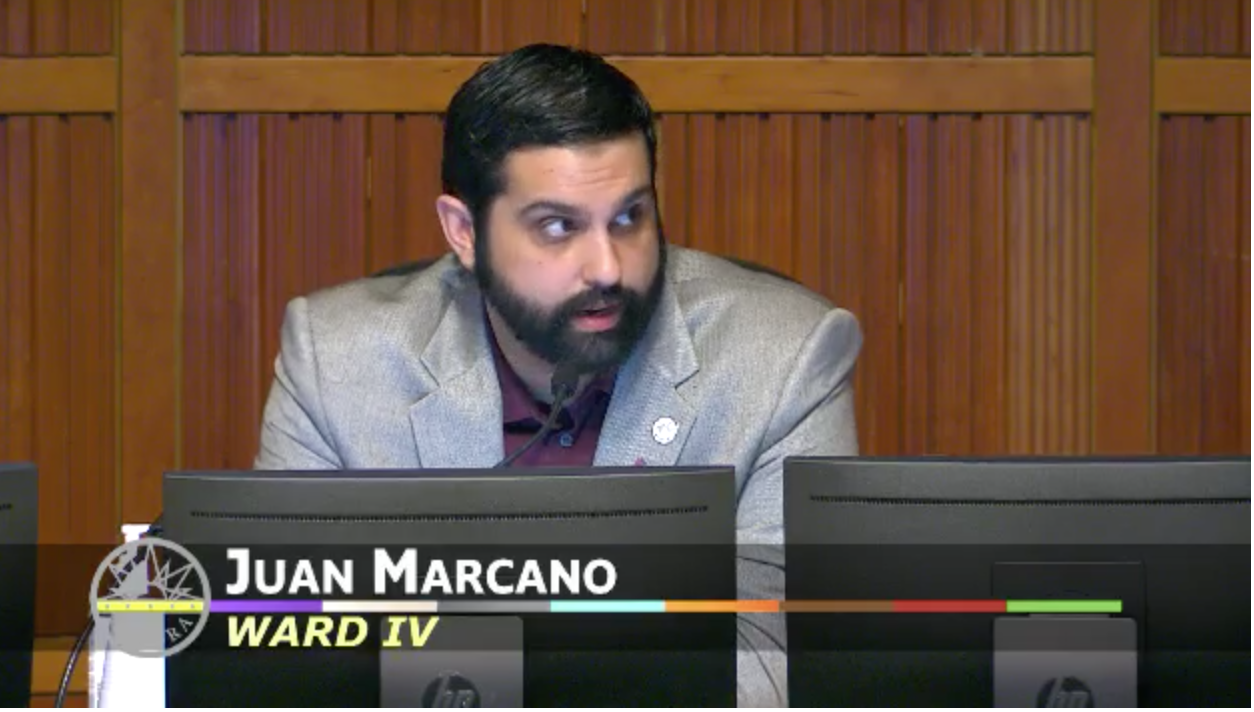
Marcano said he believed the proposed changes could also help address the polarization and partisan conflict that has become ubiquitous on the council.
Aurora’s City Council is nonpartisan in the sense that a candidate’s party affiliation isn’t included on the municipal election ballot. But Aurora council members tend to decide controversial issues along party lines, and the current council is no stranger to open partisan conflict.
Progressives achieved a functional majority on council in the final year of the Trump presidency. But when Councilmember Nicole Johnston stepped down in June 2021, the liberal and conservative factions found themselves at a deadlock and failed to fill her vacant seat because they could not agree on a replacement.
Then, in November, voters elected a new crop of mostly conservative council members. A new majority of seven has guaranteed the success of conservative proposals such as Mayor Mike Coffman’s once-torpedoed homeless camping ban but hasn’t stopped hostility from erupting on and off the dais.
Council members have given one another nicknames like “the minister of propaganda” and walked out of meetings. In March, one member sponsored a resolution to ban “attacks of a personal nature” on the dais. A month and a half later, the same council member used Twitter to accuse two colleagues of misusing public funds.
“I think that one of the best cures that we have (for) some of the polarization that we’re experiencing in our country and really improving trust in our institutions is improving the participation in our local elections,” Marcano said.
He cited academic research focusing on changes in election timing in California cities, which reportedly led to a larger group that was more representative of the total population in terms of age, race and party affiliation casting votes in local contests.
According to an essay by University of California San Diego professor Zoltan Hajnal, which Marcano included in the committee’s agenda packet, off-cycle city elections in California may grant an outsized amount of power to an “extraordinarily unrepresentative set of residents” — politically active labor unions in some places and wealthy, white conservatives in others.
Under Marcano’s proposal, shifting local elections to even-numbered years would require council candidates elected in 2023 and 2025 to accept three-year terms rather than the typical four-year term, with on-cycle local elections beginning in 2026.
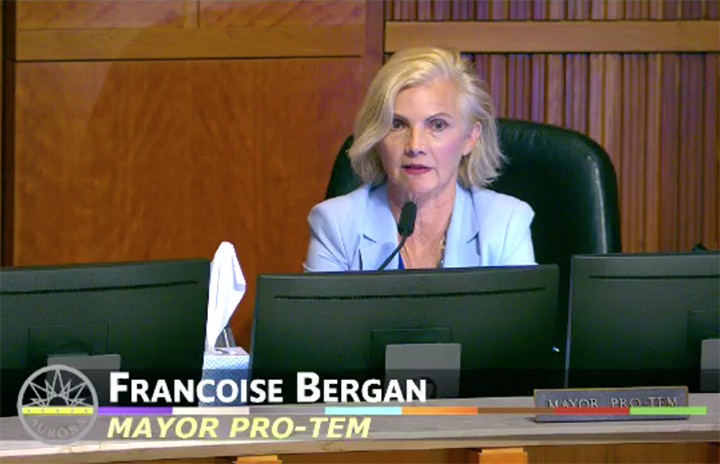
Bergan said the move would work against candidates trying to reach voters.
“We have a special election for City Council, and the attention is only on City Council. I feel like it gives us a better platform when you’re running for office to get your messages out to the voters,” Bergan said. “I think you might get greater participation, but I don’t think it’s going to be thoughtful participation.”
Marcano disagreed.
“I take offense, actually, to that characterization of our electorate,” Marcano replied. “It actually creates more cohesion around issues and candidates who are already basically building working relationships with folks who are running for other levels of government.”
He also suggested that the city start requiring candidates to declare their party affiliation or identify as unaffiliated on local ballots, which he said the city is permitted to do as a home-rule city.
Marcano argued, citing a statement from NYU Law’s Brennan Center for Justice and an article by Rice University and University of Notre Dame professors, that the change could make it easier for voters to identify candidates who share their views and could also boost participation.
The documents also indicate that officially nonpartisan elections may favor Republicans. In Aurora’s 2021 election, turnout among registered Democrats was lower than both Republicans and unaffiliated voters.
Bergan and Lawson both said they thought the change would turn people off to local politics by associating candidates with the country’s two dominant and frequently divisive political parties.
“One of the things that’s so interesting and makes municipal government unique is because it is nonpartisan,” said Lawson, who currently tends to vote with the council’s conservative bloc but identifies as unaffiliated. “Internally, let’s just be real, it is partisan. But … if you have people who are not trying to be in any of this and want to just run to do good for the people of the city and the community, then I think that’s attractive.”
Marcano said the lack of partisanship, at least in Aurora, is a myth.
“I don’t like the hyperpartisan, vitriolic environment that we have,” Marcano said. “The first step to addressing a problem is acknowledging that you have it. … I feel that it’s incumbent on us to be transparent with our residents.”
Related to the issue, Marcano and Lawson said they would work on a proposal for state lawmakers to prevent people from being barred by their employers for running for office in partisan races, which was another concern raised by Lawson.
Lawson and Bergan also said they did not support an idea of Marcano’s to fill some council vacancies by having the group who filled out a departing candidate’s nominating petition vote on their replacement, saying those signatories may not be representative of the group that ultimately elected the candidate.
A proposal by Councilmember Alison Coombs to create a citizen committee to evaluate the city’s current charter was not heard because the related materials weren’t included in the committee’s agenda packet.
The Charter Review Ad Hoc Policy Committee is scheduled to meet next at 2:30 p.m. Aug. 23, when Coombs’ proposal may be considered. A public hearing will be scheduled after that.

