


If you have been through hotel check-ins and trade show conversations, you’ll recognize a very specific moment. Someone pulls out a translator device, speaks into it, then turns it around and holds it up to a stranger’s face. The other person leans in, squints at a small screen, and for a second the whole exchange stops feeling like two people talking and starts feeling like a transaction. Wooask noticed this too, apparently for a long time, and their answer is a product that steps away from the handheld format entirely.
The company built its reputation on portable translators and translation earbuds, gear that’s been through airports and hotel counters across 160 countries. Their new device, the Wooask AI TransNote (T05), takes a different shape. It’s a dual-screen desktop unit meant to live permanently on a counter or table, right where two people who don’t share a language need to get something done together, whether that’s a hotel booking, a contract detail, or a consultation.
Why a desk gadget instead of another handheld
Wooask’s product lead Andy Lee frames the idea around something the team kept running into over 18 months. The team ran these field tests at trade shows, hotel counters, and negotiation rooms. Handheld translators, he says, were really built with tourists in mind, moving from hand to hand for the length of a quick exchange. But that hand-to-hand motion breaks eye contact every single time, and a conversation that should feel personal starts to feel mechanical instead.
I’ve felt this from the other side, standing at a counter somewhere waiting for a phone screen to get turned my way. It’s a small thing on its own, but for someone doing this all day, that small friction repeats itself constantly. This could be for anyone, like a hotel receptionist checking in dozens of guests or a professor fielding questions from an international group. Giving each side its own screen changes the shape of the whole interaction. Nobody grabs the device, nobody twists it around, and the two people can just sit and talk while the translation happens quietly on the surface between them.
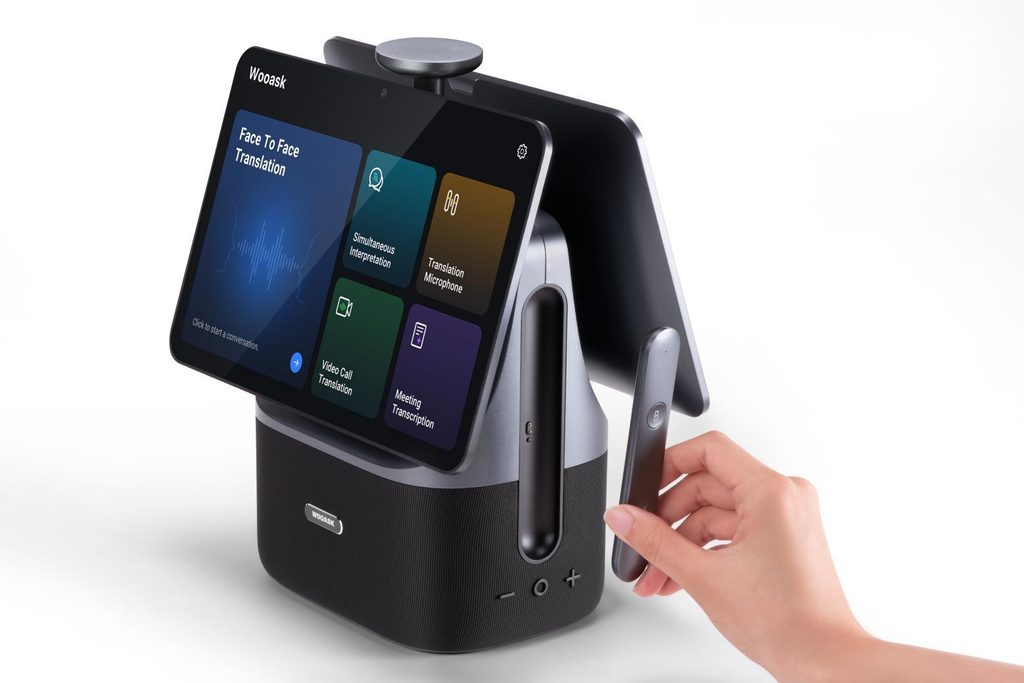
Where this is meant to live
Wooask is pitching TransNote for hotel and corporate front desks, airport service counters, government and public service halls, negotiation tables, corporate conference rooms, and lecture podiums. It’s a clear, focused list, and it tells you this was designed with a specific kind of user in mind. At the same time, it is also for someone whose job involves standing between two languages for hours at a time. This is opposite to someone packing for a two-week trip abroad.
That focus is what makes the concept interesting to me. A tourist buying a pocket translator is thinking about battery life and portability. A hotel, a service counter, or a company bringing in a fixed desk unit is thinking about how naturally it fits into a shift, how quickly staff can pick it up, and whether it actually makes daily interactions smoother instead of adding another gadget to manage. TransNote seems built with that second kind of user front and center, and that’s a meaningfully different design problem to solve well.
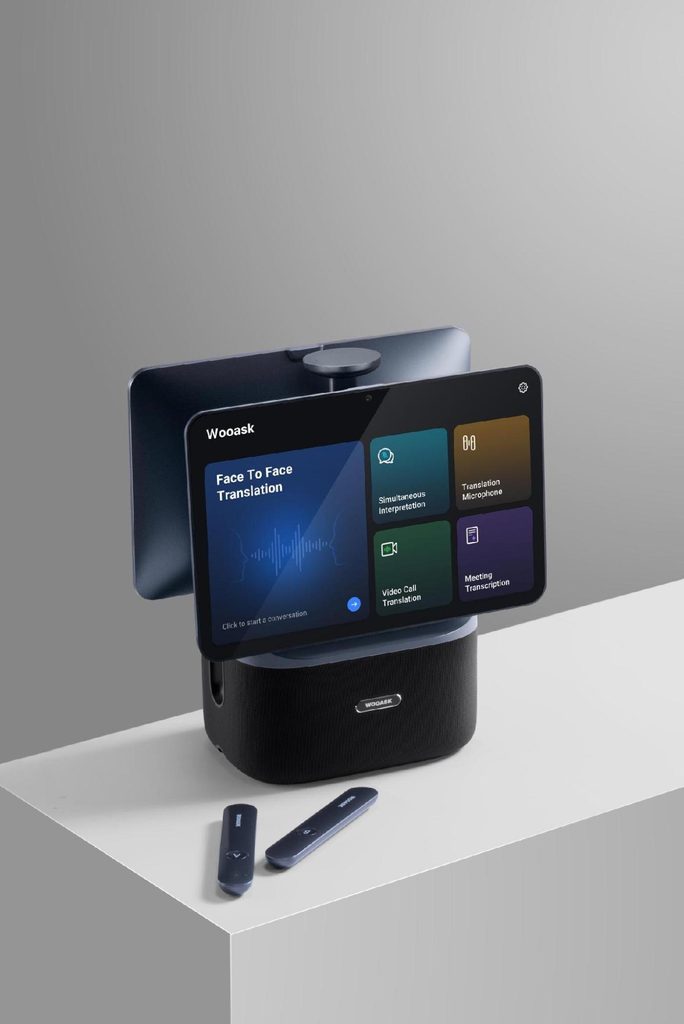
What I like about the idea
The dual-screen approach solves the exact discomfort I’ve watched happen in real life more times than I can count. There’s something genuinely nice about two people sitting across a desk, each looking at their own screen, still able to look up and make eye contact rather than passing a device back and forth like a hot potato. It keeps the human part of the interaction intact, which is easy to overlook when a product is judged mainly on translation accuracy or language count.
I also like that Wooask is drawing on a decade of experience with translation hardware rather than jumping into this cold. A team that’s already built handheld translators and earbuds used across 160 countries has presumably learned a lot about where those formats fall short, and TransNote reads like a direct response to lessons picked up in the field rather than a concept dreamed up in a boardroom.
TransNote’s other job: taking over the middle of the meeting table
There’s a second use case here that’s easy to miss if you’re only thinking about the translation angle: the conference table.
For years, meeting recording has meant someone reaching into a bag for a personal voice recorder — a Plaud Note, or something similar — and setting it down in the middle of the table. These work fine for the person who owns one. But they weren’t built to capture a full room. Pickup range drops off fast past a couple of seats, and the device stays tied to one person’s account rather than becoming something the whole meeting can use.
Put a TransNote in that same spot and the job changes. It runs a four-microphone array on top, rated for omnidirectional pickup across 5 meters (roughly 80 square meters), which covers most conference rooms without anyone needing to lean toward the device. Voiceprint recognition identifies who said what, and the system can also narrow its pickup to 45, 90, or 135 degrees for meetings that need more directional focus instead of full-room capture.
From there, it handles the parts people usually do by hand afterward. Real-time transcription runs during the meeting itself, and once it wraps, TransNote generates structured bilingual meeting minutes, a summary of key points, and a mind map of how the discussion connected. Anyone in the room can scan a QR code afterward and pull the recap straight to their phone.
It’s a different kind of desk moment than the translation use case, but the logic is the same: one device sitting in the middle of the table, doing a job that used to fall on whoever remembered to bring a recorder.
What I’m looking forward to next
As the fuller spec sheet comes out, I’ll be waiting on the details that turn a good concept into something teams actually adopt day to day. Things like how many languages it supports well, how it performs in a busy lobby with background noise, and how quickly the translation shows up on screen during a live conversation. These details tend to make or break a product like this once it’s sitting on someone’s front desk.
None of that changes the core idea, though. The instinct behind Wooask AI TransNote feels right to me. Handheld translators were never really designed for the person standing at a counter for an entire shift, and a fixed dual-screen station is a thoughtful answer to something a lot of us have experienced without quite naming it. It’s the kind of product that makes us say, “oh, of course,” once you see it, which is usually a good sign.
I’m looking forward to seeing this in action, especially in the settings Wooask is targeting, since a hotel front desk or a corporate conference room is exactly where a shift like this shows up in how people experience the interaction.

