


While some investors are already well versed in financial metrics (hat tip), this article is for those who would like to learn about Return On Equity (ROE) and why it is important. By way of learning-by-doing, we’ll look at ROE to gain a better understanding of Ubisoft Entertainment SA (EPA:UBI).
Return on equity or ROE is a key measure used to assess how efficiently a company’s management is utilizing the company’s capital. In simpler terms, it measures the profitability of a company in relation to shareholder’s equity.
Check out our latest analysis for Ubisoft Entertainment
How Do You Calculate Return On Equity?
ROE can be calculated by using the formula:
Return on Equity = Net Profit (from continuing operations) ÷ Shareholders’ Equity
So, based on the above formula, the ROE for Ubisoft Entertainment is:
6.3% = €105m ÷ €1.7b (Based on the trailing twelve months to March 2021).
The ‘return’ is the profit over the last twelve months. So, this means that for every €1 of its shareholder’s investments, the company generates a profit of €0.06.
Does Ubisoft Entertainment Have A Good ROE?
One simple way to determine if a company has a good return on equity is to compare it to the average for its industry. The limitation of this approach is that some companies are quite different from others, even within the same industry classification. If you look at the image below, you can see Ubisoft Entertainment has a similar ROE to the average in the Entertainment industry classification (6.0%).
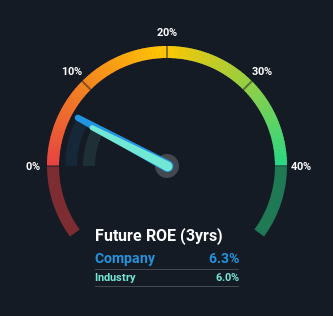
That isn’t amazing, but it is respectable. While at least the ROE is not lower than the industry, its still worth checking what role the company’s debt plays as high debt levels relative to equity may also make the ROE appear high. If true, then it is more an indication of risk than the potential. Our risks dashboardshould have the 2 risks we have identified for Ubisoft Entertainment.
How Does Debt Impact Return On Equity?
Most companies need money — from somewhere — to grow their profits. That cash can come from issuing shares, retained earnings, or debt. In the first and second cases, the ROE will reflect this use of cash for investment in the business. In the latter case, the debt required for growth will boost returns, but will not impact the shareholders’ equity. Thus the use of debt can improve ROE, albeit along with extra risk in the case of stormy weather, metaphorically speaking.
Ubisoft Entertainment’s Debt And Its 6.3% ROE
Ubisoft Entertainment does use a high amount of debt to increase returns. It has a debt to equity ratio of 1.05. Its ROE is quite low, even with the use of significant debt; that’s not a good result, in our opinion. Debt does bring extra risk, so it’s only really worthwhile when a company generates some decent returns from it.
Summary
Return on equity is a useful indicator of the ability of a business to generate profits and return them to shareholders. Companies that can achieve high returns on equity without too much debt are generally of good quality. All else being equal, a higher ROE is better.
But when a business is high quality, the market often bids it up to a price that reflects this. The rate at which profits are likely to grow, relative to the expectations of profit growth reflected in the current price, must be considered, too. So you might want to take a peek at this data-rich interactive graph of forecasts for the company.
Of course, you might find a fantastic investment by looking elsewhere. So take a peek at this free list of interesting companies.
Promoted
If you decide to trade Ubisoft Entertainment, use the lowest-cost* platform that is rated #1 Overall by Barron’s, Interactive Brokers. Trade stocks, options, futures, forex, bonds and funds on 135 markets, all from a single integrated account.
This article by Simply Wall St is general in nature. It does not constitute a recommendation to buy or sell any stock, and does not take account of your objectives, or your financial situation. We aim to bring you long-term focused analysis driven by fundamental data. Note that our analysis may not factor in the latest price-sensitive company announcements or qualitative material. Simply Wall St has no position in any stocks mentioned.
*Interactive Brokers Rated Lowest Cost Broker by StockBrokers.com Annual Online Review 2020
Have feedback on this article? Concerned about the content? Get in touch with us directly. Alternatively, email editorial-team (at) simplywallst.com.
