


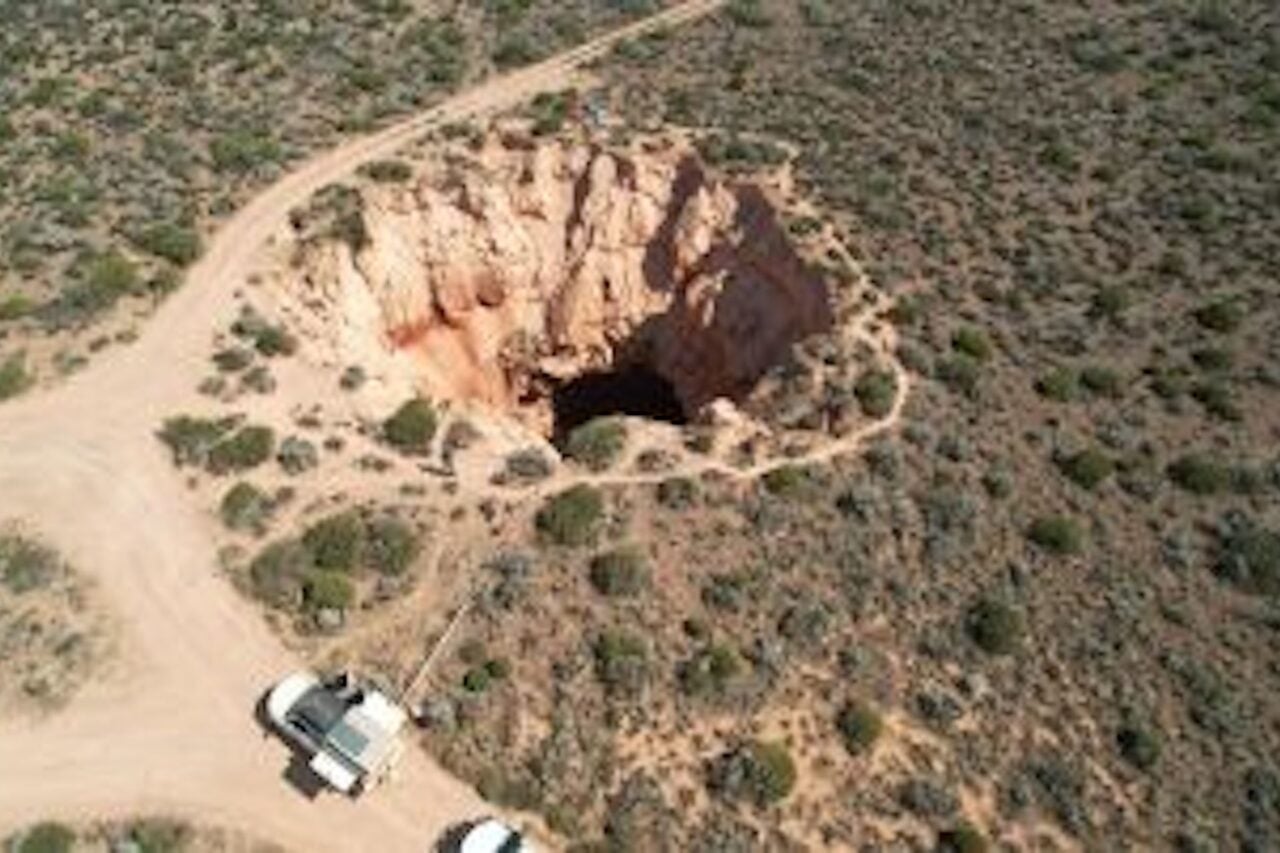
From above, they look like the remnants of ancient rivers, with long trenches stretching across Australia’s otherwise flat landscape. But these mysterious geological features aren’t the work of flowing water. Instead, researchers believe they are surface scars left behind by enormous underground cave systems that gradually collapsed over millions of years.
In a new study, scientists investigated five trenches on the Nullarbor Plain in southern Australia, where they uncovered evidence of extensive underground cavities and collapsing rock layers. Their findings offer a new explanation for how the unusual features formed, while also providing clues that could help scientists identify hidden cave systems on Mars.
A hidden world
Stretching across 77,220 square miles (200,000 square kilometers) of southern Australia, the Nullarbor Plain is one of the world’s largest limestone karst landscapes. Its name, derived from the Latin words for “no trees,” reflects its largely barren, remarkably flat terrain.
Scattered across the eastern edge of the Nullarbor Plain are five unusually long, shallow trenches. Measuring between 330 to 1,640 feet (100 to 500 meters) each, the depressions have gently sloping edges and sediment-filled floors. Although they resemble old river channels, these trenches don’t have connected drainage networks or any evidence of downstream sediment transport.
So if rivers didn’t carve out the trenches, what did?
To understand how they formed, the researchers behind the new study combined several different techniques to investigate what was happening beneath the landscape. First, they mapped the trenches using drone and aerial photography, as well as detailed satellite-based digital landscape models. Then, they looked underground using electrical resistivity tomography, a technique that sends electrical currents through the ground and measures how easily they travel through different materials.
The researchers found vertically extensive zones of low electrical resistivity beneath the trenches, suggesting the presence of sediment-filled, fractured, or otherwise disturbed material extending deep underground. These anomalies were not randomly distributed. Instead, they lined up with known cave systems and sink holes in the region.
By combining the data with existing cave records and sediment analysis, the researchers suggest that the trenches are linked to deep cave systems beneath the Nullarbor Plain.
Surface scars
The Nullarbor is made primarily of limestone, a rock that can slowly dissolve when groundwater passes through it. Over geological timescales, this process creates underground cavities, tunnels and extensive cave networks. Eventually, the roofs of these underground caves can become unstable and collapse.
But the researchers suggest something more gradual happened here. Rather than one enormous collapse that produced a surface sinkhole, the cave systems experienced a progressive collapse that led to the development of shallow depressions.
The recent findings could help scientists identify caves beyond Earth, according to the study. Scientists have identified numerous elongated depressions on Mars that are often interpreted as ancient river channels or collapsed lava tubes. But the researchers behind the study suggest that some superficially similar features could have formed through the collapse of underground cave systems, much like those beneath the Nullarbor Plain.
This matters because caves are potentially important targets in the search for extraterrestrial life. If microbial life ever existed on Mars, underground caves could potentially have preserved traces of it for much longer than exposed surface environments.

