


The Schwab U.S. Dividend Equity ETF holds 102 stocks that pay high-quality dividends — and might help protect your money from an AI stock crash.
By Ben Gran –
Key Points
-
The Schwab U.S. Dividend Equity ETF has strongly outperformed the S&P 500 index and Nasdaq-100 since Oct. 6.
-
SCHD owns 102 stocks in well-established, financially strong companies and is paying a 3.07% dividend yield as of Nov. 12.
-
Based on historic returns of the past 15 years, SCHD could double your money in six years.
Investors seem to be feeling anxious about tech stocks. In the past month and a half since reaching record highs on Oct. 6, the S&P 500 index (^GSPC -0.23%) has declined by about 3.3%, and the tech-heavy Nasdaq-100 index is down about 10.5%. But some stocks are outperforming this recent market sell-off: dividend stocks.
Shares of the Schwab U.S. Dividend Equity ETF (SCHD -1.73%) have gained an impressive 31.7% year to date (as of Nov. 15), and are up about 10% since Oct. 6. This dividend index fund is moving in a different, better direction than these two benchmark indexes:
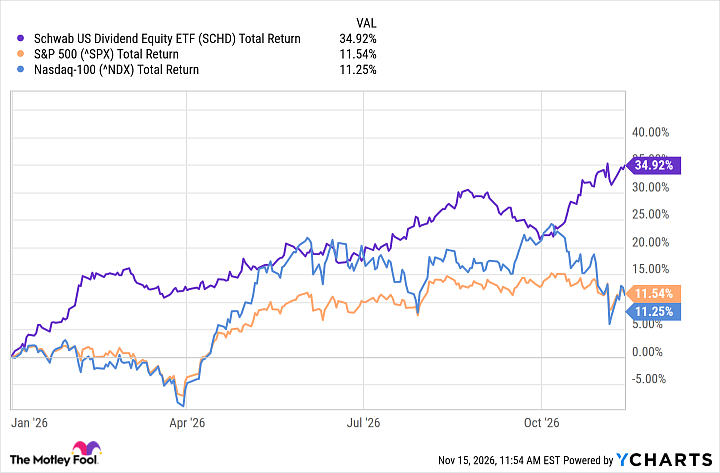
SCHD Total Return Level data by YCharts
But is the Schwab U.S. Dividend Equity ETF a good investment for the future? Let’s look at past historical returns data to see how quickly this exchange-traded fund (ETF) could double your money if you invest today.

Image source: Getty Images.
SCHD: 102 high-quality stocks that pay strong dividends
The Schwab U.S. Dividend Equity ETF only holds 102 stocks, but they tend to be good ones. This fund tracks the Dow Jones U.S. Dividend 100 Index, which selects stocks based on the companies’ financial strength and ability to deliver high-quality, sustainable dividends.
If you’re worried about the sustainability of the artificial intelligence (AI) boom and you want to diversify your investments away from tech-heavy ETFs, SCHD could be a good option. Unlike the S&P 500, this Schwab fund is not top-heavy with AI stocks. The information technology sector makes up only about 12.2% of the SCHD fund’s assets.
Top stock holdings in SCHD include household name brands like Procter & Gamble (PG -0.83%), Coca-Cola (KO -0.71%), and Home Depot (HD -0.40%). These are well-established companies with strong balance sheets that operate in totally different parts of the economy than the tech industry. This diversification could make SCHD relatively safe from an AI stock crash.
And the dividends from SCHD are excellent. As of Nov. 12, this fund was paying a 30-day SEC yield of 3.07%. That’s a big reason why SCHD ranks among the best dividend index funds.
SCHD: 13.75% annualized returns since Oct. 2011
If you invest in SCHD today, how fast could you double your money? Keep in mind that past returns don’t guarantee future performance. But in the past 15 years since the fund’s inception in October 2011, the Schwab U.S. Dividend Equity ETF has delivered annualized returns of 13.75%. In the past five years, it’s delivered annualized returns of 10.62%.
SCHD Schwab U.S. Dividend Equity ETF
$34.70-$0.61 (-1.73%)
NYSEMKT · As of 4:00 PM ET 11/18/26
Remember the Rule of 72. If you take the number 72 and divide it by an investment’s annual rate of growth, you get the number of years for that investment to double.
Let’s assume that SCHD can keep growing at 13.75% average annual returns, the same rate it’s delivered for the past 15 years. At that rate of growth:
72 divided by 13.75 = 5.24
Your money would double in about six years. For example, if you invested $1,000 in SCHD today, and the investment grew with 13.75% compounding annual returns, after 2 years you’d have $1,294. After 4 years, you’d have $1,674. And after 6 years, you’d have $2,166 — more than doubling your money.
What if SCHD grows more slowly in the future, at the same 10.62% rate it’s delivered for the past five years? That’s still enough to double your money fast. Let’s take the Rule of 72:
72 divided by 10.62 = 6.78
At 10.62% annualized returns, your investment in SCHD would double in about seven years — only one year longer. If you invested $1,000 in SCHD and the fund kept delivering 10.62% annualized returns, after three years you’d have $1,354. After five years, you’d have $1,656. And after seven years, you’d have $2,027 — doubling your money.
Where to invest $1,000 right now
When our analyst team has a stock tip, it can pay to listen. After all, Stock Advisor’s total average return is 794%* — a market-crushing outperformance compared to 203% for the S&P 500.
They just revealed what they believe are the 10 best stocks for investors to buy right now, available when you join Stock Advisor.
See the stocks ›
*Stock Advisor returns as of November 19, 2026.

