


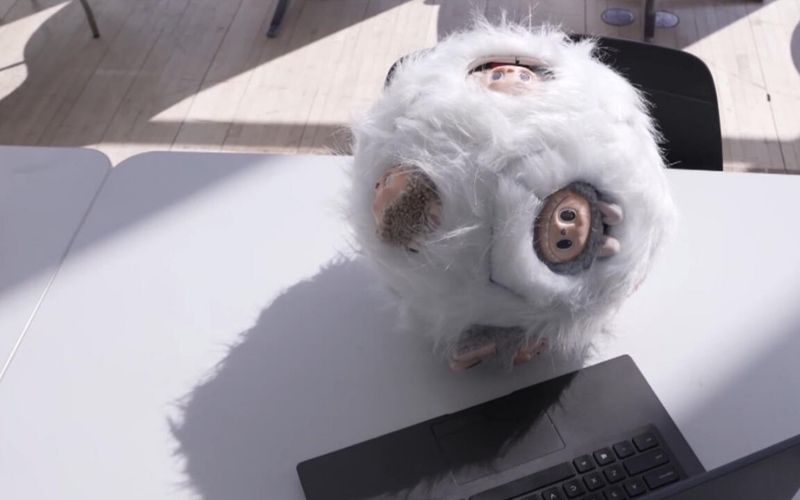
I thought the internet had already pushed Labubu as far as it could go. We got the blind-box obsession, the resale madness, the TikTok bag charms, and the endless debates over whether the ugly-cute gremlin thing looked adorable or deeply cursed. Apparently that still wasn’t enough. Now a group of MIT grad students has fused twelve Labubu heads into a rolling robot called Labububot, and somehow it feels like the perfect final form of modern internet culture.
The first video alone looks like something engineered in a lab specifically to make people uncomfortable. A fuzzy spherical creature with twelve identical faces slowly rolls across the floor while staring at you from every angle at once. It follows people around like a haunted collectible that escaped a shelf at 3 a.m. The wild part is that I can’t decide if I hate it or love it.
That confusion feels intentional.
Why Labubu became such a huge trend
Part of what makes Labububot so fascinating is that Labubu itself already sits at the center of internet trend culture. The dolls exploded in popularity after BLACKPINK’s Lisa got spotted collecting them, and from there the craze spiraled into full collector mania. Suddenly everybody wanted one hanging off a designer bag or sitting on a shelf behind their desk setup.
But the toy itself was never the whole story.
A massive part of the hype came from the blind-box system. Buyers never knew which variant they would get, which gave the whole experience the same dopamine hit as loot boxes or gacha games. Online discussions about Labubu always circle back to that same point. Some people genuinely love the weird ugly-cute aesthetic. Others think the entire craze feels like influencer-fueled gambling disguised as collectibles.
And honestly, both sides make valid points.
Labububot feels like satire made real
That’s exactly why Labububot works so well as an art project. Instead of creating another clean, friendly social robot with soft lighting and a cute digital face, the MIT team leaned fully into the chaos. Twelve Labubu heads merge into one giant rolling sphere that follows people around like an escaped mascot from a cursed arcade machine.
The official description almost reads like a fake nature documentary. Deep within MIT hallways “where sunlight barely reaches the office floor” lives one of the rarest monsters on Earth. Its twelve heads supposedly help it communicate and move through unfamiliar terrain. That dramatic storytelling makes the project even funnier because everybody involved clearly understands how ridiculous the robot looks.
At the same time, there’s something smart underneath the joke.
A social robot that wants you to feel uncomfortable
Most social robots try extremely hard to appear approachable. They aim for cute, safe, and emotionally readable. Labububot does the complete opposite. It embraces the uncanny feeling instead of hiding it.
That choice makes the robot way more memorable than another generic “friendly AI companion” project. The thing looks unsettling, but it also feels weirdly alive in motion. That tension gives the project personality. Depending on who sees it, the robot comes across as adorable, creepy, hilarious, or nightmare-inducing.
Maybe that says more about us than the robot itself.
The creators describe the project as “a playful critique of social robots” and a question about what our creations reveal about humanity. For a giant rolling ball covered in Labubu faces, that idea lands harder than expected.
The perfect symbol of 2026 internet culture
What fascinates me most is how perfectly this project captures the current state of online culture. Labubu started as a collectible toy boosted by celebrity influence, scarcity marketing, and social media hype. Then it evolved into a fashion accessory and resale phenomenon. Now it has transformed again into experimental robotics art at MIT.
That pipeline sounds absurd, yet it makes complete sense in 2026.
Created by graduate students Miranda Li, Jake Read, and Dimitar Dimitrov, Labububot will make its public debut this summer as a finalist at the International Conference on Social Robotics.
Which means there’s a real chance this twelve-faced creature eventually rolls through public spaces terrifying innocent people in person instead of just online.
I still can’t decide whether it’s genius, ridiculous, cute, or deeply cursed.
It’s probably all four.
What happens when Labububot leaves the internet and enters the real world
Labububot isn’t staying locked inside an MIT lab as a private experiment. It’s heading straight into a formal spotlight. This summer, it will make its public debut as a finalist for the Grand Challenge at the 2026 International Conference on Social Robotics (ICSR).
A controlled research environment allows designers to shape expectations. A conference floor introduces real observers who carry their own assumptions about what robots should feel like. Labububot moves through that space as a rolling cluster of twelve expressive faces, which guarantees a wide spread of reactions. Some viewers will read it as art. Others will treat it as unsettling. A few will probably stand somewhere in between, unsure how to categorize what they are seeing.
After its debut, the project sits at a crossroads common to experimental robotics. Some systems remain confined to demonstrations, valued for the ideas they surface rather than any long-term use. Others evolve into public installations or research platforms for future iterations. Labububot already carries enough cultural weight from its Labubu origins that it could travel beyond academic spaces, but it also functions well as a one-time statement piece about attention, hype, and machine presence.
Grigor Baklajyan is a copywriter covering technology at Gadget Flow. His contributions include product reviews, buying guides, how-to articles, and more.

