


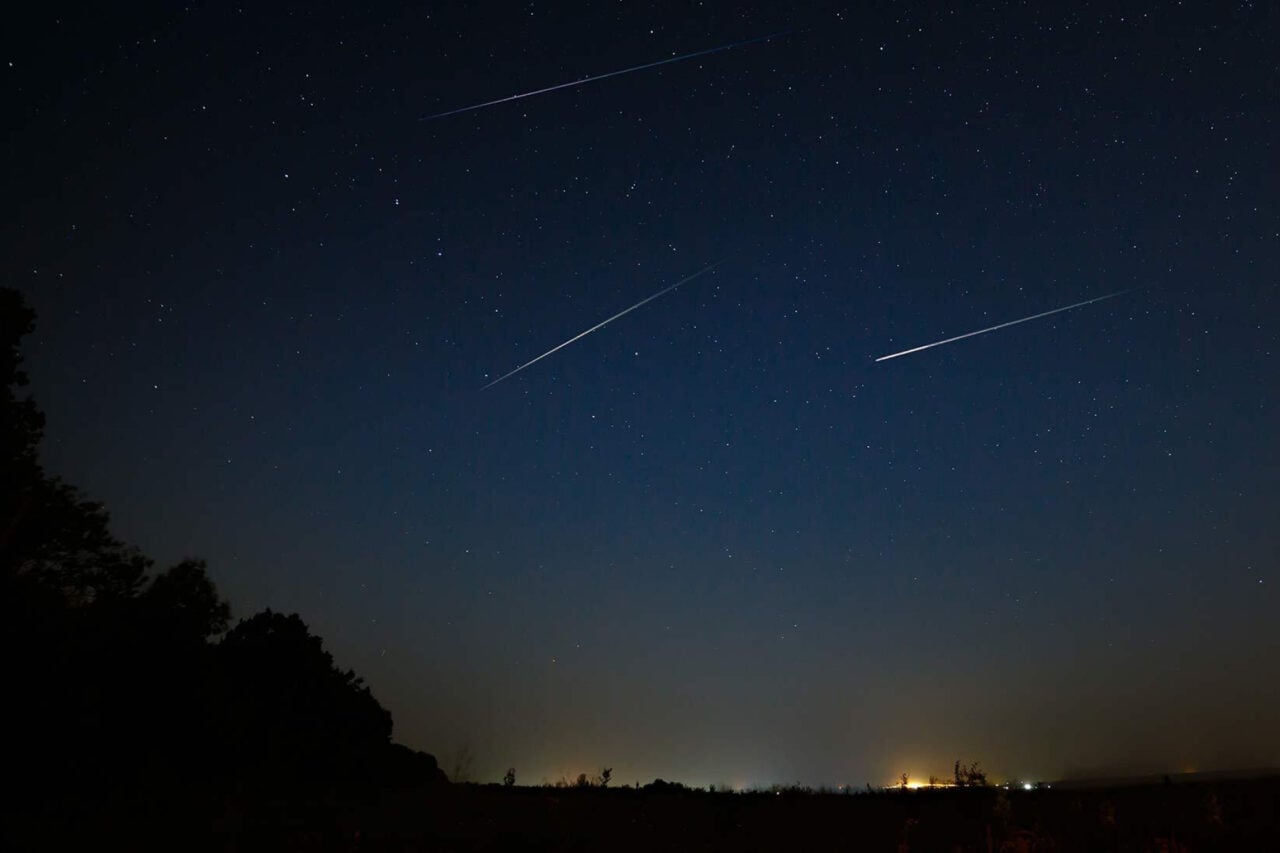
The peak of pollen season brings to the sky something less painful—the Lyrids, or the first wave of shooting stars in spring. These meteorites will peak later today and stay visible until April 26. Don’t miss it!
According to the American Meteor Society (AMS), the Lyrids are particles shed by the comet C/186 G1 Thatcher. Since 1861, the Lyrids have streaked across the sky in springtime, with small fluctuations in volume every 12-to-20-year period. This year will be one of the less active periods, with around six meteors per hour at the shower peak just this morning, explained Thaddeus LaCoursiere, planetarium program coordinator at the Bell Museum in Minnesota, to AP News.
But the meteor shower will continue to be visible until April 26, so keep your eyes peeled. To check out the best viewing conditions for your area, timeanddate.com has this tool for you to customize.
Tips from experts
The most ideal conditions for catching meteors are when the skies are dark. This year, the Moon will be at its waxing crescent phase during the Lyrids. So the viewing conditions won’t be perfect, but you should still have a fair chance at around 4 to 5 a.m. local daylight time, AMS explained. For viewers “limited to more civilized hours,” start around 10 p.m., the organization added.
Also, be patient.
“You might not be able to see anything for the first 10 minutes while your eyes adjust to the dark,” Ashley King, a planetary scientist with the National History Museum in the U.K., explained in a blog post. “Once you get used to the low light levels, you’ll begin to notice more and more. So don’t give up too quickly.”
Some background info
If you’re just here for the science, don’t worry! We got you covered. Meteor showers are often called shooting stars, but these streaks of light aren’t actually stars. Meteoroids are particulate streams of debris left behind by comets and asteroids; they’re tiny but travel at blinding speeds through space.
When these particles interact with charged particles in Earth’s atmosphere, they become “heated up by the friction and form the impressive flash that we see,” King explained. “The Earth isn’t close to the comet or asteroid—it’s just passing through some of the dust it left behind.”
The “peak” of a meteor shower, therefore, refers to when Earth passes through the thickest section of the debris stream from a comet. On the other hand, more feisty-looking “Lyrid fireballs” are actually marble-sized meteoroids that pass through Earth’s atmosphere.
“Space is full of dust,” explained The Planetary Society, “so on a typical night from a dark location, you might see up to 10 meteors per hour—no shower required! But during a meteor shower, especially on its peak night, you can probably expect to see a higher number of meteors.”

