


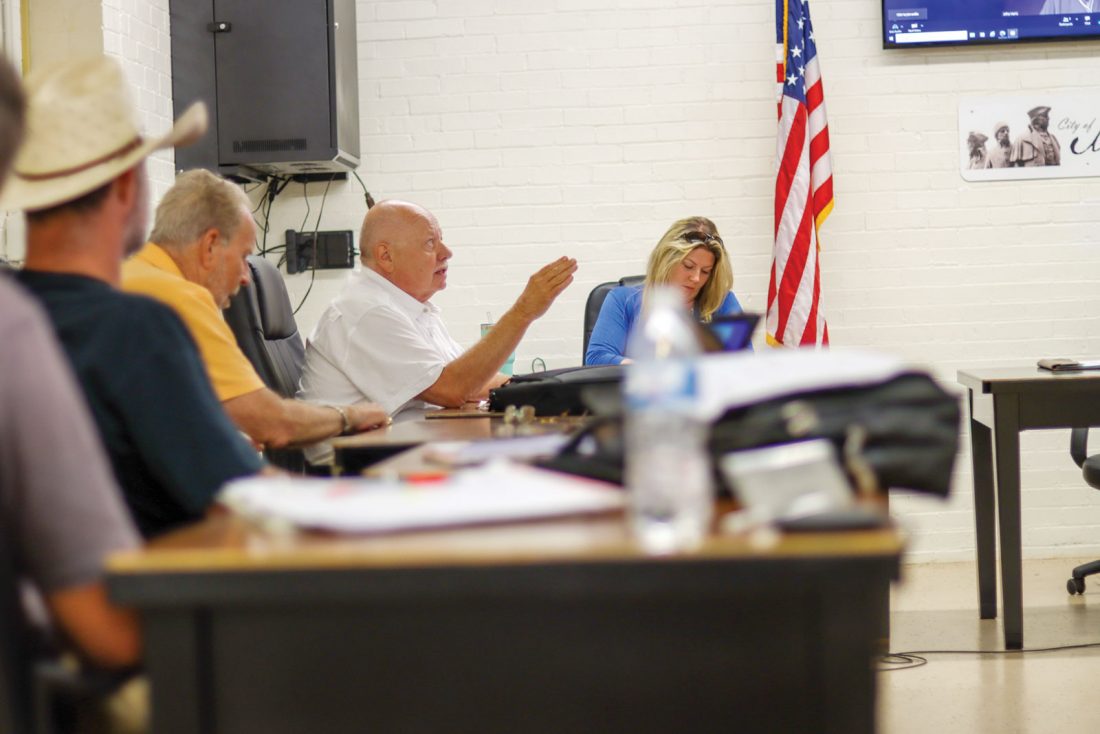
Marietta City Councilmember Mike Scales discusses the Marietta Main Street Proposal. Pictured from left are council members Geoff Schenkel, Bill Gossett, Mike McCauley, Scales, and Clerk of Council Jennifer Starkey. (Photo by James Dobbs)
Marietta City Council’s Finance Committee met Monday to discuss the American Rescue Plan Act (ARPA) funds and how it would fund the Marietta Main Street Proposal.
Jeffry D. Harris, with Bricker & Eckler, assisted the committee with legal advice on what can be done with the funds.
Harris said he believes the ARPA funds will come straight from the U.S. Treasury and not from the state of Ohio itself. He said Marietta is considered an entitlement city for its ARPA funds. This means Marietta only has to adhere by the Treasury guidelines instead of the Ohio Office of Budget and Management or the Ohio General Assembly.
Harris then asked the committee about the following requests within the Marietta Main Street Proposal: $190,000 for downtown building care and maintenance; $30,000 for small business assistance and support; $40,000 for operational support and long term investment; and $450,000 for downtown enhancement and infrastructure.
Councilmember Mike Scales said the city believes the downtown enhancement and infrastructure is what the ARPA funds should go to.
Harris said that some of the elements may be ARPA-eligible. He believes the $250,000 in initial design fees for the riverfront enhancement on Butler Street would not be eligible for ARPA, unless it was related to COVID-19. The ARPA funds could be used if the cause of the enhancement was for the prevention or mitigation of COVID-19.
“If any of the requests for proposal or qualifications asked for addressing impacts from the pandemic or to approve buildings for COVID mitigation — think HVAC upgrades or build-out for space enhancements for social distancing — then those elements of that planning and design fee element, could be ARPA-eligible, but only those components not the entirety of the $250,000 of design fees,” said Harris.
Harris said he did not see anything in the $250,000 design fees that would be considered COVID related. The Treasury department has identified the travel and tourism industry as being “hard hit” by the pandemic, he said.
Harris then went on to say there was a $150,000 request for wayfinding signage, and that this request could be considered for ARPA, as long as there was paperwork stating that council was planning the signage before the pandemic. Harris said the paperwork could imply that the plans were interrupted by the pandemic.
“Always document everything,” he said.
Harris also talked about the Marietta mural work, which would be a local art grant for $30,000. Harris said if this was characterized as benefiting outdoor spaces, which gets people outside, which is a mitigation factor for COVID, that this could be ARPA eligible.
Scales then asked Harris about the $150,000 grant program. Harris said there were a few factors that could make this eligible for ARPA. Lead abatement and HVAC or ventilation upgrades were the main factors. This would be considered as trying to prevent COVID transmission.
Harris said the $30,000 for small business relief funds would be ARPA eligible if the funds offset negative economic impacts on small businesses due to the pandemic.
The Finance Committee went into executive session but took no action.

