


Deborah Sengupta Stith introduced Austin readers to Black Pumas before the band became a Grammy-nominated phenom. This year, the longtime music writer was inducted into the Recording Academy herself.
She currently shares the music beat with Peter Blackstock, one of city’s most authoritative voices on icons like Willie Nelson and Jerry Jeff Walker. Together, they’ve kept local artists in the spotlight as the city continues to transform.
Eric Webb has shared with readers his conversations with some of today’s biggest arts personalities — from local tastemakers like the Glitoris, Dayglow and Louisianna Purchase to Hollywood stars like Jeff Goldblum and Holland Taylor.
Speaking of tastemakers: As the local dining world exploded over the past decade, Matthew Odam chronicled the rise of chef-driven restaurants such as Barley Swine, Foreign & Domestic, Dai Due, Olamaie and Emmer & Rye, helping elevate them to national attention.
And under the leadership of executive features editor Sharon Chapman since 2014, the American-Statesman’s entertainment writers have racked up top awards from press organizations like the Society for Features Journalism and the Texas Associated Press Managing Editors, all for expert coverage of everything we love to do in one of the fastest growing cities in the world.

That’s not even mentioning how hard they work during South by Southwest or Austin City Limits Music Festival while everyone else is partying.
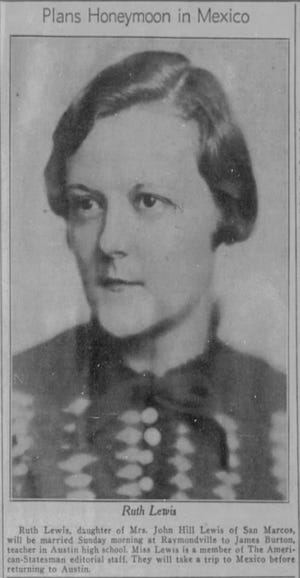
Before anyone ever uttered the words “Live Music Capital of the World,” and less than midway through the Statesman’s 150-year history, this newspaper’s coverage of arts and entertainment started with one woman: Ruth Lewis.
A lot has changed in 87 years.
How the Statesman started covering entertainment
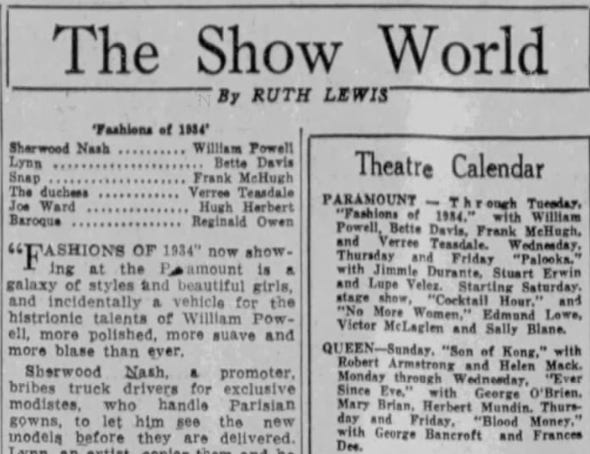
On Feb. 25, 1934, the Statesman’s coverage of entertainment took a dramatic turn. That’s when Austin’s daily newspaper introduced “The Show World.”
That day, the new column by Lewis soberly reviewed two movies, “Fashions of 1934” and “Son of Kong.” It reported on the delay in a touring stage play, “Cocktail Hour” and announced that theatrical star Eva La Gallienne had been booked to appear at the Paramount Theatre.
Alongside Lewis’ column — the first of its kind in Austin and among the first regular Austin columns written by a woman — ran an outlined box that listed upcoming events at the Paramount, Queen, Hancock, Texas, Ritz and Skinny’s theaters.
Lewis changed how the newspaper covered arts and entertainment. Since its founding as the Democratic Statesman on July 26, 1871, the newspaper’s coverage of vaudeville, music, theater, concerts, movies, radio and local arts had been hodgepodge at best, mostly anonymous and sometimes unreliable.
In fact, it was a customary for short-handed and deadline-stressed American newspapers, not just the American and the Statesman brands before they merged in 1924, to accept reviews submitted by the very companies that produced the shows.
Thus, Lewis can be considered the city’s first true arts and entertainment journalist. In those days, her beat came under the charming rubric “Amusements ” — a term that outlasted her tenure by decades.
From the first appearance of Lewis’ refined column in 1934, the paper usually committed at least one staff beat reporter to entertainment. The man who inherited her column in the postwar era was John Bustin. Employing a martini-dry sense of humor, this self-effacing native Austinite had played drums in a dance band and started writing about jazz for the University of Texas magazine in the 1940s. His soothing and distinctive voice was just right for an urbanizing Austin of the 1950s and ‘60s that wanted to feel connected to Hollywood, Broadway and the recording industry, as well as to broadcast radio and TV.
Younger reporters cherished his old-school “Bustinisms.” For instance, when he was writing an overnight review on deadline for the morning paper, a crusty city editor would bawl: “Bustin, are you writing for the American — or for the ages?”

A new Austin scene requires new reporting
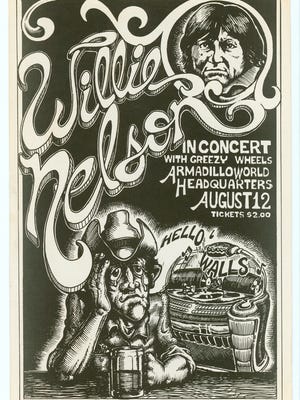
With the opening of the Armadillo World Headquarters in 1970 and the rapid growth of the city’s music scene, Bustin, who was more comfortable with jazz standards than with redneck rock, faded from his position as the city’s amusements editor.
Among those journalists who followed him at the Statesman were Townsend Miller, John T. Davis, Michael Point, Joe Nick Patoski, Casey Monahan, Michael MacCambridge, the recently deceased Ed Ward and yet another amusements editor, Susan Barton. During the next two decades, these reporters tried to keep up with the city’s burgeoning and increasingly diversified entertainment scene.
Music writer Blackstock joined the American-Statesman in 1982, first as a sports clerk, while he was still a senior at McCallum High School. By the mid-1980s, he was in college at UT and coming of age just as the town’s alternative music scene was attracting widespread note.
“Eventually, I realized that, since I was spending most of my nights at the Continental Club, Liberty Lunch, Hole in the Wall and Cactus Café, I should consider shifting my focus from the sports desk to the entertainment department,” he says.

The 1990 arrival of Don McLeese, a nationally renowned writer from Chicago, significantly upgraded the Statesman’s music coverage. Michael Corcoran, who had cut his teeth at the Austin Chronicle and is now a respected music historian, later shared the beat with McLeese, as did a fresh Minnesotan named Chris Riemenschneider. Young talents such as Marc Fort, Joe Gross and Deborah Wolfinsohn helped energize the city’s all-important music coverage.
Another aspect of the newsroom was changing, too. During the 1980s and ‘90s, the paper hired more women and people of color, as well as openly LGBTQ journalists. To make it in a tough, demanding business with constant deadlines, these newcomers often turned to one another for guidance. The entertainment team earned a reputation as a good place to start out in the business.
Anne Rodgers, who now splits time between Florida and Texas, started working at the Statesman in 1984. For years, part of Rodgers’ job was to manage the entertainment sections.
“We had to balance how much budget we had for freelance work each month, how much room we had in the paper to run reviews and advances for shows, and what events would need to be downsized to a capsule mention or, worse, a mere listing,” she says. “Freelancers routinely pitched their stories to us, helping us sort through which shows simply had to receive coverage. It was a tough balance week after week, with Austin’s entertainment scene exploding beyond our ability to keep up.”
Rodgers arrived in the newsroom at a time when it was still overwhelmingly male. As she rose to entertainment editor, then features editor, she witnessed some effective mentoring of young women, but gender equity was still a work in progress.
“Mentoring is a time-intensive process,” Rodgers says, “and I wasn’t the recipient of consistent help in that regard. Almost everyone I knew had more work than they could say grace over every single day.”

From XL ent to Austin360
Founded in 1981, the alternative weekly Austin Chronicle competed with the Statesman’s entertainment coverage and, to some extent, for its advertising income.
Beginning on Aug. 25, 1994, the Statesman answered the Chronicle challenge with “XL ent,” a large tabloid-style section aimed at younger readers.
Entertainment editor Ed Crowell, the paper’s former state editor, led a team of about 10 newsroom members that came up with XL ent. He recalls that Cox Newspapers, then the Statesman’s Atlanta-based owner, brought in a facilitator from out of state to lead brainstorming sessions for two weeks at a local hotel.
“Her one suggestion — I’ll never forget — is that we tell people how long the lines for popcorn would be at movie theaters,” Crowell says. “In real time — for a weekly, somehow, before the Internet was in place.”
The name XL ent, which was later shortened to XL, came up serendipitously when Crowell spied the size tag on one of his team’s shirt collars.

When covering South by Southwest, founded in 1987, XL went toe to toe with national media outlets. A 96-page edition in 1995 covered just about everything one could see at the festival.
Crowell wrote in a column: “With apologies to the organizers and volunteers of South by Southwest, this monster they’ve created is a pain in the butt. That is, for us media types who have to work twice as hard as usual just to cover a fraction of the 500 bands playing tonight through Sunday. For the rest of the city and visitors, let the showcases begin.
“SXSW is fun,” he continued. “All sleep is hereby postponed until next week.”
When COVID canceled SXSW and everything:An oral history of the week the music stopped
The lessons learned while producing XL were applied to other reporting at the newspaper.
“The first Texas Book Festival arrived in November 1996 and we treated it like a big musical event, interviewing the stars in town,” Crowell says.
Rodgers, who took over editorship of XL, recalls how comprehensive coverage of Austin’s entertainment scene sorely stretched the newspaper’s resources.
“Especially with XL, the Statesman was attempting to exhaustively list every music show, theater offering, concert and film in town,” Rodgers says. “It was a huge undertaking. Early issues were 80-plus pages, and that expanded considerably during SXSW.”
During the 1990s and early 2000s, one area of coverage saw especially rapid growth — the arts, with reporting from writers like Jeanne Claire van Ryzin and myself. Writing on theater, dance, opera, classical music, visual art and community arts — in-depth news coverage of unprecedented building projects such as the Long Center for the Performing Arts, Zach Theatre, Ransom Center and Blanton Museum of Art — echoed the city’s increasing sophistication and new-found culture of philanthropy.
Into the next century, nightlife and fashion (covered by writers like Marques Harper) presented fresh areas for intensified reporting. Nancy Flores kept the city’s Latino arts community well represented in the paper, too.
After moving over from the arts, this writer contributed a decade of work as the paper’s social columnist to Austin’s rounds of parties — most of them for charity. Later, I focused more coverage on the people, places, culture and history of Austin and Texas.

Austin’s arts, music, fashion, nightlife and movie scenes had come into their own by the 21st century — that last coverage effort helmed for years by award-winning film critic Chris Garcia; then voices like Gross, Odam and Charles Ealy; and now Webb, the current Austin360 editor.
The dining scene, however, eventually took over the role as the city’s creative marquee act, along with an ever-expanding list of breweries, wineries and food festivals. In recent years, Addie Broyles served as Austin’s must-read food columnist, guiding Austinites toward delicious fun; writers like Emma Janzen and Arianna Auber carved out space for news about beer, spirits and bars.
The dining critic, a role that had been mostly freelanced for decades, became a cultural arbiter. A succession of well-informed Statesman staff critics — including Dale Rice, Mike Sutter and, for the past decade, Odam — made permanent impressions on the scene.
In his crucial 2019 book, “Austin to ATX: The Hippies, Pickers, Slackers and Geeks Who Transformed the Capital of Texas,” veteran journalist Patoski deemed Odam the “new Margaret Moser,” referring to the late, very influential Austin Chronicle music writer.
“He knew all the places and all the standout chefs,” Patoski writes. “If he liked your restaurant, you could expect a good run.”

Austin’s entertainment scene goes online
This newspaper launched two websites in the 1990s. Straight news went to Statesman.com, which looked somewhat like a sober newspaper. As for entertainment, the newly created Austin360.com became a lifestyle website aimed at younger readers who presumably might never pick up a hard-copy newspaper.
In the early days, Austin360 came with a staff and leadership separate from the newsroom, and for a while, it leased its own mid-rise tower downtown. It became a successful brand. After Austin360 came back into the newsroom, the name was used to rebrand the XL section and eventually the entire Statesman features section.
The entertainment team branched out into event promotion. They staged studio concerts and large parties and supported streaming music station Austin360 Radio and multiple podcasts. Before the coronavirus pandemic, the newspaper also took advantage of its large outdoor and indoor spaces to promote even larger events, especially during SXSW.

After the dot-com bust of the early 21st century, Austin’s stratospheric growth hit a speed bump. At the same time, print newspaper readership and advertising — here and all across the country — began a long, precipitous dive.
Despite a changing, severely undermined business model and a downsized newsroom, Austin360 often outpaced other media outlets, especially in coverage of big local events.
“Although our team is the smallest it’s ever been, we love what we cover, and our passion still shows through,” Chapman, the executive features editor, says.
Old-school reporting skills have been called upon again and again in recent years, especially during the pandemic. At a time when clubs, restaurants, concert halls, theaters, galleries and museums closed due to safety precautions, Austin360’s reporters told stories of personal loss, economic distress and uncertainty about whether the city’s now globally recognized cultural scene could ever bounce back.
As Black Lives Matters protests brought home the persistence of systemic racism, that same staff went deeper into the lives and stories of the city’s people of color.
“Last summer’s racial justice protests had us looking at ourselves, too,” Chapman says. “What stories and communities are we missing? We hold others to a higher standard, and we try to do the same with ourselves. It’s an ongoing process.”
Related:4 black Austin musicians on discrimination, empty promises and how to move forward
Among the reporters who most acutely examined the intersection of social justice and journalism was music writer Sengupta Stith. She held a series of candid roundtable discussions, streamed to the Austin360 Facebook pages, with Black, Latino, Asian and LGBTQ musicians. With Blackstock, she also asked hard questions about the viability of the music scene and, in a series of profiles, she held local leaders accountable for inequities in the system.
“People outside newsrooms might not realize that most journalists’ egos can take criticism and an honest look at what we’ve done well and what we can do better,” Chapman says. “In fact, we love feedback and learning what we don’t know. There’s a reason my third-grade teacher said I ask too many questions.”
Michael Barnes writes about the people, places, culture and history of Austin and Texas. He can be reached at mbarnes@statesman.com. Eric Webb contributed to this report.
American-Statesman at 150
The Austin American-Statesman turns 150 on July 26, 2021. So far, this ongoing series about the newspaper’s history has included:
July 26, 2020: Born to shine a light on Austin
July 26, 2020: The Statesman’s most loyal subscriber
July 26, 2020: Inside the Statesman’s very first edition
July 30, 2020: Denouncing the views of our founders
Aug. 9, 2020: We found images of 13 newspaper homes
Nov. 1, 2020: Austin’s newspaper began to grow up
Feb. 7, 2021: The Statesman goes to war

