


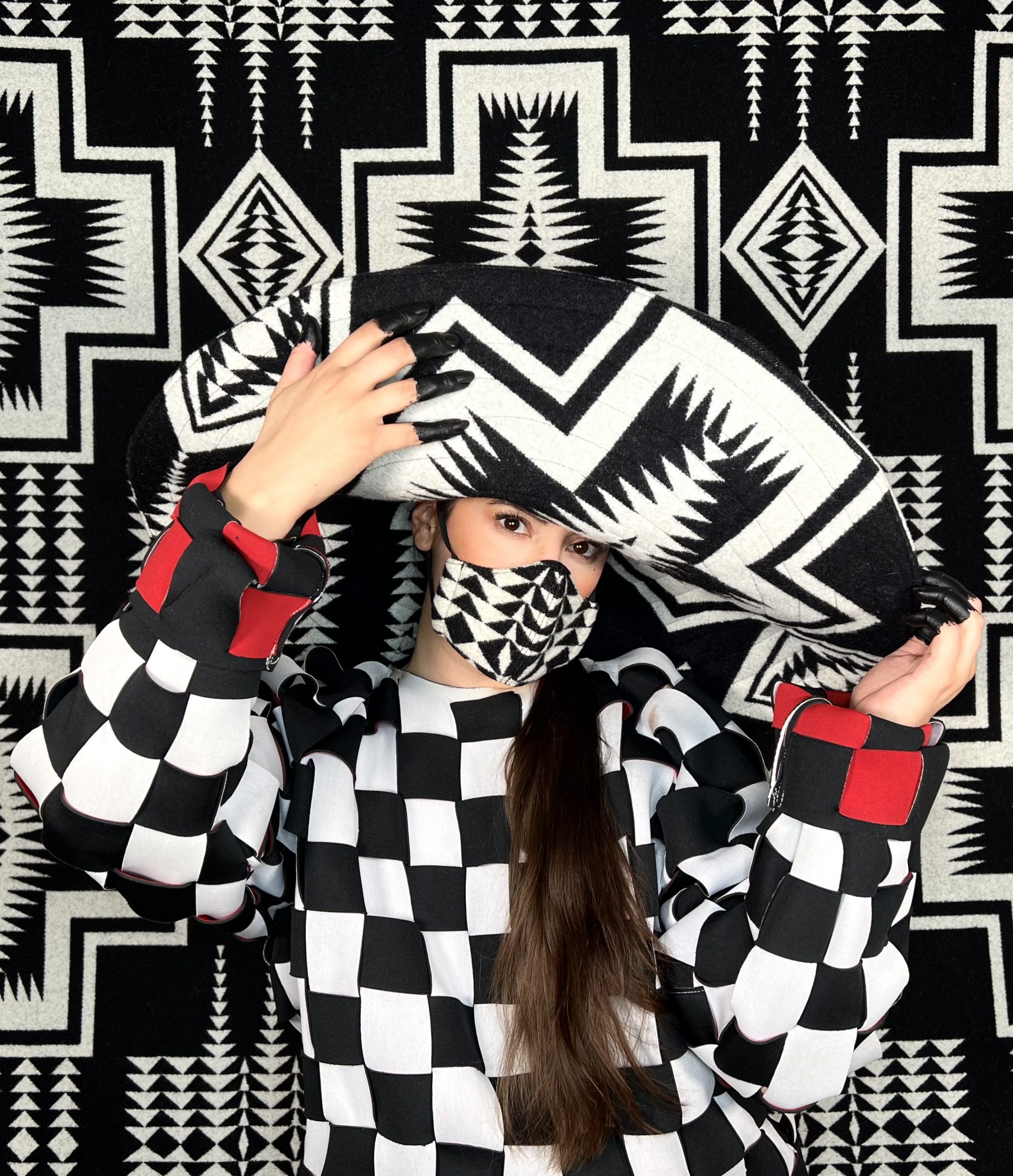
How did it feel to showcase your work at the Indigenous Fashion Arts Festival?
I feel incredibly honoured to be included in the Indigenous Fashion Arts Festival. Having the opportunity to show my new collection among so many talented Indigenous artists and designers brings a feeling greater than gratitude, but one of resilience and pride. Sage Paul’s dedication to creating space for Indigenous artists to thrive and present their work on numerous platforms is so encouraging.
What is it like being an Indigenous designer in the fashion industry?
While I try to work outside the restrictive nature of ‘Industry’, my art is multi-disciplinary and my medium is textile, although I do often have to work within the industry’s parameters. Being an Indigenous designer may always feel like being “other” in an industry that is just recently spotlighting our work. This is why festivals like IFAF are so important to Indigenous artists and designers. We get to share space to celebrate each other’s work on this large, diverse, and inclusive platform. So often we are marginalized in the fashion industry, being seen as “niche” or “novelty”, which can feel like a constant reminder that we don’t get to share the same platforms as well-known fashion houses.
I love working alongside great minds in our communities to be able to give voice and support for Indigenous high fashion and art without the pressure of “outside” approval. Proving that sometimes it’s not about getting a seat at “their” table, but having the confidence and drive to build our own tables with the endless rows of seats we pull out for each other. I look forward to seeing the continuing strength and support that builds up our communities and truly celebrates our work in art and fashion.
Where did you get the inspiration for your most recent collection?
This collection titled: Misshapen Chaos of Well Seeming Forms is an exploration of the visual symbols in the media over the last few years. It is a discussion on the illusion of freedom, and the complex divisions in society as a whole. It is a story of reclamation through our own well-being, shutting out the noise, and meeting our responsibility to life.
It is a reflection of my personal process of healing through my work and coming to terms with my own mental health. Allowing myself to build something out of it rather than let it rot inside of me. The toll on our collective mental health in the past few years has been ubiquitous with the constant deluge of information filtered through the media as we try to understand and process a constant state of chaos. I find myself best able to process my struggles with mental health through my work and my culture. Knowing that the more connected I am to my art and my people, I will be guided to the good in my life and fulfill my responsibility.
What is your design process like?
With this collection, I truly wanted to focus on my strengths as a designer, incorporating tailoring and weaving. I am greatly inspired by color and music and can see a full collection in my mind before I start the physical process of making. Because I often work alone on samples, it can be tedious, but I love to spend time with each garment, recognizing that my energy goes into the fabrics I work with while creating adornments birthed from my thoughts. Capturing the energy of my work has been easy while using iPhone 13 Pro, which can focus on the smallest details of my textile work to the full-room energy of my runway show. The use of this technology allows me to translate and share my work seamlessly through an exemplary lens.
I work best in limitations with a great focus on sustainability, which is why I focus on working with wool and upcycled materials. The wool fabrics I use have been Cradle to Cradle Certified by MBDC. Wool is an environmentally friendly and naturally renewable fiber that can be recycled or composted as a healthy additive to the soil. Circularity is always a part of my design process as I focus on how my work, holistically, will impact the future.
How have you incorporated your Indigenous history into your work?
The piece that garnered that biggest reaction was definitely a coat I tailored in the Hudson’s Bay print that was chaotically wrapped in red wool strands, restricting the model’s (Scott Wabano) arms and ability to move. This piece is a nod to the ensemble I have currently on view at The Metropolitan Museum of Art in NY which explores my own familial ties to HBC as an Indigenous person.
My four-times-great-grandfather worked for the Hudson’s Bay Company as a canoe middleman from 1826 to 1842, until his retirement to [Washington] state, where their children were raised. My family has resided in the same area since then, where my great-grandmother Rose Juanita McLeod (Puyallup/Nisqually) survived the Cushman residential school (also known as Puyallup Indian School) until her eighth-grade year. My reclamation of the HBC fabrics gives a voice to my family and calls attention to the colonial violence and exploitation perpetrated by the Hudson’s Bay Company against Indigenous people. I want to tell our stories and highlight the multi-generational strength I carry because of the resilience of my ancestors, despite enduring decades of violence. We are still here.

