


SPRINGFIELD – Lawyers for Illinois’ Democratic legislative leaders last week filed a motion to dismiss a lawsuit from Republicans and a Mexican American advocacy group regarding newly drawn legislative maps, calling the challenge “purely speculative” until full U.S. Census data is released.
The motion, filed Friday, was an expected move following a Wednesday, July 14, status hearing for two consolidated lawsuits filed by Republican legislative leaders Sen. Dan McConchie, R-Hawthorn Woods, and Rep. Jim Durkin, R-Western Springs, as well as the Mexican American Legal Defense and Educational Fund, or MALDEF.
Both suits name the Illinois State Board of Elections and its individual members as well as Illinois House Speaker Emanuel “Chris” Welch and Senate President Don Harmon as defendants.
The lawsuits focus on whether American Community Survey data, rather than full census data, is a permissible source for drawing legislative district lines.
Every 10 years after the census, the Illinois General Assembly has the first crack at redrawing the lines of Illinois’ 59 Senate and 118 House districts, and they face a June 30 deadline set by the Illinois Constitution after which the process is handed to an eight-person commission made up of four members from each party.
People are also reading…
If that group fails to approve maps by Aug. 10, a ninth member, who could come from either party, would be randomly chosen and added to the commission to give one party a single-vote advantage.
This year, the supermajority Democrats in the General Assembly passed new redistricting maps by the end of the regular session in May and Gov. JB Pritzker signed them into law on June 4.
But full census data wasn’t available at the time and still won’t be released until Aug. 16, so lawmakers used data from the Census Bureau’s American Community Survey and other private sources to draw the maps.
MALDEF and the Republican leaders argued in their court documents that the use of American Community Survey data represents an incomplete count and therefore violates the “one person, one vote” principle under the equal protection clause of the U.S. Constitution.
The Republican leaders have asked the court to either force Welch and Harmon to appoint a bipartisan commission to oversee redistricting, or appoint a special party to draw the maps themselves. At last week’s status hearing, lawyers for the Democratic leaders argued that would be an extreme remedy in which federal judges are intervening in matters of state law.
MALDEF requested a judge block the new maps from taking effect in any future elections.
But lawyers for the Democratic leaders – which include Michael Kasper, a longtime Democratic redistricting operative and ally to former House Speaker Michael Madigan – argued in the dismissal motion “there is no way to measure the validity of Plaintiffs’ equal protection allegations until the Census Bureau issues the 2020 census data.”
The lawyers for the Democratic leaders focused on the state constitution in other aspects of their motion to dismiss as well, arguing, “Nothing in the U.S. Constitution or Illinois’ Constitution or statutes mandates only the use of final census numbers in redistricting.”
“Plaintiffs do not suggest that the General Assembly should have used a different data set – plaintiffs only suggest that the General Assembly, led by defendants Welch and Harmon, should have done nothing and simply ignored the directives of the state constitution,” the lawyers wrote. “The federal constitution does not require such inaction on the part of state officials.”

SPRINGFIELD — The Illinois National Guard will have to cut training and force time off if not reimbursed for providing security to the U.S. Ca…
Welch and Harmon’s lawyers also argued that the claims against them lack standing because the plaintiffs make no specific claims that the districts in which they reside are negatively impacted by the use of ACS data.
“They have not alleged—nor can they allege—that their personal voting strength is diluted by the current redistricting plan,” they wrote in the court document. “They have not alleged, for example, that their votes are diluted by overpopulation in their districts when compared to the voting power of those residing in less populated districts.”
The state elections board, which is represented by Illinois Attorney General Kwame Raoul’s office, also filed a motion to dismiss the suit Friday, claiming immunity in the case via the 11th Amendment to the U.S. Constitution and echoing claims that the plaintiffs have not demonstrated injury in the case.
The case is before a three-judge federal panel, which has a tentative trial date set for Sept. 27-29.
But there is also another status hearing scheduled for Aug. 24 – or just over a week after full census numbers will be made available. In an order scheduling that hearing, the court acknowledged that planned expert testimony is likely to “be affected (perhaps substantially) by information that will not be available until the census numbers come out.”
At the virtual August hearing, the parties are scheduled to discuss “the effect, if any, of the release of the census data on the complexity of the case and the presentation of evidence, either on a paper record or a trial,” as well as the logistics of the trial and dates for additional status hearings.
See the new Illinois laws that took effect July 1
665 bills
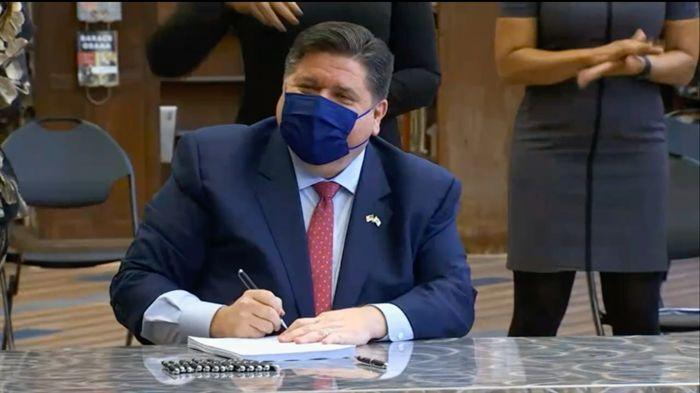
The Democrat-controlled Illinois General Assembly approved 665 bills this legislative session, with the vast majority awaiting Gov. J.B. Pritzker’s signature.
But, Pritzker has signed 42 bills into law. A handful of those will take effect Jan. 1, 2022, but most went into effect immediately upon signing or will take effect this Thursday.
Here are some notable new laws in effect now or on Thursday that Illinoisans should know.
Election reform

With pandemic-related delays to U.S. Census redistricting numbers, lawmakers moved back the state’s 2022 primary election from March 15 to June 28. The legislation also makes Election Day a state holiday, requires every county to have at least one universal voting center and allow people to be added to a permanent vote-by-mail list. (SB825)
Vote by mail

Some pandemic-induced changes to voting for the 2020 general election, such as vote-by-mail and curbside drop-off, will now be permanent features of future elections. (House Bill 1871)
State legislative redistricting

As they are tasked with doing every 10 years, lawmakers approved new district boundaries for the Illinois House and Senate. The Democrat-drawn maps, which utilized the U.S. Census’ American Community Survey instead of waiting for the decennial census numbers that will arrive later this year, have been challenged in court by Republicans and some other groups. (HB2777)
Illinois Supreme Court redistricting
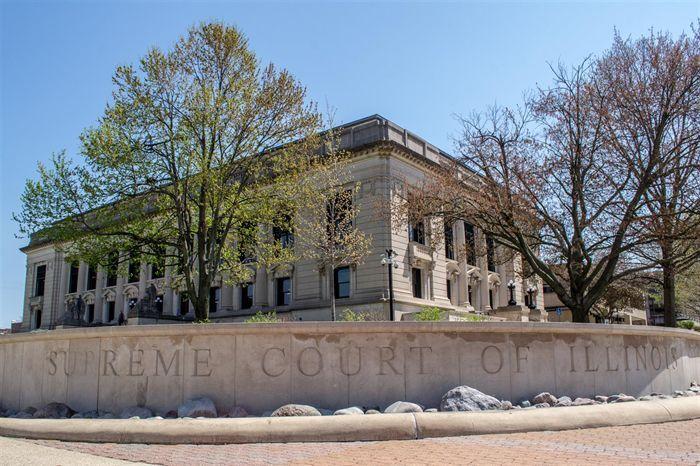
The seven-person Illinois Supreme Court’s district boundaries were successfully redrawn for the first time since the 1960s. (SB642)
Police reform

There was no more controversial bill that passed this year than House Bill 3653, also known as the SAFE-T Act, which passed during the lame duck session this January. The provisions ending cash bail and requiring all police to wear body cameras will not take effect until 2023 and 2025, respectively. But starting Thursday, police will be required to render aid to the injured, intervene when a fellow officer is using excessive force and and be limited in use of force. It also offers stricter guidelines for the decertification of officers and would allow people to file anonymous complaints of police misconduct. (HB3653)
Payday loans

Lenders are now prohibited from charging more than 36% annual percentage rate on consumer loans. The average rate in Illinois was nearly 300% prior to the law’s signing. (SB1792)
Vaccine lottery

Tucked into the state’s fiscal year 2022 budget is $10 million for a “vaccine lottery.” All Illinois residents vaccinated by July 1 will be automatically entered into the contest. It includes $7 million in cash prizes to vaccinated adults, ranging from $100,000 to $1 million, and $3 million in scholarship awards to vaccinated youth. (SB2800)
COVID-19 emergency housing

Created guidelines for distributing more than $1 billion in federal stimulus funds for COVID-related housing relief. Also creates automatic sealing of evictions during the pandemic. (SB2877)
Pretrial interest

Victims in personal injury and wrongful death cases will be allowed to collect interest from defendants from the time a lawsuit is filed. It is meant to incentivize settlement of these cases. It was supported by the trial lawyers and opposed by business groups. (SB72)
Casino labor

All casino applicants in Illinois are now required to enter into a project-labor agreement when seeking a new or renewed license. (SB1360)
Crime victims compensation

Provides that a victim’s criminal history or felony status shall not automatically prevent compensation to that victim or the victim’s family. Extends the applicant’s period for submitting requested information to 45 days from 30 days and provides that a final award shall not exceed $45,000, up from $27,000, for a crime committed on or after August 7, 2022. (HB3295)
Electronic signature

Provides that a contract, record, or signature may not be denied legal effect or enforceability simply because it is in electronic form or an electronic record was used in its formation. Provides that if a law requires a record to be in writing, an electronic record satisfies the law. (SB2176)

